• About UGM
  • Academic Portal
  • IT Center
  • Library
  • Research
  • Webmail
  • Informasi Publik
  • English
    • Indonesia
Universitas Gadjah Mada Faculty of Cultural Sciences
Universitas Gadjah Mada
  • Home
  • Profile
    • History
    • Vision and Mission
    • Organizational structure
    • Administration
    • Staff
    • Faculty Members
  • Academic
    • Academic Calendar
    • Undergraduate Programs
      • Bachelor of Cultural Antrophology
      • Bachelor in Archaeolagy
      • Bachelor in History
      • Bachelor in Tourism
      • Bochetor in Korean Language and Culture
      • Bachelor in Indonesian Language and Culture
      • Bachelor in English
      • Bachelor in Arabic
      • Bachelor in Japanese Language and Culture
      • Bachelor in Javanese Language, Literature and Culture
      • Bachelor in French language and literature
    • Graduate Programs
      • Master in Antrophology
      • Master in ArchaeoIogy
      • Master in History
      • Master in Linguistics
      • Master in Literature
      • Master In American Studies
      • Master in Middle Eastern Cultural Studies
    • Post-Graduate Programs / S3
      • Doctor in Antropology
      • Doctor in American Studies
      • Doctor in Humanities
    • Student Service
  • KPPM
    • Research Information
    • Scientific / Academic Publications
    • Community Service
    • International Cooperation
    • Domestic Cooperation
  • Student Organizations
    • Student Executive Council
    • Semi-Autonomous Organizations
      • KAPALASASTRA
      • Christian Student Alliance
      • LINCAK
      • Saskine
      • Catholic Student Family
      • Dian Budaya
      • Sastra Kanuragan (sasgan)
      • Family of Muslim Cultural Sciences Students (KMIB)
      • Bejo Mulyo
    • Autonomous Organizations
      • Family of Anthropology Students (KEMANT)
      • English Department Student Association
      • Tourism Students Association (HIMAPA)
      • Family of Indonesian Literature Students (KMSI)
      • West Asian Literature Student Association (IMABA)
      • Association of Korean-Language Students (HIMAHARA)
      • Family of Regional Indonesian Literatures Students (KAMASUTRA)
      • The Family Body of History Students (BKMS)
      • The French Literature Students Association (HMSP)
      • Family of Anthropology Students
      • Japanese Student Association (HIMAJE)
  • Admission
    • Student Evaluation
  • Home
  • 2025
  • page. 32
Arsip:

2025

HMJ Kamastawa Serves the Community through Social Service and Teaching

SDGs 10: Mengurangi KetimpanganSDGs 10: Reduced InequalitiesSDGs 11: Sustainable cities and communitiesSDGs 17: Partnerships for the GoalsSDGs 3: Good health and well-beingSDGs 4: Quality Education Tuesday, 9 September 2025

On Sunday (August 24, 2025), HMJ Kamastawa conducted social service and teaching activities at the Darun Najah Orphanage and Shelter for the Poor in Maguwoharjo Village, Depok, Sleman. This initiative, organized by the Social Community Division and the Academic Division, reflects the students’ social responsibility and dedication to the community as part of implementing the Tri Dharma of Higher Education. The target audience for the activity was orphaned and underprivileged children, with a focus on educational support for female high school students.

Prior to the social service activity, the Social Community Division opened donations of money and goods, including reading books, stationery, and cleaning supplies. These donations were then distributed to meet the needs of the Darun Najah Orphanage.

The series of events began with a teaching activity guided by the Academic Division with the theme of Javanese script and how to write it. In this session, students presented interactive group games. Participants were asked to answer questions competitively, and each correct and quick answer would earn points. After the game ended, the group with the most points was entitled to a prize.

The event continued with a social service activity by the Social Community Division, which donated snacks and necessities for the orphanage, such as brooms, boxes, and so on. The funds for these necessities were obtained from an open donation that had been opened previously. 

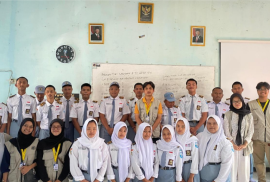
The event concluded with a symbolic presentation of commemorative plaques and the handover of donations from the chairman of HMJ Kamastawa to representatives of the Darun Najah Orphanage management. Students and orphanage children also took part in a group photo session to commemorate the occasion and share stories.

Kamastawa’s community service activities are not merely about carrying out work programs, but also provide a shared learning space that offers valuable experiences for both students and children at the orphanage. In addition, these activities support the achievement of the Sustainable Development Goals (SDGs) in the areas of health, education, equality, and sustainable communities and partnerships.

Author : Maysa Putri Fatihah & Dwiyan Teguh Darmawan
Editor : Haryo Untoro

UGM Students Preserves Javanese Script Through the “P4 Carakan” KKN-PPM Program

News ReleaseSDGs 10: Mengurangi KetimpanganSDGs 11: Sustainable cities and communitiesSDGs 17: Partnerships for the GoalsSDGs 4: Pendidikan Berkualitas Tuesday, 9 September 2025

Yogyakarta, September, 9, 2025 – Gadjah Mada University (UGM) is once again implementing the Community Empowerment Field Study Program (KKN-PPM), a student service program that is both an academic tradition and a form of social responsibility for universities towards the community. The 50-day program, running from June 20 to August 8, 2025, places students in various regions to interact with the community, identify needs, and provide creative, science-based solutions. Among the many programs initiated by students, one that stands out is P4 Carakan (Introduction, Learning, Training, and Application of Carakan), a concrete effort to preserve and promote Javanese script in Pacitan Regency, East Java.

This program was conceived by Dhiny Maulina Mahanani, a student of the Javanese Language, Literature, and Culture Study Program, and implemented at Madrasah Ibtidaiyah Negeri (MIN) 2 Pacitan, Bungur Village, Tulakan District, Pacitan Regency, East Java.

Dhiny explained that the background of this program stems from the low interest of students in learning local content, especially Javanese script, which is often considered complicated. Therefore, he developed a more interactive and enjoyable learning method. The activity began with the screening of an animated video about the history of Javanese script, followed by an introduction to the basics of Carakan, its rules of use, and an interactive quiz with prizes to encourage students to express their opinions. This resulted in increased enthusiasm among students, as evidenced by their active participation and various questions.

“The goal of this program is to dispel the notion that learning Javanese script is difficult, while also increasing young people’s interest in local knowledge. This is part of a real effort to preserve Javanese culture,” said Dhiny in an online interview on September 30, 2025.

Initially, the program was planned to be targeted only at third-grade students. However, thanks to the support of the school, the teaching target was expanded to include all students in grades 1-6, with a total of 109 participants. This situation presented its own challenges in implementing the program.

Despite facing challenges in managing a large number of students, Dhiny admitted that interactive methods helped her maintain the participants’ focus and enthusiasm. Support from the school was also key to the success of this program. “I am proud and happy to be able to share my knowledge and successfully attract students to learn about local knowledge. I am also touched because all the teachers and students have noticed a change in the students’ enthusiasm for learning,” she added.

The presence of the P4 Carakan program is an example of how community service activities can serve to empower the community while also promoting local culture that has begun to be marginalized. The P4 Carakan program is proof that efforts to preserve and revive culture can begin in small classrooms in rural areas. Through continuous cooperation, cultural preservation does not only remain at a symbolic level, but can also find its relevance in the midst of community life, namely as a form of national identity and the cultural wealth of the archipelago.

ERASMUS+ Guest Lecture Explores Sustainable Tourism Practices at FIB UGM

News Release Tuesday, 9 September 2025

Yogyakarta, September 2, 2025 – The Undergraduate Tourism Program, Faculty of Cultural Sciences, Universitas Gadjah Mada, held a guest lecture as part of the ERASMUS+ Staff Mobility program with the theme “Sustainability and Sustainable Practices in Tourism Enterprises.”

The lecture featured Assoc. Prof. Göktaş Kulualp from Karabuk University, Türkiye. In his presentation, Prof. Kulualp elaborated on several key aspects of sustainable tourism.

He began by providing an overview of the introduction to sustainable tourism, covering its definition and basic principles. He then discussed global trends and policy frameworks set by UNWTO, including regulations for hotels, tour operators, and tourist destinations. According to him, after the Covid-19 pandemic, there has been a growing interest in slow tourism, ecotourism, and nature-based travel.

Prof. Kulualp also highlighted sustainable tourism practices in Türkiye, particularly through eco-friendly certification programs. One example is the Green Star Certificate, awarded by the Turkish Ministry of Culture and Tourism to environmentally conscious hotels, with assessments on energy and water efficiency, waste management, and the use of local products. In addition, he mentioned international eco-labels such as Green Key and Blue Flag, which are awarded to hotels and beaches that protect the environment.

These efforts align with the Sustainable Development Goals (SDGs), specifically SDG 8 (Decent Work and Economic Growth), SDG 12 (Responsible Consumption and Production), and SDG 13 (Climate Action). Through sustainable tourism practices, the tourism sector is expected not only to generate economic benefits but also to maintain environmental and socio-cultural balance.

The event concluded with an interactive Q&A session, allowing students to gain deeper insights into the implementation of sustainable tourism concepts in various countries, including their relevance to the Indonesian context.

[Public Relations FIB UGM, Alma Syahwalani]

A UGM Student Implements the “Sira Saraja” (Sinau Rame Aksara Jawa) Program to Promote the Use of Javanese Script and Language in Blitar

SDGs 10: Reduced InequalitiesSDGs 11: Sustainable cities and communitiesSDGs 17: Partnerships for the GoalsSDGs 4: Quality Education Monday, 8 September 2025

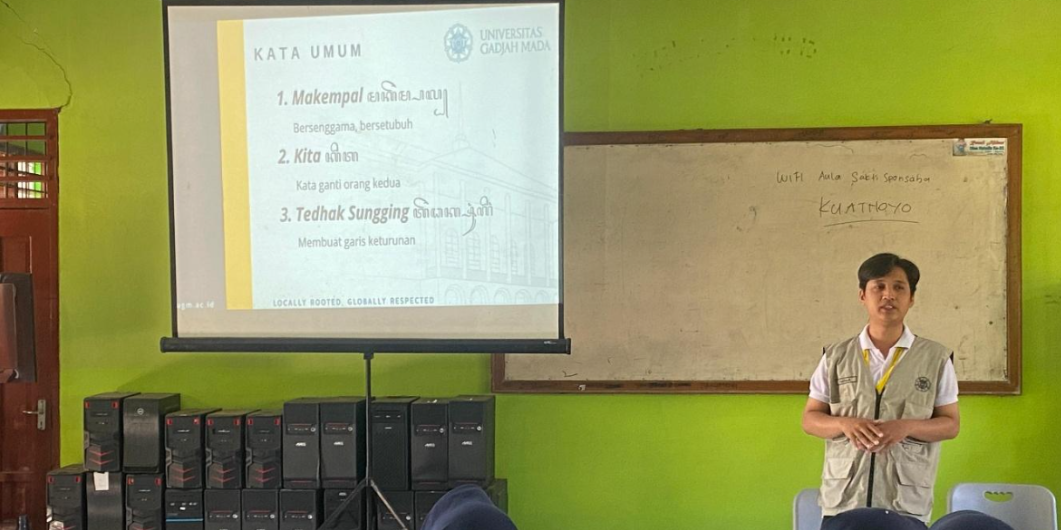
Universitas Gadjah Mada is holding a 50-day Community Empowerment Field Study Program (KKN-PPM) from June 20 to August 8, 2025. In its implementation, students are assigned to serve by carrying out programs aimed at community empowerment. This includes Yudha Adhistira, a student in the Javanese Language, Literature, and Culture Study Program, who is implementing the “Sira Saraja” (Sinau Rame Aksara Jawa) program in Blitar Regency, East Java. This program focuses on socializing the use of Javanese script and language to elementary to high school students in Bululalang Village and Bakung District, highlighting a number of common mistakes, such as the use of the words “makempal” and “tedhak sungging,” as well as errors in writing the names of villages and public places on digital platforms such as Google Maps.

In an online interview on August 31, 2025, Yudha explained that the aim of this program is to reduce misconceptions about the use of Javanese script and language, while fostering motivation and interest among the younger generation in  Javanese language objects. “To attract this interest, the material has been designed to be appealing, such as displaying examples of beautiful Javanese manuscripts, conducting case studies of Javanese-language pop works, and introducing the potential of Javanese cultural objects and tourism in the Blitar area,” he explained.

However, the implementation of this program is not without challenges. Yudha revealed that there is still a lack of educators who are experts in the Javanese language and a limited number of student worksheets (LKS) that focus on Javanese script. Nevertheless, the students’ enthusiasm was evident through their active questioning and interaction during the activities. “The situation was quite exciting and challenging, especially when presenting new things that could attract the children’s interest. Despite some difficulties, the children’s enthusiasm through their interactions and many questions about this teaching method is a joy in itself,” he added.

The Sira Saraja program also reflects the importance of preserving regional languages as part of national identity. The slogan “language is the soul of a nation” is relevant in efforts to preserve and develop regional languages. The conditions in Bululalang Village and Bakung District are concrete examples of the current state of regional languages, which are becoming increasingly “foreign” to their speakers.

In line with this, in his lecture, Prof. Dr. Hendrokumoro, M.Hum., lecturer in the Javanese Language, Literature, and Culture Study Program and professor of Linguistics at the Faculty of Cultural Sciences, Universitas Gadjah Mada, emphasized the importance of a flexible, enjoyable, and relevant approach to learning regional languages (Hendrokumoro 2025, May 8). This is an important strategy so that regional language learners, especially native speakers, can continue to preserve and revive regional languages as a form of national identity. Therefore, synergy between various parties is needed as a joint effort in the preservation and development of regional languages in Indonesia.

Author : Haryo Untoro

Bibliography

Hendrokumoro. [Universitas Gadjah Mada]. (2025, May 8). Pengukuhan Prof. Dr. Hendrokumoro, M.Hum., Guru Besar Fakultas Ilmu Budaya UGM. [Video]. Youtube. Retrieved from https://www.youtube.com/watch?v=1d6PJDguBFk.

From Yogyakarta to Buru: Pocket Dictionary & Arabic Learning, UGM’s KKN Innovation in Maluku

News ReleaseSDGs 4: Quality Education Monday, 8 September 2025

Buru Island, July 16, 2025 – Universitas Gadjah Mada (UGM) continues to carry out its Kuliah Kerja Nyata (KKN) program across 35 provinces in Indonesia. One of its inspiring initiatives came from Shang Narendra, affectionately known as Adam, a student of the Arabic Study Program, Faculty of Cultural Sciences, UGM. During his KKN service in Lamahang Village, Waplau District, Buru Regency, Maluku Province, Adam introduced two unique programs: the creation of a pocket Arabic dictionary and simple Arabic language lessons for students.

The pocket dictionary was carefully prepared in Yogyakarta and later distributed during the school orientation period (Matsama – Masa Ta’aruf Madrasah) at MTs Al-Khairaat in Lamahang. The classes targeted first-year students who had never been exposed to Arabic before, aiming to introduce them to basic vocabulary, everyday conversation, and inspire early motivation to learn a foreign language.

The pocket dictionary contains practical, thematic vocabulary across categories such as household, school, environment, body parts, and pronouns, making it easier for students to recall and use words in daily situations. Beyond serving as a learning resource, the dictionary was also given as a keepsake to MTs Al-Khairaat. Interestingly, its usefulness sparked interest from KKN students in other regions, who later helped distribute the dictionary more widely—turning it into one of UGM’s KKN innovations with a broader impact on Arabic language education.

In practice, Adam began lessons by introducing simple greetings and personal pronouns (isim dhamir) through interactive learning media such as colorful slides and posters. The students of MTs Al-Khairaat welcomed the sessions with great enthusiasm, showing remarkable eagerness to learn. Not only did they enjoy the introductory Arabic lessons, but they were also able to immediately practice the new words with their peers.

The program was considered highly successful in sparking student interest to explore Arabic further. The school even expressed hopes for more future visits from UGM’s KKN participants. As a touching farewell, the KKN team received parting gifts from the MTs students before their departure—a heartfelt gesture that reflected the strong bonds formed between the students, teachers, and the local community.

[Public Relation of FIB UGM, Shang Narendra]

1…3031323334…84

Video UGM

[shtmlslider name='shslider_options']
Universitas Gadjah Mada

Faculty of Cultural Sciences
Universitas Gadjah Mada
Jl. Nusantara 1, Bulaksumur Yogyakarta 55281, Indonesia
   fib@ugm.ac.id
   +62 (274) 513096
   +62 (274) 550451

Work Units

  • Office of Journal & Publishing
  • INCULS
  • Information Technology and Database
  • Language Learning Center
  • Library Unit
  • Public Relations
  • Research

Facilities

  • Computer Laboratory
  • Gamelan
  • Guest House
  • Language Library
  • Library
  • Phonetics Library
  • Self Access Unit
  • Student Internet Centre

Importan Links

  • Journal of Humaniora
  • Subscriber Journal
  • Alumni Portal
  • Career
  • Departmens News
  • UGM Streaming

Contacts

  • Academic
  • Administration
  • Dean’s Office
  • Departments / Study Programs
  • Public Relations

© 2024 Faculty of Cultural Sciences Universitas Gadjah Mada

KEBIJAKAN PRIVASI/PRIVACY POLICY

[EN] We use cookies to help our viewer get the best experience on our website. -- [ID] Kami menggunakan cookie untuk membantu pengunjung kami mendapatkan pengalaman terbaik di situs web kami.I Agree / Saya Setuju