• About UGM
  • Academic Portal
  • IT Center
  • Library
  • Research
  • Webmail
  • Informasi Publik
  • English
    • Indonesia
Universitas Gadjah Mada Faculty of Cultural Sciences
Universitas Gadjah Mada
  • Home
  • Profile
    • History
    • Vision and Mission
    • Organizational structure
    • Administration
    • Staff
    • Faculty Members
  • Academic
    • Academic Calendar
    • Undergraduate Programs
      • Bachelor of Cultural Antrophology
      • Bachelor in Archaeolagy
      • Bachelor in History
      • Bachelor in Tourism
      • Bochetor in Korean Language and Culture
      • Bachelor in Indonesian Language and Culture
      • Bachelor in English
      • Bachelor in Arabic
      • Bachelor in Japanese Language and Culture
      • Bachelor in Javanese Language, Literature and Culture
      • Bachelor in French language and literature
    • Graduate Programs
      • Master in Antrophology
      • Master in ArchaeoIogy
      • Master in History
      • Master in Linguistics
      • Master in Literature
      • Master In American Studies
      • Master in Middle Eastern Cultural Studies
    • Post-Graduate Programs / S3
      • Doctor in Antropology
      • Doctor in American Studies
      • Doctor in Humanities
    • Student Service
  • KPPM
    • Research Information
    • Scientific / Academic Publications
    • Community Service
    • International Cooperation
    • Domestic Cooperation
  • Student Organizations
    • Student Executive Council
    • Semi-Autonomous Organizations
      • KAPALASASTRA
      • Christian Student Alliance
      • LINCAK
      • Saskine
      • Catholic Student Family
      • Dian Budaya
      • Sastra Kanuragan (sasgan)
      • Family of Muslim Cultural Sciences Students (KMIB)
      • Bejo Mulyo
    • Autonomous Organizations
      • Family of Anthropology Students (KEMANT)
      • English Department Student Association
      • Tourism Students Association (HIMAPA)
      • Family of Indonesian Literature Students (KMSI)
      • West Asian Literature Student Association (IMABA)
      • Association of Korean-Language Students (HIMAHARA)
      • Family of Regional Indonesian Literatures Students (KAMASUTRA)
      • The Family Body of History Students (BKMS)
      • The French Literature Students Association (HMSP)
      • Family of Anthropology Students
      • Japanese Student Association (HIMAJE)
  • Admission
    • Student Evaluation
  • Home
  • HEADLINES
  • FIB Encourages a Sustainable Campus Culture Through Waste Management Training

FIB Encourages a Sustainable Campus Culture Through Waste Management Training

  • HEADLINES, News Release
  • 18 November 2025, 09.20
  • Oleh: Humas FIB
  • 0

Yogyakarta, 14 November 2025 — The Faculty of Cultural Sciences at Universitas Gadjah Mada (FIB UGM) reaffirmed its commitment to developing an environmentally responsible campus by organizing a Workshop on Waste Management and Recycling at the Multimedia Room, RM Margono Building. The program forms part of the UGM Sustainability Campus Action FIB 2025 initiative and serves as a concrete effort to support the Sustainable Development Goals (SDGs), particularly SDG 11 (Sustainable Cities and Communities), SDG 12 (Responsible Consumption and Production), and SDG 13 (Climate Action).

In her opening remarks, the Vice Dean for Research, Community Service, Cooperation, and Alumni of FIB UGM, Dr. Mimi Savitri, M.A., Ph.D., emphasized the essential role of the academic community in maintaining environmental sustainability. She noted that an eco-conscious culture can only be achieved through shared awareness and collective participation across all campus components. The workshop thus served as both a discussion forum and a practical training platform to build new perspectives and habits in waste management, especially for administrative staff, cleaning personnel, the landscaping team, and representatives of LEM FIB UGM, all of whom participated enthusiastically.

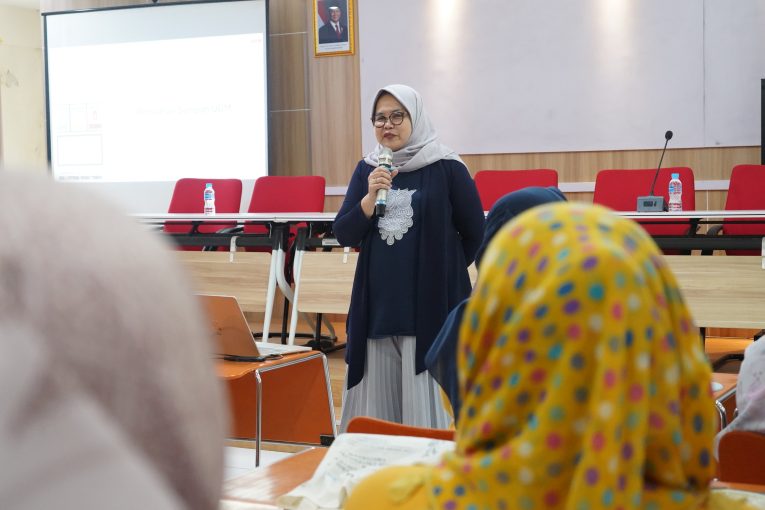
The main session featured Prof. Ir. Wiratni, S.T., M.T., Ph.D., IPM., an environmental engineering expert who presented the fundamental concepts of waste management based on the 3R principles—Reduce, Reuse, Recycle. During her presentation, Prof. Wiratni elaborated on the importance of separating organic and inorganic waste, simple recycling techniques applicable in office settings, and case studies of waste management implementation in other campuses. She also highlighted the challenges UGM continues to face in reducing waste production and outlined practical strategies that each work unit can adopt to contribute to long-term solutions.

The event continued with an interactive discussion session between the audience and the speaker. Student participants conveyed their evaluations and aspirations regarding improved facilities to foster a cleaner faculty environment and strengthen discipline in waste sorting. Meanwhile, representatives from the cleaning team shared various ongoing efforts in handling inorganic waste such as leaves and food remnants. “Food waste has thankfully been managed by turning it into animal feed. As for fallen leaves, some are discarded, shredded, and processed into compost,” explained one of the FIB cleaning staff members. The dialogue remained lively as participants exchanged insights on waste management practices currently implemented across UGM, particularly within FIB.

The workshop produced several positive outcomes, including improved staff understanding of waste categories and management methods, as well as stronger collective awareness of the urgency of waste reduction on campus. Several work units also expressed their commitment to implementing continuous waste sorting practices. As a follow-up, FIB UGM plans to provide additional waste-sorting facilities around the faculty and conduct regular monitoring led by the FIB Sustainability Team. These steps align with the faculty’s long-term efforts to support UGM’s green campus goals in accordance with the SDGs.

Through this initiative, FIB UGM hopes that all staff and students can become agents of change in creating a cleaner, healthier, and more resource-efficient academic environment. The workshop reinforces FIB UGM’s dedication to advancing a culture of sustainability and strengthening its contribution to global sustainable development goals, positioning the campus as a real-world model of environmentally friendly practices for the broader community.

[Public Relations of FIB UGM, Candra Solihin]

Tags: Faculty of Cultural Sciences UGM FIB UGM SDGs SDGs 11: Sustainable Cities and Communities SDGs 12: Responsible Consumption and Production SDGs 13: Climate Action

Video UGM

[shtmlslider name='shslider_options']
Universitas Gadjah Mada

Faculty of Cultural Sciences
Universitas Gadjah Mada
Jl. Nusantara 1, Bulaksumur Yogyakarta 55281, Indonesia
   fib@ugm.ac.id
   +62 (274) 513096
   +62 (274) 550451

Work Units

  • Office of Journal & Publishing
  • INCULS
  • Information Technology and Database
  • Language Learning Center
  • Library Unit
  • Public Relations
  • Research

Facilities

  • Computer Laboratory
  • Gamelan
  • Guest House
  • Language Library
  • Library
  • Phonetics Library
  • Self Access Unit
  • Student Internet Centre

Importan Links

  • Journal of Humaniora
  • Subscriber Journal
  • Alumni Portal
  • Career
  • Departmens News
  • UGM Streaming

Contacts

  • Academic
  • Administration
  • Dean’s Office
  • Departments / Study Programs
  • Public Relations

© 2024 Faculty of Cultural Sciences Universitas Gadjah Mada

KEBIJAKAN PRIVASI/PRIVACY POLICY

[EN] We use cookies to help our viewer get the best experience on our website. -- [ID] Kami menggunakan cookie untuk membantu pengunjung kami mendapatkan pengalaman terbaik di situs web kami.I Agree / Saya Setuju