
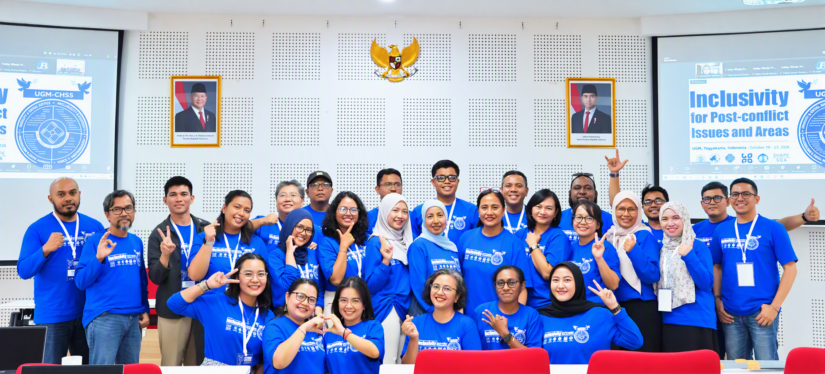
Universitas Gadjah Mada (UGM), in collaboration with CHSS (Cultivating the Humanities and Social Sciences and Supporting Under-Represented Scholars of Asia), is holding the UGM–CHSS Writing and Academic Capacity Building Workshop: Inclusivity for Post-Conflict Issues & Areas from 19 to 23 October 2026. The scientific writing workshop is part of an initiative by the Association for Asian Studies (AAS), funded by the Swedish International Development Cooperation Agency (SIDA). The event reflects a shared commitment to equality in education and the principle of equal access to academic opportunities for scholars from post-conflict regions.
UGM has received a three-year grant from AAS-SIDA (2026–2028) to run this workshop series and to serve as a HUB representing Indonesia, together with its partner, the Asian Research Institute of Universitas Indonesia. Other HUBs come from several universities across Southeast and South Asia, including Chiang Mai University (Thailand), Lahore University of Management Sciences (LUMS) in Lahore, Pakistan, Savitribai Phule Pune University in India, and Universidade Nacional Timor Lorosa’e from Timor-Leste. This network embodies the spirit of equal opportunities, ensuring that scholars from diverse and often underrepresented backgrounds can participate in and benefit from international academic collaboration.
In addition, the workshop is supported by SHAPE-SEA (Strengthening Human Rights and Peace Research and Education in ASEAN), which is also a SIDA grantee, through empowerment activities in peacebuilding, including travel grants and research support. The activities at Universitas Gadjah Mada aim to strengthen academic capacity and scientific writing skills, particularly in examining post-conflict issues through an inclusive lens. This inclusive approach is essential to guaranteeing equal access to knowledge production for communities and researchers who have historically been marginalized by conflict.
The workshop was opened on Monday (19/10) in Room S.709, Faculty of Cultural Sciences (FIB) UGM, by the Vice Dean for Research and Cooperation of FIB UGM, Mimi Savitri, Ph.D. The event continued with remarks from the CHSS resource person for UGM, Prof. Dr. Wening Udasmoro, S.S., M.Hum., DEA., who presented the Theory of Change, explaining the importance of the workshop in delivering concrete benefits for participants. She emphasized that the Theory of Change is crucial given the diversity of participants from various countries and post-conflict regions—a diversity that underlines the importance of equality in every stage of the program.
Participants came from Thailand, the Philippines, Papua New Guinea, and Myanmar, while those from Indonesia came from Papua, Poso, Ambon, Sampit, Aceh, and various other regions. The presence of scholars from these areas reflects a deliberate effort to promote equal opportunities for academics working on peace and reconciliation in contexts that are often underrepresented in international scholarship, thereby advancing education that is truly inclusive.
In the first plenary session, the speaker was Dr.phil. Geger Riyanto, an expert in peacebuilding who has written extensively in international journals on the subject. He discussed peacebuilding issues with Dr. Wulan Tri Astuti, S.S., M.A., as moderator. The session became a space for discussion on approaches and perspectives in understanding peacebuilding processes, especially in the context of post-conflict societies such as Ambon, Poso, Aceh, and Sampit after Indonesia’s 1998 Reform era. The dialogue highlighted how empowerment of local voices is central to sustainable peace.
The next presentation was delivered by Prof. Dr. Agus Suwignyo, M.A., who reviewed article writing for reputable journals. This session provided insights into developing academic writing that meets scientific publication standards, reinforcing the importance of education and mentorship in building scholarly confidence among early-career researchers from post-conflict areas.
In the third plenary session, Theresia Dyah Wirastri, S.H., M.A., Ph.D., and Dr. Mohamad Yusuf, M.A., discussed the article submission process from the perspective of international editors through the topic “Article Submission: International Editors’ Point of View.” The session, moderated by Mubarika Dyah Fitri Nugraheni, S.Ant., M.A., explored editorial perspectives in the submission process for international publication, helping to level the playing field and ensure equal access to global academic platforms.
The first day’s series of activities concluded with a mentoring breakdown session led by Prof. Dr. Wening Udasmoro, S.S., M.Hum., DEA., and a pre-workshop survey completed by participants as part of preparations for the mentoring program. These mentoring structures are designed to provide sustained empowerment, enabling participants to transform their research into publications that can influence policy and peacebuilding practice in their home regions.
The UGM workshop will also be followed by other programs to be implemented next year, including grants for selected participants to attend the Association for Asian Studies conference in Malaysia on 1–3 July 2027. Such initiatives reaffirm the commitment to equality and equal opportunities in global academic exchange, ensuring that scholars from post-conflict areas can share their knowledge on international stages and contribute to a more inclusive understanding of peace and development.
Contributors: Nada & Jusma, 2026
