
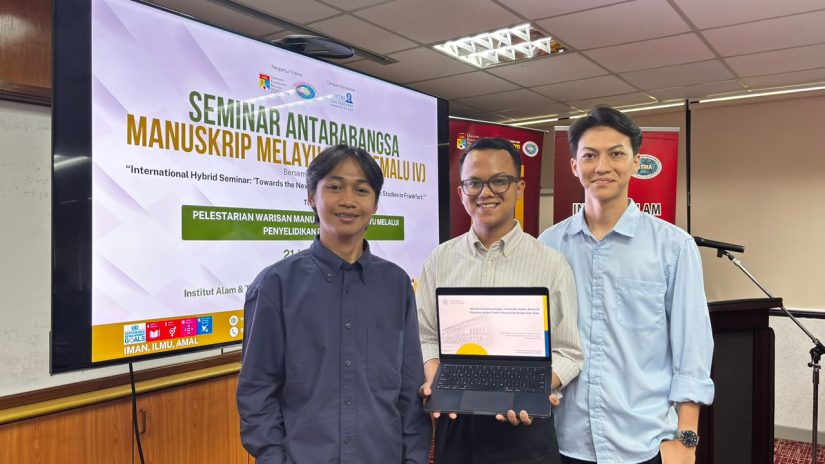
BANGI, SELANGOR — Three Master’s students in Literary Studies from the Department of Language and Literature, Faculty of Cultural Sciences, Universitas Gadjah Mada (UGM)—Priyo Joko Purnomo, M. Aufal Ghufron, and Maulana Nurul Izza—participated as paper presenters at the 4th International Seminar on Malay Manuscripts (Seminar Antarabangsa Manuskrip Melayu/SEMALU IV) 2026.
At the international seminar, organized by the Malay World Manuscript Research Centre (Pusat Penyelidikan Manuskrip Alam Melayu/PPMAM), Institute of the Malay World and Civilization (Institut Alam dan Tamadun Melayu/ATMA), Universiti Kebangsaan Malaysia (UKM), the three researchers presented a study entitled “Fortune-Telling: The Dynamics of the Abajadun Numerical System in Malay and Javanese Manuscript Traditions.”
SEMALU IV 2026 was held at Universiti Kebangsaan Malaysia, Bangi, Selangor, Malaysia, on July 21, 2026. The seminar carried the theme “Preserving the Heritage of Malay World Manuscripts through Research and Innovation” and brought together scholars, researchers, academics, and the general public to discuss the richness of Malay manuscripts and the intellectual heritage of the Malay world.
Through their research, the three UGM students examined the dynamics of the adaptation of the Abajadun numerical system within Malay and Javanese manuscript traditions, particularly in the manuscripts Syair Raksi Macam Baru (SRMB) and Kitab Mujarrabat Pegon (KMP). The study highlights how a numerical system that assigns numerical values to Arabic letters underwent processes of adaptation, negotiation, and localization as it interacted with Malay and Javanese cultures.
The study demonstrates that Abajadun is not merely a system of calculation or fortune-telling. Within the manuscript traditions of the Nusantara, the system developed into a cosmological technology that connects human beings, time, nature, and God within a network of meaning. Through calculations involving letters, names, days, and various other elements, communities sought to understand future possibilities and determine appropriate courses of action.
In the Malay tradition, the study of Syair Raksi Macam Baru reveals the use of the Abajadun system to determine compatibility between couples through the calculation of names. Meanwhile, Kitab Mujarrabat Pegon demonstrates the intersection between the Abajadun numerical system and the Javanese tradition of petungan, including the use of the concept of neptu—the numerical values associated with days and market days—for various purposes, such as determining auspicious times for trading, medical treatment, and marriage.
The study also emphasizes that Malay and Javanese manuscripts serve as spaces for the production and negotiation of knowledge. Numbers, letters, names, days, and fate are woven together into a cultural mechanism that helps communities understand uncertainty and organize various decisions in social life.
Drawing on Stuart Hall’s perspective on cultural representation and E.J. Aarseth’s concept of ergodic literature, the study views Abajadun as a sign system whose meanings are not always directly available in the text. Readers must perform a series of operations, beginning with converting letters into numbers, calculating particular values, and interpreting the results. In this process, readers play an active role in discovering the meanings contained within the manuscripts.
“Abajadun serves as a navigator that guides readers from letters to numbers, from numbers to interpretation, and from interpretation to social decisions,” reflects the central idea proposed in the study.
The participation of UGM Master’s students in SEMALU IV 2026 forms part of broader efforts to expand research on Nusantara manuscripts while demonstrating the relevance of traditional knowledge heritage within contemporary academic discourse. The study of Abajadun also shows that Malay and Javanese manuscripts reflect a creative encounter between Islamic traditions and local cosmologies, giving rise to distinctive knowledge systems in the Nusantara.
Through the SEMALU IV forum, the study further strengthens efforts to preserve the manuscript heritage of the Malay world through research and innovation. Manuscripts are not merely viewed as historical relics, but also as sources of knowledge that can continue to be studied, interpreted, and introduced to new generations.
Author: Khotibul Umam
