• About UGM
  • Academic Portal
  • IT Center
  • Library
  • Research
  • Webmail
  • Informasi Publik
  • English
    • Indonesia
Universitas Gadjah Mada Faculty of Cultural Sciences
Universitas Gadjah Mada
  • Home
  • Profile
    • History
    • Vision and Mission
    • Organizational structure
    • Administration
    • Staff
    • Faculty Members
  • Academic
    • Academic Calendar
    • Undergraduate Programs
      • Bachelor of Cultural Antrophology
      • Bachelor in Archaeolagy
      • Bachelor in History
      • Bachelor in Tourism
      • Bochetor in Korean Language and Culture
      • Bachelor in Indonesian Language and Culture
      • Bachelor in English
      • Bachelor in Arabic
      • Bachelor in Japanese Language and Culture
      • Bachelor in Javanese Language, Literature and Culture
      • Bachelor in French language and literature
    • Graduate Programs
      • Master in Antrophology
      • Master in ArchaeoIogy
      • Master in History
      • Master in Linguistics
      • Master in Literature
      • Master In American Studies
      • Master in Middle Eastern Cultural Studies
    • Post-Graduate Programs / S3
      • Doctor in Antropology
      • Doctor in American Studies
      • Doctor in Humanities
    • Student Service
  • KPPM
    • Research Information
    • Scientific / Academic Publications
    • Community Service
    • International Cooperation
    • Domestic Cooperation
  • Student Organizations
    • Student Executive Council
    • Semi-Autonomous Organizations
      • KAPALASASTRA
      • Christian Student Alliance
      • LINCAK
      • Saskine
      • Catholic Student Family
      • Dian Budaya
      • Sastra Kanuragan (sasgan)
      • Family of Muslim Cultural Sciences Students (KMIB)
      • Bejo Mulyo
    • Autonomous Organizations
      • Family of Anthropology Students (KEMANT)
      • English Department Student Association
      • Tourism Students Association (HIMAPA)
      • Family of Indonesian Literature Students (KMSI)
      • West Asian Literature Student Association (IMABA)
      • Association of Korean-Language Students (HIMAHARA)
      • Family of Regional Indonesian Literatures Students (KAMASUTRA)
      • The Family Body of History Students (BKMS)
      • The French Literature Students Association (HMSP)
      • Family of Anthropology Students
      • Japanese Student Association (HIMAJE)
  • Admission
    • Student Evaluation
  • Home
  • News Release
  • Inaugurated as UGM Professor, Aris Munandar Emphasizes Locally Rooted English Competence

Inaugurated as UGM Professor, Aris Munandar Emphasizes Locally Rooted English Competence

  • News Release
  • 7 May 2026, 11.45
  • Oleh: Humas FIB
  • 0

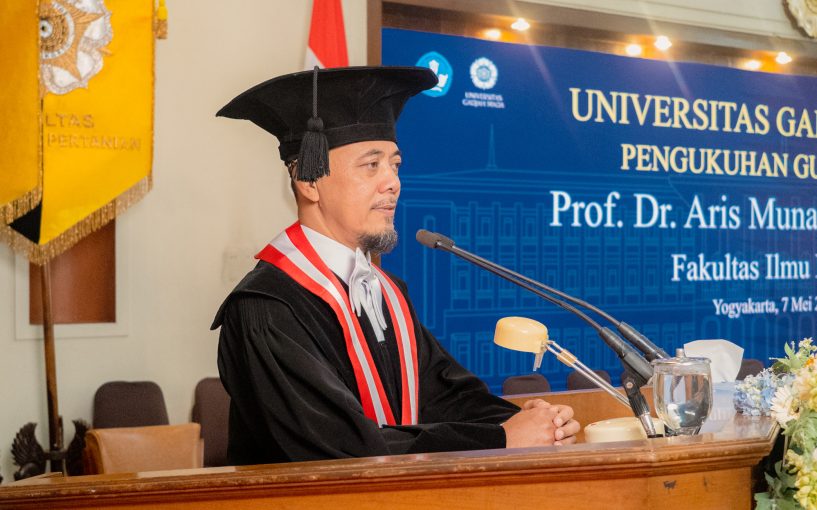
Yogyakarta, May 7, 2026 – Professor Dr. Aris Munandar, M.Hum. was officially inaugurated as a Professor of English Pragmatics at the Faculty of Cultural Sciences, Universitas Gadjah Mada (UGM). The inauguration ceremony took place at the UGM Main Building on Thursday, May 7, 2026. In his inaugural speech, Prof. Aris emphasized the importance of developing English pragmatic competence oriented toward linguistic diversity in Indonesia.

Prof. Aris explained that English now serves as a crucial global communication tool for economic growth and education systems. Based on the concept of World Englishes, the diversity of the English language is divided into three circles. Indonesia falls into the expanding circle category. This position makes Indonesia a receiver of English norms from native-speaking countries, or the inner circle.

Indonesians learn English as a foreign language without a historical background of British colonialism. This condition creates unique challenges and characteristics. The characteristics of the English spoken by Indonesians are indirectly influenced by both the national language and regional languages. One of the most striking differences is seen in the application of politeness principles, which often differ from native speaker norms.

Today, intensive English communication occurs among speakers from developing nations. Prof. Aris gave an example of common interactions within the UGM campus environment between international students from Asia and Africa and the local academic community.

“As English has become an international lingua franca and the number of speakers in expanding circle countries continues to grow, there is a wide possibility of English communication occurring among fellow speakers from these expanding circle nations,” explained Prof. Aris during his speech.

Therefore, Prof. Aris believes that pragmatic competence with a multilingual orientation must be continuously developed. This approach aims to prevent society from adopting a monolingual view that could potentially generate negative perceptions of English variations in developing countries. He asserted that the diversity of English is an inevitable linguistic reality.

This condition has practical implications for language proficiency evaluations, such as the Test of English as a Foreign Language (TOEFL). Such standardized tests are still considered biased because they heavily prioritize native speaker norms. As a solution, Prof. Aris proposed adjustments to local evaluation instruments. The Academic English Proficiency Test (AcEPT) at UGM needs to be designed as a relevant benchmark for speakers in Indonesia. This test should incorporate materials that reflect the local realities of Indonesian speakers without violating generally agreed-upon linguistic standards.

An inclusive understanding of English language diversity aligns with efforts to create an equitable and adaptive education system. Through a multilingual approach, cross-border interactions involving diverse cultural backgrounds can run harmoniously. Ultimately, this step supports the creation of an equal and inclusive global order, where every individual receives equal respect without losing their local identity roots. This resonates with UGM’s vision to remain deeply rooted in local wisdom while achieving global respect.

[Public Relations of FIB UGM, Candra Solihin]

Tags: FIB UGM SDGs 10: Reduced inequality SDGs 16: Peace Justice and Strong Institution SDGs 17: Partnerships for the Goals SDGs 4: Quality Education UGM Yogyakarta

Video UGM

[shtmlslider name='shslider_options']
Universitas Gadjah Mada

Faculty of Cultural Sciences
Universitas Gadjah Mada
Jl. Nusantara 1, Bulaksumur Yogyakarta 55281, Indonesia
   fib@ugm.ac.id
   +62 (274) 513096
   +62 (274) 550451

Work Units

  • Office of Journal & Publishing
  • INCULS
  • Information Technology and Database
  • Language Learning Center
  • Library Unit
  • Public Relations
  • Research

Facilities

  • Computer Laboratory
  • Gamelan
  • Guest House
  • Language Library
  • Library
  • Phonetics Library
  • Self Access Unit
  • Student Internet Centre

Importan Links

  • Journal of Humaniora
  • Subscriber Journal
  • Alumni Portal
  • Career
  • Departmens News
  • UGM Streaming

Contacts

  • Academic
  • Administration
  • Dean’s Office
  • Departments / Study Programs
  • Public Relations

© 2024 Faculty of Cultural Sciences Universitas Gadjah Mada

KEBIJAKAN PRIVASI/PRIVACY POLICY

[EN] We use cookies to help our viewer get the best experience on our website. -- [ID] Kami menggunakan cookie untuk membantu pengunjung kami mendapatkan pengalaman terbaik di situs web kami.I Agree / Saya Setuju