• About UGM
  • Academic Portal
  • IT Center
  • Library
  • Research
  • Webmail
  • Informasi Publik
  • English
    • Indonesia
Universitas Gadjah Mada Faculty of Cultural Sciences
Universitas Gadjah Mada
  • Home
  • Profile
    • History
    • Vision and Mission
    • Organizational structure
    • Administration
    • Staff
    • Faculty Members
  • Academic
    • Academic Calendar
    • Undergraduate Programs
      • Bachelor of Cultural Antrophology
      • Bachelor in Archaeolagy
      • Bachelor in History
      • Bachelor in Tourism
      • Bochetor in Korean Language and Culture
      • Bachelor in Indonesian Language and Culture
      • Bachelor in English
      • Bachelor in Arabic
      • Bachelor in Japanese Language and Culture
      • Bachelor in Javanese Language, Literature and Culture
      • Bachelor in French language and literature
    • Graduate Programs
      • Master in Antrophology
      • Master in ArchaeoIogy
      • Master in History
      • Master in Linguistics
      • Master in Literature
      • Master In American Studies
      • Master in Middle Eastern Cultural Studies
    • Post-Graduate Programs / S3
      • Doctor in Antropology
      • Doctor in American Studies
      • Doctor in Humanities
    • Student Service
  • KPPM
    • Research Information
    • Scientific / Academic Publications
    • Community Service
    • International Cooperation
    • Domestic Cooperation
  • Student Organizations
    • Student Executive Council
    • Semi-Autonomous Organizations
      • KAPALASASTRA
      • Christian Student Alliance
      • LINCAK
      • Saskine
      • Catholic Student Family
      • Dian Budaya
      • Sastra Kanuragan (sasgan)
      • Family of Muslim Cultural Sciences Students (KMIB)
      • Bejo Mulyo
    • Autonomous Organizations
      • Family of Anthropology Students (KEMANT)
      • English Department Student Association
      • Tourism Students Association (HIMAPA)
      • Family of Indonesian Literature Students (KMSI)
      • West Asian Literature Student Association (IMABA)
      • Association of Korean-Language Students (HIMAHARA)
      • Family of Regional Indonesian Literatures Students (KAMASUTRA)
      • The Family Body of History Students (BKMS)
      • The French Literature Students Association (HMSP)
      • Family of Anthropology Students
      • Japanese Student Association (HIMAJE)
  • Admission
    • Student Evaluation
  • Home
  • SDGs 17: Kemitraan Untuk Mencapai Tujuan
  • SDGs 17: Kemitraan Untuk Mencapai Tujuan
  • page. 16
Arsip:

SDGs 17: Kemitraan Untuk Mencapai Tujuan

Evelin Oktafianny: Building Experience at Ferris University

Student Exchange Thursday, 10 April 2025

Evelin Oktafianny, a recipient of the Ferris University Exchange Program Scholarship for Spring 2025, shares her story about the extraordinary journey she is about to undertake in Japan. This 2023 cohort student of Japanese Language and Culture shares their feelings, preparations, expectations, and the challenges faced before departing for Japan, as well as their views on the importance of student exchange programs in personal development..

Evelin expressed her interest in Ferris University due to its focus on empowering women through education. Additionally, the location of Ferris University in Yokohama, which blends traditional Japanese culture with modernity, was another major draw for her. In preparing for her studies in Japan, Evelin focused on improving her Japanese language skills to facilitate the adaptation process. “I have been learning Japanese, especially for everyday conversations, so I can interact more easily with the new environment,” she explained.

Evelin hopes that this exchange program will deepen her knowledge of the Japanese language and culture and provide a unique learning experience. “I want to learn directly and engage in daily life in Japan,” she said. On a personal level, she aims to develop her independence, build international relationships, and improve her communication and adaptation skills in a new environment.

As a student preparing to study in Japan, Evelin has high expectations for gaining a deeper understanding of Japanese culture. “I want to learn about the work ethic, discipline, and various social values of the Japanese people,” she revealed. She is also interested in seeing how Japanese culture influences the educational system and daily life in Japanese society.

According to Evelin, student exchange programs are essential as they provide learning experiences that cannot be found in a classroom. “This program not only offers academic understanding but also helps us become more open to cultural differences and prepares us to compete globally,” she explained. Furthermore, this program plays a crucial role in building an international network that will be valuable in the future.

Evelin shared a message for her peers who wish to follow in her footsteps to obtain scholarships or participate in student exchange programs. “Do not hesitate to try. Prepare yourself well, both academically and non-academically, and do not be afraid to step out of your comfort zone,” she said. She added that the experiences gained during a student exchange will be highly valuable for personal development and future prospects.

[Bachelor of Japanese Literature, Yulia Agustiani. Editor, Valentina Pramahita Iswari]

A Century of A.A. Navis: Magister Sastra UGM and Toko Buku Natan Revitalizing Literary Heritage through Discussions and Book Launches

HEADLINESNews ReleaseSDGs 10: Reduced InequalitiesSDGs 11: Sustainable cities and communitiesSDGs 16: Peace justice and strong institutionsSDGs 17: Partnerships for the GoalsSDGs 4: Quality Education Thursday, 10 April 2025

Yogyakarta, March 23, 2025 – In an effort to revive the intellectual legacy of one of Indonesia’s greatest literary figures, Toko Buku Natan in collaboration with the Master’s Program in Literature at Universitas Gadjah Mada (UGM) held the Centennial Commemoration of A.A. Navis at Rumah Budaya Ndalem Natan, Kotagede, Yogyakarta. This event attracted literature enthusiasts, academics, and cultural figures eager to explore A.A. Navis’ critical thoughts and contributions to national literary development. Featuring a series of activities, including academic discussions, book launches, an art exhibition, and musical performances, the commemoration became a reflective moment that delved deeper into the social, cultural, and linguistic aspects of Navis’ works.

As one of the most influential figures in Indonesian literature, A.A. Navis gained widespread recognition for his classic short story, Robohnya Surau Kami (The Collapse of Our Mosque), which offered a profound critique of societal structures. Set during the harmonious spirit of Ramadan, this event brought together various stakeholders to discuss Navis’ legacy and critical thoughts, featuring renowned speakers such as Dhianita Kusuma Pertiwi (writer and curator), Prof. Dr. Aprinus Salam (academic and literary scholar), and Nasir Tamara, M.A., M.Sc., Ph.D. (cultural expert). The discussion was further enriched by a cello performance by Lintang Pramudia Swara, providing an aesthetic and immersive experience for the participants.

One of the event’s key highlights was the launch of the book “Kesalahan dan Kejahatan dalam Berbahasa” (Errors and Crimes in Language) by Prof. Dr. Aprinus Salam. This book critically examines language awareness within social and legal contexts. Drawing from his extensive academic and professional experience as an expert witness in various linguistic cases, Prof. Aprinus presents this book as a primary reference for linguistic studies and the role of language in Indonesia’s legal practices.

During the discussion, Prof. Aprinus Salam explored the contrast between social critiques in the works of A.A. Navis and Pramoedya Ananta Toer, highlighting how Navis focused more on critiquing societal structures, while Pramoedya directed his criticisms toward the government and power structures. Meanwhile, Dhianita Kusuma Pertiwi shared her research and archival experience for the 100 Years of A.A. Navis exhibition, held in Jakarta and at UNESCO in Paris. She traced Navis’ educational background at INS Kayutanam, an institution that played a crucial role in shaping his critical thinking, not only in literature but also in music and visual arts.

At the same time, Nasir Tamara, M.A., M.Sc., Ph.D. connected A.A. Navis’ intellectual lineage to the Académie française in Europe, particularly France, which was heavily influenced by the ideas of René Descartes. Citing Descartes’ philosophy “Cogito, ergo sum” (I think, therefore I am), Nasir Tamara emphasized that intellectual awareness and critical thinking are the foundations of a true thinker and writer. This perspective aligns with A.A. Navis’ approach to literary discourse, where he not only documented reality but also challenged, questioned, and inspired social change.

As part of the celebration, Lintang Pramudia Swara delivered a cello performance, enriching participants’ reflective experience. Meanwhile, an art exhibition by renowned artist Anagard featured 11 portraits of prominent Minangkabau figures, including A.A. Navis, Tan Malaka, Sutan Sjahrir, Buya Hamka, and Asrul Sani. This exhibition provided a visual narrative of the intellectual contributions and roles of Minangkabau figures in Indonesia’s national history.

The event also served as a space for literary appreciation, featuring poetry readings by Afnan Malay and a recital of Gurindam 12 by Raja Ali Haji, performed by Nasir Tamara, further enriching the significance and atmosphere of this literary celebration.

During the reflective session, Prof. Aprinus Salam presented two thought-provoking statements for participants to ponder. The first, “Your tongue is sharper than a sword,” underscored the extraordinary power of words in shaping, influencing, and even overturning societal structures. The second, “Words are only sharper for those who are sensitive,” highlighted language as not merely a communication tool but a profound expression with transformative power for those attuned to social and humanitarian realities.

This event was part of a broader initiative to honor great figures in Indonesian literature, following the centennial commemoration of Pramoedya Ananta Toer held earlier. Through the centennial of A.A. Navis, the discussion reinforced awareness of literacy, intellectual heritage, and its relevance to younger generations. Prof. Aprinus Salam emphasized that language possesses transformative power, envisioning a future where short story writers and poets stage protests by reciting poetry in front of legislative buildings, proving that words wield more power than physical weapons.

The event concluded with a communal iftar (breaking of the fast), not only fostering solidarity but also offering a profound reflection on the role of literature in shaping social and cultural consciousness. Toko Buku Natan, in collaboration with the Master’s Program in Literature at UGM, remains committed to facilitating academic discussions, literary forums, and various literacy initiatives to support intellectual and cultural development in Indonesia.

[Public Relations Magister of Literature, Anisa Dien Rahmawati]

Studying at UGM Museum: Exploring History and Contribution to the Future

Study Visit Thursday, 10 April 2025

Yogyakarta, 24/01/2025 – Students from the Gadjah Mada International Fellowship (GMIF) program had the opportunity to visit the UGM Museum as part of the Listening and Reading course. This visit is not just an educational trip, but also an in-depth reflection on the role of educational institutions in shaping a better society. The UGM Museum presents the story of the journey of the oldest university in Indonesia, including its various contributions in the fields of science, social, and culture.

The sections in this museum are divided into six periods in the development of UGM, namely:

  1. In the Midst of the Struggle (1946-1949), This section tells the history of the founding of Universitas Gadjah Mada. It begins with the presentation of the early story of the pioneering of the Universitas Gadjah Mada institution and the important figures who played a role in the process.
  2. Laying the Foundation of Education (1949-1960), This section tells the story of Universitas Gadjah Mada’s exploration and efforts to establish its identity and contribute to Indonesia. The narrative focuses on the development of the idea that students do not only learn and become students, but also participate in physical struggles and critical thinking.
  3. Building National Civilization (1961-1982), This section tells about the innovations and findings of the academic community of Universitas Gadjah Mada that are appropriate and beneficial for society.
  4. Becoming a World University (1982-2002), During this period, it is described that Universitas Gadjah Mada’s efforts to become famous in the eyes of the world through various literary works of the academic community and various programs such as Real Work Lectures (KKN).
  5. Upholding the Dignity of the Nation (2002-2017), The University of Gadjah Mada is one of the pioneers in the development of values ​​and innovations that will elevate the dignity and status of the Indonesian nation in the eyes of the world. This is shown through various works based on the values ​​of Universitas Gadjah Mada’s identity.
  6. Living in Bulaksumur, One of the interesting facts discovered by the participants was that the 44th President of the United States, Barack Obama, once lived in the UGM environment. This shows that this university has become part of global history and continues to contribute to building world civilization.

During the visit, GMIF students participated in various interactive activities designed to deepen their understanding of the history and role of UGM. They took a guided tour of the museum by the curator, listened to explanations about the historical collections, and discussed UGM’s contributions in various fields. Not only that, they also participated in a group reflection session, where they shared perspectives on how history can inspire a better future. This activity not only improved their academic understanding but also strengthened togetherness and collaboration among students.

Quality education is the main key in creating a generation that is aware of the importance of history and oriented towards a sustainable future. Through direct experiences such as museum visits, students not only gain academic insight but also grow awareness of the importance of innovation, inclusivity, and collaboration in building a more advanced society.

Initiatives like this also reflect the spirit of education that is not only limited to the classroom, but also builds curiosity, appreciation for cultural heritage, and encourages a constructive exchange of ideas. With more students involved in activities based on historical and cultural exploration, it is hoped that individuals will be formed who are not only academically intelligent but also have high social awareness.

Museums are not just repositories of artifacts from the past, but also living laboratories that connect history to the challenges of the present and the future. By integrating experiential learning, we contribute to creating a more just, inclusive and sustainable world for all.

[INCULS, Thareeq Arkan Falakh]

The Grand Launching of Adhiwijna Cabinet from Kamastawa Student Association

HEADLINESNews ReleaseSDGs 11: Sustainable cities and communitiesSDGs 17: Partnerships for the Goals Thursday, 27 March 2025

Yogyakarta, 27/3/2025 – On March 15, 2025 Saturday, HMJ Kamastawa held a Grand Launching of its cabinet this year. Grand Launching is one of the RPO division work programs this year which has the aim to introduce divisions, heads of divisions, and work programs of the Student Association.

Accompanied by the appearance of Cokekan, at 8 am guests ranging from lecturers to other HMJ members came. The event was opened formally by singing the song Indonesia Raya, Hymn Gadjah Mada, and Mars Literature. In addition, at the opening of this event there was a Sekar Pudyastuti dance offering displayed by 2 female students.

The event was continued with remarks both from the Chairperson of HMJ Kamastawa for the 2025/2026 period, HMJ Kamastawa Trustees, and the Chairperson of the Javanese Language, Literature and Culture Study Program. Entering the core of the event, namely the symbolic release of the cabinet led by the Chair of the Study Program by tapping the microphone 3 times, followed by the video that releases the name and the logo of the cabinet.

After that, Chairman of HMJ Kamastawa explained the color philosophy and logo designed, did not forget the vision and mission of HMJ Kamastawa for the next year. After the chairman explained his vision and mission, the event continued with the introduction of divisions, heads of divisions, and work programs of each division.

HMJ Kamastawa Trustees, Mr. Dr. Rudy Wiratama S.I.P., M.A gives a little correction that in Javanese, the Grand Launching diction can be changed to kepyakan. Then in his remarks at the beginning of the event, the Chair of the Study Program also conveyed the importance of cooperation and pleasure in launching work programs in the organization.

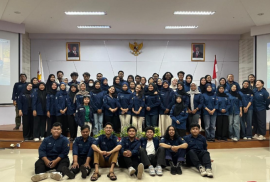
The event was closed with documentation with all members of HMJ Kamastawa, lecturers, and invited guests. With the holding of this Grand Launching, it is hoped that later HMJ Kamastawa can establish good relations and be known by other HMJ management friends, BSO, and LEM FIB.

[Public Relations of Javanese Literature, Fega Achillea Maydena]

Ghibran, Who Became A Finalist for the Dimas-Diajeng City of Jogja Even Though He Comes from Bantul

HEADLINESNews ReleaseSDGs 11: Sustainable cities and communitiesSDGs 17: Partnerships for the GoalsStudent's Activity Thursday, 27 March 2025

Yogyakarta, 27/3/2025 – Javanese Language, Literature, and Culture student of 2024 batch, Ghibran Arsha Daffa (NIM 24/543974/SA/23427) or familiarly called Ghibran, made it to the final stage in the Dimas-Diajeng contest of the Special Region of Yogyakarta. Dimas-Diajeng itself is the term for a pair of male and female teenagers who are officially appointed as DIY tourism ambassadors. For men, it is called Dimas, and for women, it is called Diajeng. The selection of Dimas-Diajeng is under the auspices of the Tourism Office. Meanwhile, the most important task of Dimas-Diajeng itself is to promote tourism and culture in their respective regions.

To start Dimas-Diajeng’s journey, Ghibran went through file selection, semifinals, psychological tests, deep interviews, then entered the final stage consisting of 15 men and 15 women. After the file selection stage, participants were given the task of creating video content about promoting tourist attractions in the city of Jogja and Ghibran chose to discuss Pasar Ngasem, which turned out that no one of the other participants chose that topic.

If selected and crowned as Dimas, Ghibran must be a representative of the dynamic and cultured youth of Jogja and actively participate in tourism promotion activities.

In the process, one of the things Ghibran remembers most is when collecting files because Ghibran collected the files 7 minutes before the registration deadline. This is because Ghibran actually intended to register for Dimas-Diajeng Bantul City, but it turned out that this year it was not going to be held. Therefore, Ghibran immediately prepared himself in a short time to register for Dimas-Diajeng Jogja City.

In addition, in the process of making video content, Ghibran found things that moved and impressed him. One of them was when he met a grandmother selling traditional toys. Ghibran said that even though her merchandise was quiet, the grandmother looked happy when she was invited to interview. According to the grandmother, she had been selling toys since she was little. The grandmother also prayed for Ghibran so that his steps would be smooth in undergoing the Dimas-Diajeng contest.

After the final, the Top 3 Dimas-Diajeng will be selected to represent the city of Jogja in the election of Dimas-Diajeng Yogyakarta Province. So if Ghibran is selected in the Top 3 list, Ghibran must compete again in Dimas-Diajeng Yogyakarta province.

However, even though Ghibran will be busy with Dimas-Diajeng activities in the city of Jogja, Ghibran still wants to contribute as a student in the Javanese Language, Literature, and Culture study program at UGM, one of which is in the field of storytelling. Ghibran intends to take part in a national-level storytelling competition, or even a monologue.

Ghibran’s hope for the future is that this Dimas-Diajeng program can help and educate many people, especially in the field of tourism. Let’s pray that all of Ghibran’s goals and aspirations will be achieved!

[Public Relations of Javanese Literature, Fega Achillea Maydena]

1…1415161718…22

Video UGM

[shtmlslider name='shslider_options']
Universitas Gadjah Mada

Faculty of Cultural Sciences
Universitas Gadjah Mada
Jl. Nusantara 1, Bulaksumur Yogyakarta 55281, Indonesia
   fib@ugm.ac.id
   +62 (274) 513096
   +62 (274) 550451

Work Units

  • Office of Journal & Publishing
  • INCULS
  • Information Technology and Database
  • Language Learning Center
  • Library Unit
  • Public Relations
  • Research

Facilities

  • Computer Laboratory
  • Gamelan
  • Guest House
  • Language Library
  • Library
  • Phonetics Library
  • Self Access Unit
  • Student Internet Centre

Importan Links

  • Journal of Humaniora
  • Subscriber Journal
  • Alumni Portal
  • Career
  • Departmens News
  • UGM Streaming

Contacts

  • Academic
  • Administration
  • Dean’s Office
  • Departments / Study Programs
  • Public Relations

© 2024 Faculty of Cultural Sciences Universitas Gadjah Mada

KEBIJAKAN PRIVASI/PRIVACY POLICY

[EN] We use cookies to help our viewer get the best experience on our website. -- [ID] Kami menggunakan cookie untuk membantu pengunjung kami mendapatkan pengalaman terbaik di situs web kami.I Agree / Saya Setuju