• About UGM
  • Academic Portal
  • IT Center
  • Library
  • Research
  • Webmail
  • Informasi Publik
  • English
    • Indonesia
Universitas Gadjah Mada Faculty of Cultural Sciences
Universitas Gadjah Mada
  • Home
  • Profile
    • History
    • Vision and Mission
    • Organizational structure
    • Administration
    • Staff
    • Faculty Members
  • Academic
    • Academic Calendar
    • Undergraduate Programs
      • Bachelor of Cultural Antrophology
      • Bachelor in Archaeolagy
      • Bachelor in History
      • Bachelor in Tourism
      • Bochetor in Korean Language and Culture
      • Bachelor in Indonesian Language and Culture
      • Bachelor in English
      • Bachelor in Arabic
      • Bachelor in Japanese Language and Culture
      • Bachelor in Javanese Language, Literature and Culture
      • Bachelor in French language and literature
    • Graduate Programs
      • Master in Antrophology
      • Master in ArchaeoIogy
      • Master in History
      • Master in Linguistics
      • Master in Literature
      • Master In American Studies
      • Master in Middle Eastern Cultural Studies
    • Post-Graduate Programs / S3
      • Doctor in Antropology
      • Doctor in American Studies
      • Doctor in Humanities
    • Student Service
  • KPPM
    • Research Information
    • Scientific / Academic Publications
    • Community Service
    • International Cooperation
    • Domestic Cooperation
  • Student Organizations
    • Student Executive Council
    • Semi-Autonomous Organizations
      • KAPALASASTRA
      • Christian Student Alliance
      • LINCAK
      • Saskine
      • Catholic Student Family
      • Dian Budaya
      • Sastra Kanuragan (sasgan)
      • Family of Muslim Cultural Sciences Students (KMIB)
      • Bejo Mulyo
    • Autonomous Organizations
      • Family of Anthropology Students (KEMANT)
      • English Department Student Association
      • Tourism Students Association (HIMAPA)
      • Family of Indonesian Literature Students (KMSI)
      • West Asian Literature Student Association (IMABA)
      • Association of Korean-Language Students (HIMAHARA)
      • Family of Regional Indonesian Literatures Students (KAMASUTRA)
      • The Family Body of History Students (BKMS)
      • The French Literature Students Association (HMSP)
      • Family of Anthropology Students
      • Japanese Student Association (HIMAJE)
  • Admission
    • Student Evaluation
  • Home
  • SDGs 10: Reduced inequality
  • SDGs 10: Reduced inequality
  • page. 2
Arsip:

SDGs 10: Reduced inequality

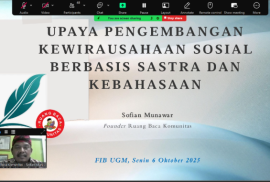
Fifth Entrepreneurship Lecture: UGM Arabic Study Program Students Explore Opportunities in Social Entrepreneurship

News Release Friday, 3 October 2025

Yogyakarta, September 29, 2025 – The Arabic Study Program, Faculty of Cultural Sciences, Universitas Gadjah Mada, continued its Entrepreneurship lecture series with the fifth meeting featuring Sofian Munawar, S.S., M.A., Founder of Ruang Baca Komunitas. In this session, students were invited to explore the concept of social entrepreneurship, a business approach that prioritizes solving social, environmental, and community issues through innovative and sustainable methods.

The lecture highlighted that social entrepreneurship is not merely profit-driven but instead focuses on social missions, innovation, sustainability, and generating real impact for communities. In the context of literature and language studies, this can be applied through creative literacy initiatives such as reading and writing workshops, digital literacy development, promoting a reading culture, and expanding public access to educational resources.

Students of the Arabic Study Program were also introduced to various examples of social entrepreneurship practices, both globally and locally. Inspiring cases such as Grameen Bank in Bangladesh, Warby Parker in the United States, and Indonesia’s National Literacy Movement showcased how social enterprises can improve quality of life while fostering independence. Locally, best practices from Yogyakarta were presented, including CV Agradaya Indonesia, which promotes sustainable spice farming; Yayasan Penyandang Cacat Mandiri, which empowers people with disabilities through woodcraft; and Sayur Sleman Academy, which trains young agripreneurs. These examples served as both motivation and inspiration for students to see the potential in their own fields.

The lecture also addressed the challenges facing literacy movements, such as limited resources, lack of student motivation, and barriers to technology access. However, students were encouraged to view these challenges as opportunities for innovation through collaboration among schools, families, and communities. This perspective reinforced the idea that literacy is not confined to classrooms but is brought to life through community activities, local culture, and digital platforms.

Through this session, Arabic Study Program students not only gained a conceptual understanding of social entrepreneurship but were also challenged to develop real initiatives rooted in literature and language that could bring tangible benefits to society. This lecture also aligns with the Sustainable Development Goals (SDGs), particularly SDG 4 (Quality Education) by strengthening literacy movements, SDG 8 (Decent Work and Economic Growth) by fostering social enterprises that create meaningful jobs, and SDG 10 (Reduced Inequalities) through inclusive community empowerment programs.

[Arabic Literature, Muhammad Ardiansyah]

Master’s Program in Literature at FIB UGM Holds Workshop on Breaking Into Reputable Journals: Strategies for Writing and Publishing Academic Articles

SDGs 10: Reduced InequalitiesSDGs 17: Partnerships for the GoalsSDGs 4: Quality EducationSDGs 5: Gender equality Thursday, 18 September 2025

Yogyakarta, 17/9/2025 – The Master’s Program in Literature, Faculty of Cultural Sciences, Universitas Gadjah Mada, organized an academic workshop themed “Breaking Into Reputable Journals: Strategies for Writing and Publishing Academic Articles.” The event, held on Wednesday (17/9) at Auditorium C, Poerbatjaraka Building, featured two keynote speakers: Prof. Dr. Wening Udasmoro, S.S., M.Hum., DEA., professor at the Faculty of Cultural Sciences UGM, and Adwidya Susila Yoga, S.Pd., M.A., an academic as well as a practitioner in scientific publishing. The session was moderated by Nada Nadillah.

In her presentation, Prof. Dr. Wening Udasmoro emphasized that writing for reputable journals requires decisiveness in selecting the issue and accuracy in building methodological frameworks. “The first thing to pay attention to is the material or issue. A strong issue is one that is specific, contextual, and intellectually challenging. Do not fall into the trap of cliché topics,” she explained.

She gave examples of fresh entry points in literary research, such as LGBTQ+ issues in Muslim-majority countries, abortion debates in Muslim contexts, and the rebellion of Indonesian women writers against male-dominated literary traditions.

Prof. Wening also highlighted the importance of a novelty-based literature review. “The literature review is the foundation. It is from there that we can demonstrate our contribution to academic debates. If we only repeat previous studies, our work will not be considered competent,” she stressed.

The second session, delivered by Adwidya Susila Yoga, S.Pd., M.A., underlined the importance of accuracy in identifying target journals and the necessity of determining clear topics. “Writing an article cannot be separated from mapping the topic and having a clear storyline. After that, we need to do optimal sourcing—do not let references pile up only in the introduction while being scarce in the discussion. The next step is the ‘journal hunt,’ which means finding journals that match the topic, are consistent, and have a good reputation,” he explained.

He also warned participants about the dangers of predatory journals. “If a journal has an excessively high publication frequency, an unusually fast review process, an invalid E-ISSN, or ambiguous publication fees, we need to be cautious. Those are usually signs of a predatory journal,” he cautioned.

Furthermore, Adwidya encouraged students to utilize digital tools. “Use digital platforms such as Grammarly, DeepL, Vosviewer, and even AI—but their use must be academically accountable. Do not just use them recklessly,” he noted.

The workshop continued dynamically with a Q&A session between participants and speakers. Naria (Master’s in Literature) raised a question regarding the selection of research material: “Should research objects be literary works that have already received awards? And should research questions always be derived from theory?” she asked.

Responding to this, Prof. Wening stated, “Research objects do not have to be award-winning works. What matters most is the issue we want to bring forward. Focus on novelty and the perspective we present, not the credibility of the text itself. As for research questions, they can arise from the problems we want to examine, not necessarily from theory alone.”

Meanwhile, Andi (Master’s in Public Administration) asked about balancing local research with global issues. “Indonesia’s research strength lies in its rich empirical evidence. How can we balance this with global issues to ensure relevance?” he inquired.

Prof. Wening emphasized, “The key is to focus on contextual issues while still opening up to global debates. Take issues that others may not be familiar with, then connect them to wider discourses. That way, our research will gain international appeal.”

This workshop successfully provided in-depth insights into strategies for writing academic articles and breaking into reputable journals. Participants not only gained theoretical knowledge but also practical guidance from the speakers. With this momentum, the Master’s Program in Literature at FIB UGM hopes its students can produce high-quality, contributive scholarly works capable of competing at both national and international levels.

Author: Marsya Kamila / Public Relations, Master’s Program in Literature

Serving the Community of Padukuhan Wotawati

News ReleaseSDGs 10: Reduced InequalitiesSDGs 11: Sustainable cities and communitiesSDGs 17: Partnerships for the GoalsSDGs 4: Quality Education Friday, 29 August 2025

Together with the Center for Cultural Studies and the Center for Disaster Studies UGM, students of the Javanese Language, Literature, and Culture study program had the opportunity to dive directly into the community environment in the context of community service. This activity involved the 2023 and 2024 batches, namely Abimanyu Mahendra, Yanuar Agung, Noviyanti Alfitri, Bayu Seta Ardiansyah, Maylafaizza Nafisha, Fega Achillea, Rafi Nur Fauzy, and Rafif Wicaksono.

This activity was led by a lecturer in philology, Dr. Sri Ratna Saktimulya, M.Hum. who also serves as the current Head of the UGM Center for Cultural Studies. For two days (22-23 June 2025), this team carried out activities in Padukuhan Wotawati, Pucung District, Gunungkidul Regency, DI Yogyakarta.

Wotawati Village, which is located in a unique valley of the former flow of the Ancient Bengawan Solo, has historical and cultural potential but faces significant problems. The main challenges include the absence of a comprehensive and credible narrative regarding the identity of the village that is vulnerable to misinformation, minimal education and preparedness for hydrometeorological disasters, and suboptimal preservation of local culture. This community service aims to empower Wotawati through an approach based on local wisdom and participatory education.

Therefore, this joint team intends to compile a literary work Babad Wotawati which contains history, geography, cultural potential, and disaster education holistically. This Babad is expected to become an official reference source regarding information and the identity of Wotawati village and can become a valuable cultural heritage in the future. This Babad is not only a medium for preserving identity, but also a disaster education tool that is easily accessible to the public. Macapat song training will also complement this effort, reviving oral traditions as a means of conveying messages to the younger generation. Thus, Wotawati can rise as an independent, empowered, and widely known community with a complete and accurate narrative, while being ready to face future challenges.

Thus, in-depth research efforts are needed by visiting and observing directly at the research location. Javanese Language, Literature, and Culture students are given the task of practicing karawitan, introducing tembang dolanan, practicing macapatan, interviewing residents, or documenting activities.

With this activity, it is hoped that students can apply the knowledge and skills they have gained during their studies and can provide benefits to the community directly.

Authors: Haryo Untoro

Learning Culture from Its Source: NCCU Students Explore Traditions in the Center of Yogyakarta

SDGs 10: Reduced InequalitiesSDGs 17: Partnerships for the GoalsSDGs 4: Quality Education Friday, 1 August 2025

Yogyakarta, 11/7/2025 – Yogyakarta has once again become a magnet for cultural learning, this time for students from National Chengchi University (NCCU) who are currently undergoing an internship program at the Faculty of Cultural Sciences, Universitas Gadjah Mada (UGM). Rather than simply sitting in an office, they are invited to explore the vibrant life of the local community and to understand the richness of culture from its source.

The journey began at Pasar Ngasem, one of the oldest traditional markets in Yogyakarta. Here, the students witnessed firsthand the interactions between vendors and buyers, the variety of local food ingredients, and the lively and dynamic atmosphere of the market. For many of them, this was their first experience seeing a traditional market that is vastly different from those in their home countries.

The adventure continued to Tamansari, the former royal garden of the Yogyakarta Sultanate, which is rich in historical and architectural value. Amidst the corridors and bathing pools filled with stories, the students not only listened to tales of the past but also reflected on how culture and history continue to thrive in the public spaces of this city.

Interestingly, on their way back from Tamansari, the group passed by a location where shadow puppet crafts are produced. Their curiosity led them to stop. At this site, they not only observed artisans at work but also received direct explanations about the world of wayang—ranging from the types of characters, the philosophy behind the stories, to the tools and materials used in the production process. Some even had the opportunity to hold the carving tools and buffalo leather used in the crafting process.

“This is a rich experience. I didn’t expect that Wayang Kulit has such deep meanings and that its production process is so intricate,” said one participant from Taiwan.

This activity serves as evidence that learning about culture cannot be confined to theory alone. By immersing themselves in places that are integral to the lives of the community, foreign students not only gain new knowledge but also emotional experiences that leave a lasting impression.

Through small steps like these, cultural exchange becomes more vibrant—bringing closer what is distant and uniting what is different in experiences that enrich both sides. The partnership between civil society and educational institutions plays a crucial role in facilitating such meaningful interactions.

As the students continue their journey, they are not just learning about Indonesian culture; they are also contributing to the preservation and appreciation of cultural diversity. This aligns with the Sustainable Development Goals (SDGs), particularly in promoting inclusive and sustainable cultural practices.

In conclusion, the experience of NCCU students in Yogyakarta highlights the importance of direct engagement with local culture. It emphasizes that understanding and appreciating cultural diversity requires more than just academic study; it necessitates active participation and genuine interaction with the community.

Igniting the Light of Education Through Real Action

SDGs 10: Reduced InequalitiesSDGs 4: Quality Education Tuesday, 17 June 2025

“As a child, I always wondered: why is it that when I can think of something, others may not? And vice versa, others can come up with ideas that have never crossed my mind. Over time, I realized that every person possesses a unique way of thinking and their own kind of intelligence.”

This simple yet profound reflection has become the foundation for the inspiring journey of Noveza Prima Prasta, a second-semester student of Arabic Literature at the Faculty of Cultural Sciences, Universitas Gadjah Mada (UGM). Her path has led her into the heart of education—not merely as someone who teaches, but as someone who learns from life and the children she meets along the way.

Seeing the World Through a Child’s Eyes

At a young age, Noveza has actively immersed herself in various educational volunteer programs. Her firm belief that understanding a child’s reality and mindset is the first step toward change has shaped her journey. She has been involved in communities such as Rumah Mengajar UGM, Elbom, Arabic Camp, and TPA Al Akhdor. These experiences have taught her more than just how to instruct; they’ve revealed the beauty of character diversity, hope, and the limitless ways children perceive the world.

“Every time I engage with children from different environments, I learn one thing: no intelligence is greater than another. There are simply different brain functions and different life experiences,” she shared.

Education Beyond the Classroom

Noveza’s commitment to education goes far beyond academic content. She actively participates in inclusive educational initiatives like Sekolah Rakyat Serdadu Kumbang, where she emphasizes empathy and inclusivity in every learning session. She recognizes that education is not just about delivering materials—it’s about taking a stand, being present, and showing genuine care.

“Many children just need to be heard, appreciated, and assured that they are capable,” she said.

Her approach is not limited to being a teacher; she chooses to be a learning companion—one who listens to each whisper from a child’s heart, one who validates their silent hopes.

The Right to Learn, the Right to Be Understood

Throughout her journey, Noveza has often encountered a touching reality: many Indonesian children still lack access to learning spaces that honor their individual thinking styles and intelligence. She sees firsthand that every child has unique strengths. Some shine in logic, others in art; some blossom in discussion, while others thrive on emotional connection.

Unfortunately, a rigid, results-oriented education system often fails to embrace this diversity. Many students are left behind—not because they are incapable, but because their learning needs are unmet.

“Sometimes, I meet children who are labeled ‘slow’ at school. But when I engage them through play-based learning, they absorb information rapidly,” she explained. “The problem isn’t with the children—it lies in the approach that doesn’t yet accommodate all kinds of learners.”

A Life Devoted to Empowerment

For Noveza, volunteering is not a hobby—it’s a calling. She dreams of one day building a community learning center for marginalized children—a safe, joyful space where learning feels natural, stress-free, and full of warmth. In her view, consistent small actions, no matter how modest, can become beacons of hope in a world full of challenges.

One quote she holds dear encapsulates her mission: “العلم نور”—knowledge is light.

Her story reminds us that education should never be confined to walls, tests, or rigid systems. Instead, it must grow into a dynamic force that meets children where they are. For Noveza, every child—regardless of background—deserves an equitable, understanding space to grow. And in that space, the spark of learning becomes a light that never fades.

[Public Relations FIB UGM, Candra Solihin]

1234…15

Video UGM

[shtmlslider name='shslider_options']
Universitas Gadjah Mada

Faculty of Cultural Sciences
Universitas Gadjah Mada
Jl. Nusantara 1, Bulaksumur Yogyakarta 55281, Indonesia
   fib@ugm.ac.id
   +62 (274) 513096
   +62 (274) 550451

Work Units

  • Office of Journal & Publishing
  • INCULS
  • Information Technology and Database
  • Language Learning Center
  • Library Unit
  • Public Relations
  • Research

Facilities

  • Computer Laboratory
  • Gamelan
  • Guest House
  • Language Library
  • Library
  • Phonetics Library
  • Self Access Unit
  • Student Internet Centre

Importan Links

  • Journal of Humaniora
  • Subscriber Journal
  • Alumni Portal
  • Career
  • Departmens News
  • UGM Streaming

Contacts

  • Academic
  • Administration
  • Dean’s Office
  • Departments / Study Programs
  • Public Relations

© 2024 Faculty of Cultural Sciences Universitas Gadjah Mada

KEBIJAKAN PRIVASI/PRIVACY POLICY

[EN] We use cookies to help our viewer get the best experience on our website. -- [ID] Kami menggunakan cookie untuk membantu pengunjung kami mendapatkan pengalaman terbaik di situs web kami.I Agree / Saya Setuju