• About UGM
  • Academic Portal
  • IT Center
  • Library
  • Research
  • Webmail
  • Informasi Publik
  • English
    • Indonesia
Universitas Gadjah Mada Faculty of Cultural Sciences
Universitas Gadjah Mada
  • Home
  • Profile
    • History
    • Vision and Mission
    • Organizational structure
    • Administration
    • Staff
    • Faculty Members
  • Academic
    • Academic Calendar
    • Undergraduate Programs
      • Bachelor of Cultural Antrophology
      • Bachelor in Archaeolagy
      • Bachelor in History
      • Bachelor in Tourism
      • Bochetor in Korean Language and Culture
      • Bachelor in Indonesian Language and Culture
      • Bachelor in English
      • Bachelor in Arabic
      • Bachelor in Japanese Language and Culture
      • Bachelor in Javanese Language, Literature and Culture
      • Bachelor in French language and literature
    • Graduate Programs
      • Master in Antrophology
      • Master in ArchaeoIogy
      • Master in History
      • Master in Linguistics
      • Master in Literature
      • Master In American Studies
      • Master in Middle Eastern Cultural Studies
    • Post-Graduate Programs / S3
      • Doctor in Antropology
      • Doctor in American Studies
      • Doctor in Humanities
    • Student Service
  • KPPM
    • Research Information
    • Scientific / Academic Publications
    • Community Service
    • International Cooperation
    • Domestic Cooperation
  • Student Organizations
    • Student Executive Council
    • Semi-Autonomous Organizations
      • KAPALASASTRA
      • Christian Student Alliance
      • LINCAK
      • Saskine
      • Catholic Student Family
      • Dian Budaya
      • Sastra Kanuragan (sasgan)
      • Family of Muslim Cultural Sciences Students (KMIB)
      • Bejo Mulyo
    • Autonomous Organizations
      • Family of Anthropology Students (KEMANT)
      • English Department Student Association
      • Tourism Students Association (HIMAPA)
      • Family of Indonesian Literature Students (KMSI)
      • West Asian Literature Student Association (IMABA)
      • Association of Korean-Language Students (HIMAHARA)
      • Family of Regional Indonesian Literatures Students (KAMASUTRA)
      • The Family Body of History Students (BKMS)
      • The French Literature Students Association (HMSP)
      • Family of Anthropology Students
      • Japanese Student Association (HIMAJE)
  • Admission
    • Student Evaluation
  • Home
  • Antropologi Budaya UGM
  • Antropologi Budaya UGM
  • page. 2
Arsip:

Antropologi Budaya UGM

Sharing with the Devil: Pujo Semedi Talks to Ghosts through Ethnography

HEADLINESNews Release Wednesday, 26 November 2025

On Friday (November 21, 2025), Prof. Dr. Pujo Semedi served as a panel discussant in the session “Monsters, Devils, and Survival: The Persistence of Plantations and People in the Scholarship of Pujo Semedi” at the 2025 Annual Meeting of the American Anthropological Association (AAA) in New Orleans, LA, supported by FULLBRIGHT funding through the Scholar in Residence Grant at the University of Colorado Boulder for Fall 2025. The panel was inspired by Pujo’s academic work on plantations, which investigates how colonial hegemony in its efforts to build capital accumulation by sacrificing human sociality has instead resulted in the loss of assets and weakened capacities for survival. In his presentation, Pujo invited participants to explore how non-human entities such as “ghosts” influence social and material relations within plantation environments.

Through ethnographic research in Kalimantan’s palm oil plantations, Java’s tea plantations, and Germany’s vineyards, Pujo argues that “ghosts” are understood as empirical and material realities by plantation communities. Although spiritual beings are not bound by physical laws or fixed forms, belief in them becomes a productive lens for ethical and emic understanding. Positioned within a strong postcolonial perspective, Pujo’s ideas are seen as important for advancing research on extraction and imperial accumulation in postcolonial nations. The panel, featuring Carla Jones and five PhD students from the University of Colorado Boulder, embodied efforts to decolonize knowledge, highlighting Pujo Semedi’s role in fostering cross-cultural academic collaboration.

Author: Penulis: Okky Chandra Baskoro
Guest Lecture on Anthropology: The Role of Visual Media in Facing Mining Contests

News Release Thursday, 20 November 2025

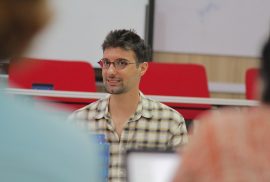
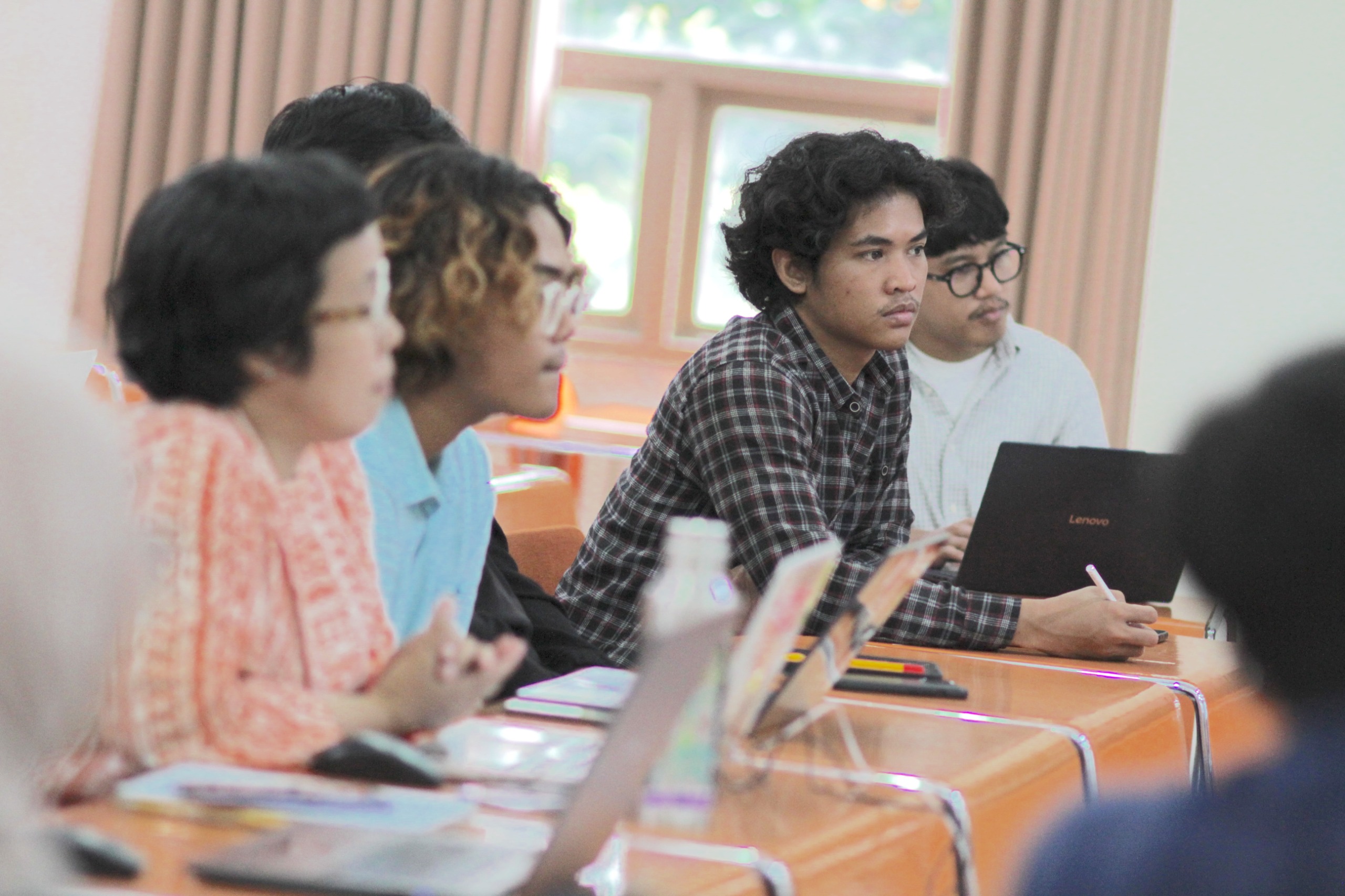
Yogyakarta, November 14th, 2025 –  The Ethnography of Maluku and Nusa Tenggara class held by the Department of Anthropology featured a guest lecturer. Danishwara Nathaniel (Mas Dan) is a PhD candidate from the Geneva Graduate Institute, currently doing research on Ternate, Northern Maluku. During the first session of the class, Mas Dan presented part of his research, titled Visual Activism and Maritime Identity in Indonesia’s Extraction Frontier. In this research, Mas Dan highlights the importance of visual media for the activist movement that is going on in Maluku, which historically has always been an important frontier for natural resources. During the colonial era, the resources being fought over were mainly spices; nowadays, minerals and mines are the resources being extracted from Northern Maluku. Mas Dan explained that Ternate is a sacrifice zone: a specific area that is being ‘sacrificed’ to better the lives of people in other parts of the world. In this context, Maluku’s nature is being destroyed by nickel mines, used for lithium batteries to power electrical vehicles.

Mas Dan further explains the importance of visual and digital media to help put the situation in Northern Maluku on a spotlight. In the past, maps were the visual media being used by colonial forces to plan the conquest of Ternate. This topdown, unspecified view makes the location seem static and controllable, void of any living elements that have their own agencies. Now, visual media helps the people of Ternate to voice their resentment towards the extraction project that they are facing. News and articles are being published all throughout the internet by international journalists and NGOs, spreading awareness about the impacts of green energy development. Mas Dan also mentions that visual and digital media can also be used to dampen the work that the activists have put in. This is mainly done by the government or stakeholders in the mining industry, through the launching of counter-narratives and censorship of the news.

In the second session of the class, Mas Dan brought in his friend as well as his interlocutor (through Zoom Meetings) to share more about the Ternate situation to the class. Adlun Fiqri is an activist from Halmahera who has been vocal in the struggle against the mining industry going on in his hometown. Mas Adlun is also a bachelor of anthropology from Universitas Airlangga, and even did an exchange semester here in UGM. Mas Adlun shared his experience of documenting and actively fighting the mining industry, even being captured a couple of times. He also explains the difference that the mines have brought to local communities: people are becoming more wary and less friendly, after facing countless encounters with the generally aggressive agents from the mines. The main point that is being projected through this class by Mas Dan and Mas Adlun is that Northern Maluku is currently a victim of the growing green energy movement. Visual and digital media can serve as loudspeakers to the world that Northern Maluku is not okay, and spread the word about the impacts of industries on local communities.

Author: Amadeus Abhirama Paramanindita

Congratulations! Lembaran Antropologi Journal Receives Best Journal Governance Award

HEADLINESSDGS Tuesday, 18 November 2025

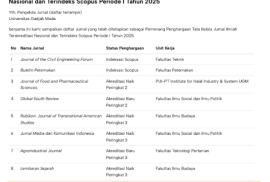
Yogyakarta, 15 October 2025 — After receiving its accreditation rating from SINTA earlier this year, Lembaran Antropologi, a journal managed by the Department of Anthropology at UGM, has once again achieved a new milestone. It was awarded the title of Winner of the Award for Governance of Nationally Accredited and Scopus-Indexed Scientific Journals, Period I of 2025 by the Directorate of Research. The announcement was delivered through Decree No. 12517/UN1.P2/Dit-Lit/PJ.00.02/2025, in which Lembaran Antropologi ranked 9th out of 12 journals that successfully passed the selection.

Lembaran Antropologi aims to promote academic discourse and anthropological analysis in the study of human relations, culture, and society across the Global North and South. The journal publishes two issues each year: Issue 1 (January–June) and Issue 2 (July–December). In its second issue, the journal releases a special edition, a thematic issue often developed in collaboration with experienced researchers in relevant fields. Submissions are open and free of charge. We warmly welcome contributors to share their best work!

Penulis: Penulis: Novilatul Ananda Ramadhani

Faculty of Cultural Sciences (FIB) of UGM Students Represent the Campus at the 18th MTQMN in Banjarmasin

HEADLINESNews Release Monday, 13 October 2025

Banjarmasin, October 5, 2025 — Three students from the Arabic Literature Program, Faculty of Cultural Sciences (FIB), Universitas Gadjah Mada, proudly represented UGM as delegates in the 18th National University Qur’an Recitation Competition (MTQMN XVIII), held at Lambung Mangkurat University, Banjarmasin, South Kalimantan.

The delegates were Muhammad Candra Solihin (Arabic Literature, Class of 2023, Contemporary Calligraphy Male category), Pandhita Hapsari (Arabic Literature, Class of 2023, Qur’anic Debate in Arabic), and Hasifa Zara (Arabic Literature, Class of 2024, Qur’anic Debate in Arabic). In addition, Muhammad Shofyyulloh (Cultural Anthropology 2023) as an official, also accompanied the group from UGM.

Before advancing to the national stage, the three students had to undergo a series of rigorous selection processes. These included internal selection at UGM, followed by an online pre-national selection involving hundreds of students from various universities across Indonesia, before finally being chosen as UGM’s official representatives.

The 18th MTQMN brought together around 1,500 students from universities throughout Indonesia, with the competition running over five days. The event featured an opening ceremony, preliminary rounds, final rounds, and a closing ceremony.

This prestigious competition aims to strengthen students’ Qur’anic character, nurturing a generation with noble character, academic excellence, and the ability to contribute to the nation.

UGM provided full support for its delegates, including regular training, academic guidance, and full facilitation of competition needs. Such support reflects the university’s commitment to fostering achievements while upholding UGM’s reputation on the national stage.

The participation of Arabic Literature students in categories such as Qur’anic debate in Arabic highlights the strong relevance between academic learning and competition. It not only sharpens language mastery but also broadens networks and strengthens the tradition of Islamic scholarship on campus.

[Public Relations of FIB UGM, Candra Solihin]

Exploring Ethnographic Archives: Workshop at FIB UGM with Marco Del Gallo

SDGs 11: Sustainable cities and communitiesSDGs 16: Peace justice and strong institutionsSDGs 4: Quality Education Wednesday, 10 September 2025

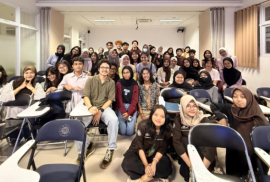
Yogyakarta, 28/8/2025 – The Faculty of Cultural Sciences at Universitas Gadjah Mada (FIB UGM) hosted a thought-provoking workshop titled “Archives of Ethnographic Encounters”  at the Multimedia Room, Margono Building. The event ran from 10 a.m. to 2 p.m. and featured Marco Del Gallo, a PhD candidate in Anthropology at the London School of Economics.

In this workshop, Marco shared his experience working with the personal photographic archive of the late Haswinar Arifin, an anthropology student and photographer who documented life in North Jakarta from the 1970s to the early 2000s. Through this material, Marco invited participants to reconsider the meaning of archives—not merely as collections of documents, but as living traces that hold stories, emotions, and social dynamics.

The discussion raised fundamental questions about the very definition of an archive. Are people, through the simple act of storing photographs, notes, or recordings, in fact producing historical documents for the future? If so, how should researchers engage with these materials—both their own and those created by others? This line of thought opened up a broader understanding of archives, extending beyond official documents to include photographs, sound recordings, videos, and creative writings that capture everyday experiences.

Marco also emphasized the ethical responsibility that comes with working on archives collected by others. Personal materials that enter the academic space bring their own dilemmas: how can intimacy be preserved when private archives are circulated publicly? Where do we draw the line between the researcher’s role, the rights of ownership, and the community represented in these archives? Such questions demand sensitivity to ethics, care, and fairness in collaborative ethnographic work.

Marco’s reflections stem from his doctoral research based on 26 months of fieldwork among fishing communities in North Jakarta. His work contributes to broader discussions on urbanism, capitalism, environmental transformation, collective politics, and labor. His presence at FIB UGM demonstrated how ethnographic experiences in the field can be woven into larger theoretical reflections through archival engagement.

The workshop ultimately became more than an academic gathering; it served as a reminder that archives are not static collections but living spaces of memory. They allow us to see how everyday life becomes history, and how preserving archives also means preserving collective memory for the future.

123

Video UGM

[shtmlslider name='shslider_options']
Universitas Gadjah Mada

Faculty of Cultural Sciences
Universitas Gadjah Mada
Jl. Nusantara 1, Bulaksumur Yogyakarta 55281, Indonesia
   fib@ugm.ac.id
   +62 (274) 513096
   +62 (274) 550451

Work Units

  • Office of Journal & Publishing
  • INCULS
  • Information Technology and Database
  • Language Learning Center
  • Library Unit
  • Public Relations
  • Research

Facilities

  • Computer Laboratory
  • Gamelan
  • Guest House
  • Language Library
  • Library
  • Phonetics Library
  • Self Access Unit
  • Student Internet Centre

Importan Links

  • Journal of Humaniora
  • Subscriber Journal
  • Alumni Portal
  • Career
  • Departmens News
  • UGM Streaming

Contacts

  • Academic
  • Administration
  • Dean’s Office
  • Departments / Study Programs
  • Public Relations

© 2024 Faculty of Cultural Sciences Universitas Gadjah Mada

KEBIJAKAN PRIVASI/PRIVACY POLICY

[EN] We use cookies to help our viewer get the best experience on our website. -- [ID] Kami menggunakan cookie untuk membantu pengunjung kami mendapatkan pengalaman terbaik di situs web kami.I Agree / Saya Setuju