• About UGM
  • Academic Portal
  • IT Center
  • Library
  • Research
  • Webmail
  • Informasi Publik
  • English
    • Indonesia
Universitas Gadjah Mada Faculty of Cultural Sciences
Universitas Gadjah Mada
  • Home
  • Profile
    • History
    • Vision and Mission
    • Organizational structure
    • Administration
    • Staff
    • Faculty Members
  • Academic
    • Academic Calendar
    • Undergraduate Programs
      • Bachelor of Cultural Antrophology
      • Bachelor in Archaeolagy
      • Bachelor in History
      • Bachelor in Tourism
      • Bochetor in Korean Language and Culture
      • Bachelor in Indonesian Language and Culture
      • Bachelor in English
      • Bachelor in Arabic
      • Bachelor in Japanese Language and Culture
      • Bachelor in Javanese Language, Literature and Culture
      • Bachelor in French language and literature
    • Graduate Programs
      • Master in Antrophology
      • Master in ArchaeoIogy
      • Master in History
      • Master in Linguistics
      • Master in Literature
      • Master In American Studies
      • Master in Middle Eastern Cultural Studies
    • Post-Graduate Programs / S3
      • Doctor in Antropology
      • Doctor in American Studies
      • Doctor in Humanities
    • Student Service
  • KPPM
    • Research Information
    • Scientific / Academic Publications
    • Community Service
    • International Cooperation
    • Domestic Cooperation
  • Student Organizations
    • Student Executive Council
    • Semi-Autonomous Organizations
      • KAPALASASTRA
      • Christian Student Alliance
      • LINCAK
      • Saskine
      • Catholic Student Family
      • Dian Budaya
      • Sastra Kanuragan (sasgan)
      • Family of Muslim Cultural Sciences Students (KMIB)
      • Bejo Mulyo
    • Autonomous Organizations
      • Family of Anthropology Students (KEMANT)
      • English Department Student Association
      • Tourism Students Association (HIMAPA)
      • Family of Indonesian Literature Students (KMSI)
      • West Asian Literature Student Association (IMABA)
      • Association of Korean-Language Students (HIMAHARA)
      • Family of Regional Indonesian Literatures Students (KAMASUTRA)
      • The Family Body of History Students (BKMS)
      • The French Literature Students Association (HMSP)
      • Family of Anthropology Students
      • Japanese Student Association (HIMAJE)
  • Admission
    • Student Evaluation
  • Home
  • News Release
  • page. 7
Arsip:

News Release

FIB UGM and Local Artisans Preserve Traditional Arts at Gadjah Mada Wayang Festival 2026

HEADLINESNews Release Tuesday, 26 May 2026

Yogyakarta, May 21, 2026 – The Faculty of Cultural Sciences at Universitas Gadjah Mada (FIB UGM) has officially opened the Gadjah Mada Wayang Festival 2026 at the UGM Center for Javanese Studies (Pusaka Jawa). The event, running from Thursday, May 21, to Saturday, May 23, 2026, is part of the Indonesian Endowment Fund for Education Agency (LPDP RI) EQUITY program and serves as a celebration of the 80th anniversary of FIB UGM.

This year’s festival highlights the main theme “Kita. Butuh. Wayang.” (We Need Wayang). This theme carries a vital message regarding the effort to build a balanced synergy between the academic sphere of UGM and the creative pulse of wayang artisans in Butuh Hamlet, Sidowarno Village, Klaten Regency.

FIB UGM emphasizes that this year’s theme reflects a commitment to keeping traditions alive. It serves as a declaration that the existence of wayang cannot merely be preserved in museum showcases or through stage performances. Wayang must be actively sustained by empowering its makers in Butuh Hamlet, appreciating its creative process, and ensuring its noble values are carried forward by ‘Us’ into the present and future.

The Gadjah Mada Wayang Festival series opened on Thursday, May 21, 2026, with an Opening Ceremony and a Solo Wayang Performance. On the same day, the committee also hosted a Cardboard Wayang Coloring and Wayang Painting (Sungging) Competition. For three full days, the general public can visit the Wayang Exhibition and Market, which showcases a variety of highly valuable artworks crafted by local artisans.

The second day, Friday, May 22, 2026, focuses on strengthening the academic foundation through an Expert Lecture. The highlight of the festival will take place on Saturday, May 23, 2026. On this final day, the public will have the opportunity to participate in a Tatah Sungging (Wayang Carving and Painting) Workshop, watch the vibrant Nusantara Wayang Parade, and attend the closing ceremony along with the announcement of the competition winners.

The Gadjah Mada Wayang Festival 2026 represents a concrete step by the university to preserve the nation’s cultural heritage. Empowering village artisans and placing them at the center of art preservation will foster self-reliance and economic growth within local communities. This empowerment-based preservation approach ensures that ancestral heritage remains competitive, inclusive, and capable of supporting the welfare of its artisans across generations.

[Public Relations of FIB UGM, Candra Solihin]

Literature and Mythmaking in the Narratives of Chinese Indonesian Life

News Release Monday, 25 May 2026

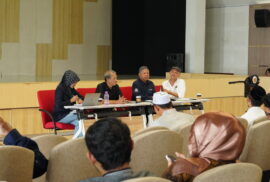
The Master’s Program in Literature once again held a public discussion titled “Exercises in Chineseness: Literature, Mythmaking & Identity in Contemporary Tionghoa Communities” at Room 105 Soegondo, Faculty of Cultural Sciences, Universitas Gadjah Mada, on Wednesday (20/5/2026). The event featured researcher Alexandra Masri Do from Cornell University, moderated by Naria Nur Iftitah from the Master’s Program in Literature, FIB UGM. The discussion explored contemporary Chinese Indonesian identity through literature, collective memory, and everyday cultural practices.

In her presentation, Alexandra highlighted the position of Chinese Indonesians as part of the world’s largest Chinese diaspora population. She explained that Chinese communities in the Indonesian archipelago existed long before the emergence of the modern nation-state, with records of settlements dating back to the seventh century. According to her, “Chinese” identity in Indonesia has never been singular, but rather continuously negotiated through language, culture, historical experience, and intergenerational social relations.

Alexandra also examined how the legacy of Dutch colonialism created social stratifications whose effects continue to persist today. She referred to 1965 and 1998 as two traumatic historical moments deeply embedded in the collective memory of Chinese Indonesian communities. The political circumstances of those periods, she argued, shaped the ways Chinese Indonesians viewed themselves, the state, and the very idea of citizenship.

Through several contemporary literary works, Alexandra demonstrated how the experience of being Chinese in Indonesia is articulated through personal narratives. She quoted The Longing by Alberta Natasia Adji, which portrays the younger generation’s disconnection from their ancestral cultural roots: “I’m a copy of my mother, but I speak the language of the locals. The closest thing I’ve got to my Chinese heritage now is eating noodles with chopsticks and checking my luck according to the Chinese horoscope.”

Referring to the passage, Alexandra noted that Chinese identity often survives only through simple cultural symbols such as chopsticks or zodiac beliefs, while ancestral languages gradually disappear from everyday life.

Beyond literature, Alexandra presented field documentation that she described as both collective and deeply personal, gathered from areas such as Glodok, Pantjoran PIK, Jambi, and Yogyakarta. Photographs of Chinese temples, Chinese schools, markets, and even citizenship archives from 1953 illustrated how Chinese identity continues to be reproduced through social spaces and cultural practices. She referred to this process as “mythmaking,” or the construction of collective narratives surrounding who Chinese Indonesians are and how they are understood.

Alexandra’s research also explored the aspirations of contemporary Chinese Indonesians, particularly the post-1998 generation. She questioned whether the idea of “homeland” is understood as Indonesia, China, or an in-between space of identity. These questions emerge alongside social change, globalization, and the increasing mobility of younger generations.

During the discussion, Alexandra emphasized the importance of fiction and literature as mediums for understanding minority experiences that are often absent from official historical narratives. In her view, literary works are capable of capturing the emotions, anxieties, and hopes of Chinese Indonesian communities more intimately than formal historical documents.

The event proceeded interactively with enthusiastic participation from students and academics. The discussion expanded to issues of discrimination, nationalism, and the representation of Chinese Indonesians in Indonesian popular culture. Through this public lecture, participants were encouraged to see Chinese identity not as a static category, but as an experience continually shaped by history, politics, culture, and everyday life.


[Magister Sastra, Khotibul Umam]

Celebrating Its 80th Anniversary, Faculty of Cultural Sciences Held Blood Donation and Sports Events

HEADLINESNews Release Monday, 25 May 2026

Yogyakarta, May 22, 2026 – The Faculty of Cultural Sciences at Universitas Gadjah Mada (FIB UGM), in collaboration with the UGM Academic Hospital (RSA UGM), organized a blood donation drive. Centered at the Soegondo Building, this humanitarian activity was part of the events celebrating the 80th anniversary of FIB UGM.

The blood donation drive took place from 8:00 a.m. to 11:00 a.m. Western Indonesia Time (WIB) in Room S107 on the first floor of the Soegondo Building. This social initiative successfully attracted participation from various members of the academic community. Participants who came to donate their blood included students, lecturers, professional staff, and alumni.

Before the blood donation began, the campus was already lively early in the morning with a group sports event titled “FIB Sehat” (Healthy FIB). Starting at 7:00 a.m. WIB, participants gathered to take part in a variety of weekend sports activities, such as volleyball, line dancing, a fun walk, and a fun bike ride. Meanwhile, tennis facilities were specially prepared at the Lembah Sports Hall. Through an official announcement, the organizing committee invited the entire FIB UGM community to get ready and join early in the morning to make the event a success.

The combination of physical activities and social initiatives added profound meaning to the FIB UGM anniversary celebration. This event served as a tangible step in maintaining physical fitness while fostering a sense of solidarity. The spirit of care generated through the blood donation and shared sports activities is expected to support a healthier, more balanced, and prosperous quality of life for the campus community and the wider public.

[Public Relations of FIB UGM, Candra Solihin]

Arabic Literature Sweeps Top Awards at UGM Faculty of Cultural Sciences Graduation

News Release Monday, 25 May 2026

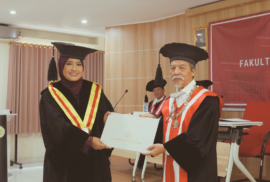
Yogyakarta, May 20, 2026 – The Faculty of Cultural Sciences at Universitas Gadjah Mada (FIB UGM) held a celebratory graduation ceremony for the Undergraduate Program Period III of the 2025/2026 Academic Year. The event, which took place at the Poerbatjaraka Auditorium of FIB UGM, officially released 115 new graduates.

Overall, the average Grade Point Average (GPA) of the faculty’s graduates for this period reached 3.71 out of a 4.00 scale. Meanwhile, the average study period for students to complete their undergraduate education was exactly four years. Based on the distribution data per study program, the Indonesian Language and Literature program produced the highest number of graduates with 18 students, followed closely by Arabic Literature with 17 students.

The Arabic Literature Study Program took the spotlight in this graduation period after successfully securing three individual award categories at once. The Best Graduate title was awarded to Sayyidah Khalimatussakdiah with an outstanding GPA of 3.97. The Fastest Graduate category was achieved by Rangga Rayhan Paristyo, who completed his studies in 3 years, 5 months, and 15 days. Meanwhile, the Youngest Graduate award was presented to Akifatul Farizah, who successfully graduated at the age of 21 years and 5 months.

The Dean of FIB UGM, Professor Setiadi, expressed high appreciation for these extraordinary achievements. He stated that the proud accomplishments at the Period III FIB Graduation came from the Arabic Literature Study Program. Professor Setiadi also emphasized the crucial role of educators in the students’ success.

“The top three graduate categories originate from the Arabic Literature Study Program, namely the Best Graduate, the Fastest Graduate, and the Youngest Graduate. Certainly, this achievement is inseparable from the contributions of the lecturers who have educated and guided them to successfully graduate today,” Professor Setiadi remarked during his welcoming speech.

The graduation of these new humanities scholars marks the first step of their tangible contributions to society. The academic success and study period efficiency demonstrated by the graduates reflect the success of a high-quality and inclusive education system. Equipped with a strong academic foundation, this young generation is expected to be ready as driving agents who bring a positive impact on socio-cultural advancement and sustainable community welfare in the future.

[Public Relations of FIB UGM, Candra Solihin]

Psycholinguistics Course: Understanding Language through the Perspectives of Mind, Brain, and Human Behavior

News Release Friday, 22 May 2026

The Psycholinguistics course is designed to provide students with an in-depth understanding of the relationship between language, the mind, and human biological processes. Through this course, students are introduced to the ways in which humans, as subjects, utilize their neurobiological capacities to process language as an object, while also examining the various obstacles that may arise in such processes.

The course materials encompass the study of humans as biological beings possessing the brain, neurological systems, auditory and visual senses, and speech organs that play essential roles in language processing. In addition, students explore the nature of human language and the various stages of linguistic processing, including language perception and comprehension, first language acquisition, second and foreign language learning, memory storage and retrieval processes, as well as spoken and written language production.

Beyond focusing solely on typical language processes, the Psycholinguistics course also addresses a range of language impairments and disorders caused by neurological and biological abnormalities. Through this approach, students are expected to develop a more comprehensive understanding of language from cognitive, biological, and social perspectives.

The course is delivered through a combination of face-to-face and blended learning modes in accordance with faculty guidelines. The instructional format consists of 60 percent in-person learning and 40 percent blended learning. Indonesian is used as the primary language of instruction throughout the course.

As part of strengthening students’ academic competencies and analytical skills, assessment is conducted through assignments and quizzes weighted at 20 percent, as well as article writing based on a case-based learning approach weighted at 80 percent. This approach encourages students to relate psycholinguistic theories to real linguistic phenomena occurring in society.

Another distinctive feature of the course is the student presentation sessions conducted in their respective regional languages to discuss specific topics related to psycholinguistics. This activity not only enriches students’ academic perspectives on Indonesia’s linguistic diversity, but also serves as a reflective space for understanding the relationship between language, culture, and human cognitive processes.

Through the Psycholinguistics course, students are expected to develop an interdisciplinary understanding of language as part of the human cognitive system, while simultaneously enhancing their sensitivity to linguistic diversity and various language-related issues encountered in everyday life.


[Magister Linguistik]

1…56789…236

Video UGM

[shtmlslider name='shslider_options']
Universitas Gadjah Mada

Faculty of Cultural Sciences
Universitas Gadjah Mada
Jl. Nusantara 1, Bulaksumur Yogyakarta 55281, Indonesia
   fib@ugm.ac.id
   +62 (274) 513096
   +62 (274) 550451

Work Units

  • Office of Journal & Publishing
  • INCULS
  • Information Technology and Database
  • Language Learning Center
  • Library Unit
  • Public Relations
  • Research

Facilities

  • Computer Laboratory
  • Gamelan
  • Guest House
  • Language Library
  • Library
  • Phonetics Library
  • Self Access Unit
  • Student Internet Centre

Importan Links

  • Journal of Humaniora
  • Subscriber Journal
  • Alumni Portal
  • Career
  • Departmens News
  • UGM Streaming

Contacts

  • Academic
  • Administration
  • Dean’s Office
  • Departments / Study Programs
  • Public Relations

© 2024 Faculty of Cultural Sciences Universitas Gadjah Mada

KEBIJAKAN PRIVASI/PRIVACY POLICY

[EN] We use cookies to help our viewer get the best experience on our website. -- [ID] Kami menggunakan cookie untuk membantu pengunjung kami mendapatkan pengalaman terbaik di situs web kami.I Agree / Saya Setuju