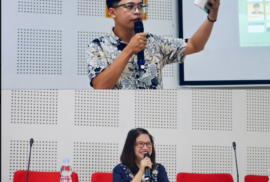
During the final meeting of the first half of the Postcolonialism course, students of the Master’s Program in Literature at Universitas Gadjah Mada had the opportunity to attend a guest lecture titled Baltic Postcolonialism, delivered by Dr. Irma Budginaitė-Mačkinė, Associate Professor of Sociology at Vilnius University, Lithuania. Dr. Irma visited Indonesia as part of a research mobility scheme funded by Project MARS: Non-Western Migration from Global Perspectives.
The lecture was organized by Dr. Arifah Arum Candra Hayuningsih, the lecturer responsible for the first half of the Postcolonialism course. The guest lecture for the Master’s Program in Literature was held on Monday (27/4/2026) at Soegondo Building Room 224, Faculty of Cultural Sciences, Universitas Gadjah Mada.
Postcolonialism is one of the compulsory courses designed to provide students with an understanding of the dynamics of colonialism and its impacts on various aspects of life, including language, literature, economics, politics, and culture. The course does not only focus on countries in Asia and Africa, but also covers other regions such as the Caribbean, Kenya, India, Vietnam, and Eastern Europe, including Lithuania, which experienced forms of domination different from classical colonialism.
These diverse colonial experiences gave rise to postcolonial thinkers who sought to critique and deconstruct colonial hegemony through reflective and critical ideas. Figures such as Aimé Césaire, Albert Memmi, Frantz Fanon, Ngũgĩ wa Thiong’o, Trinh T. Minh-ha, Chandra Talpade Mohanty, and Édouard Glissant contributed diverse perspectives in understanding colonialism and the process of decolonization.
In her presentation, the academic, whose interdisciplinary background spans political science and sociology, highlighted Lithuania’s ambiguous position within postcolonial studies, particularly in the post-Soviet context. To understand this ambiguity, Lithuania must be viewed within a post-imperial framework, as a country transitioning from the rule of the Russian Empire and later the Soviet Union into the post-Soviet era. Lithuania cannot easily be categorized as a “colonized” nation in the classical colonial sense, yet it still experienced forms of colonial-like domination.
Geographically, Lithuania covers an area of approximately 65,300 km², roughly half the size of Java Island, with a population of around 2.9 million people, comparable to the population of Yogyakarta City. Its national language, Lithuanian, belongs to the Baltic branch of the Indo-European language family and remains an important part of the country’s national identity despite historical pressures.
Historically, Lithuania was once part of a political union through the Polish–Lithuanian Commonwealth in 1569. However, in 1795, the country lost its sovereignty and became part of the Russian Empire. Since then, various policies demonstrated that the domination imposed upon Lithuania was neither simple nor singular, but systematic and complex.
During her presentation, the sociologist, who has conducted scientific research for more than a decade, also discussed the perspective of historian Darius Staliūnas, who described Russian domination in Lithuania as extending into many aspects of life. Politically, Lithuania was placed under external control that restricted national sovereignty. Socially, repression in the form of censorship and limitations on freedom became part of the people’s lived experience. Economically, exploitation and the redirection of economic orientation served the interests of the imperial center.
In the spheres of culture, language, and religion, this domination manifested through policies promoting Russification. The Russian government promoted Orthodox Christianity, limited the influence of the Catholic Church, and at one point prohibited the use of the Latin alphabet. These policies reflected systematic attempts to displace Lithuania’s local identity. Furthermore, education and knowledge were also used as instruments of control to shape public ways of thinking according to the interests of those in power.
As a response to these pressures, Lithuanians demonstrated various forms of resistance, one of which was large-scale migration. Between 1865 and 1915, around 700,000 Lithuanians left their country and migrated to regions such as the United States, the United Kingdom, Canada, Brazil, Argentina, and Germany. This migration can be understood as an indirect form of resistance against the domination they experienced.
Following the collapse of the Soviet Union, Lithuania entered a post-Soviet transition phase marked by the restoration of political independence in 1990 and the end of direct external control. Nevertheless, the effects of previous domination continue to be felt today. Like many other Eastern European countries, Lithuania faces challenges as a relatively less-developed nation that is not yet fully modernized and is still striving to catch up with Western countries.
Therefore, Lithuania’s experience demonstrates that colonialism does not always take the form of explicit geographical occupation, but can also be recognized through complex and layered power relations. This ambiguity makes Lithuania a compelling case in postcolonial studies, while also expanding the scope of postcolonial analysis beyond the Global South.
[Magister Sastra, Selvia Parwati Putri]