• About UGM
  • Academic Portal
  • IT Center
  • Library
  • Research
  • Webmail
  • Informasi Publik
  • English
    • Indonesia
Universitas Gadjah Mada Faculty of Cultural Sciences
Universitas Gadjah Mada
  • Home
  • Profile
    • History
    • Vision and Mission
    • Organizational structure
    • Administration
    • Staff
    • Faculty Members
  • Academic
    • Academic Calendar
    • Undergraduate Programs
      • Bachelor of Cultural Antrophology
      • Bachelor in Archaeolagy
      • Bachelor in History
      • Bachelor in Tourism
      • Bochetor in Korean Language and Culture
      • Bachelor in Indonesian Language and Culture
      • Bachelor in English
      • Bachelor in Arabic
      • Bachelor in Japanese Language and Culture
      • Bachelor in Javanese Language, Literature and Culture
      • Bachelor in French language and literature
    • Graduate Programs
      • Master in Antrophology
      • Master in ArchaeoIogy
      • Master in History
      • Master in Linguistics
      • Master in Literature
      • Master In American Studies
      • Master in Middle Eastern Cultural Studies
    • Post-Graduate Programs / S3
      • Doctor in Antropology
      • Doctor in American Studies
      • Doctor in Humanities
    • Student Service
  • KPPM
    • Research Information
    • Scientific / Academic Publications
    • Community Service
    • International Cooperation
    • Domestic Cooperation
  • Student Organizations
    • Student Executive Council
    • Semi-Autonomous Organizations
      • KAPALASASTRA
      • Christian Student Alliance
      • LINCAK
      • Saskine
      • Catholic Student Family
      • Dian Budaya
      • Sastra Kanuragan (sasgan)
      • Family of Muslim Cultural Sciences Students (KMIB)
      • Bejo Mulyo
    • Autonomous Organizations
      • Family of Anthropology Students (KEMANT)
      • English Department Student Association
      • Tourism Students Association (HIMAPA)
      • Family of Indonesian Literature Students (KMSI)
      • West Asian Literature Student Association (IMABA)
      • Association of Korean-Language Students (HIMAHARA)
      • Family of Regional Indonesian Literatures Students (KAMASUTRA)
      • The Family Body of History Students (BKMS)
      • The French Literature Students Association (HMSP)
      • Family of Anthropology Students
      • Japanese Student Association (HIMAJE)
  • Admission
    • Student Evaluation
  • Home
  • News Release
  • page. 35
Arsip:

News Release

Childism and the Defamiliarization of Language in Ziggy Zezsyazeoviennazabrizkie’s Works

News Release Monday, 23 June 2025

Yogyakarta, June 23, 2025 — The Department of Language and Literature, Faculty of Cultural Sciences, Universitas Gadjah Mada, held a public lecture titled “Childism and the Defamiliarization of Language in Ziggy Zezsyazeoviennazabrizkie’s Works.” The event was conducted both offline and online, featuring renowned writer Ziggy Zezsyazeoviennazabrizkie as the main speaker, with Narayda Akmal as the discussant and Ruhaeni Intan as the moderator.

The lecture opened with a presentation by Narayda Akmal, who reviewed several of Ziggy’s works, including di Tanah Lada, Kita Pergi Hari Ini, and Semua Ikan di Langit. She highlighted how these works reflect the spirit of childism, a perspective that provides agency to children in a world that often neglects their voices and experiences. Ziggy’s language was seen as unique and unconventional, creating a distance from common linguistic norms while revealing the complexity of childhood.

Through her writings, Ziggy seeks to challenge the traditional view of children as passive beings. On the contrary, she presents children as active figures responding to harsh social realities. The linguistic strategies in her works are not mere playfulness, but serve as a medium to raise issues such as poverty, inequality, and alienation within the domestic space.

In the novel di Tanah Lada, for instance, the experiences of children facing urban poverty are portrayed sharply. The home is no longer a place of refuge but a source of suffering. Ziggy depicts simplicity through the eyes of children trapped in the misunderstanding of adults—a condition that often leads to emotional neglect and miscommunication.

Meanwhile, Semua Ikan di Langit combines elements of fantasy, science fiction, fairy tales, and mythology. The road novel format adopted in this book allows readers to follow the imaginative journey of the main character, while also accessing layers of meaning that challenge conventional ways of understanding childhood.

Moderator Ruhaeni Intan added a perspective on the importance of space for writers to store and process their ideas. She used the metaphor of a suitcase full of thoughts waiting to be unpacked to emphasize the creative process, which is inseparable from the role of the literary community. In this process, writers do not work alone but are connected with publishers, readers, and researchers who appreciate and develop literary studies.

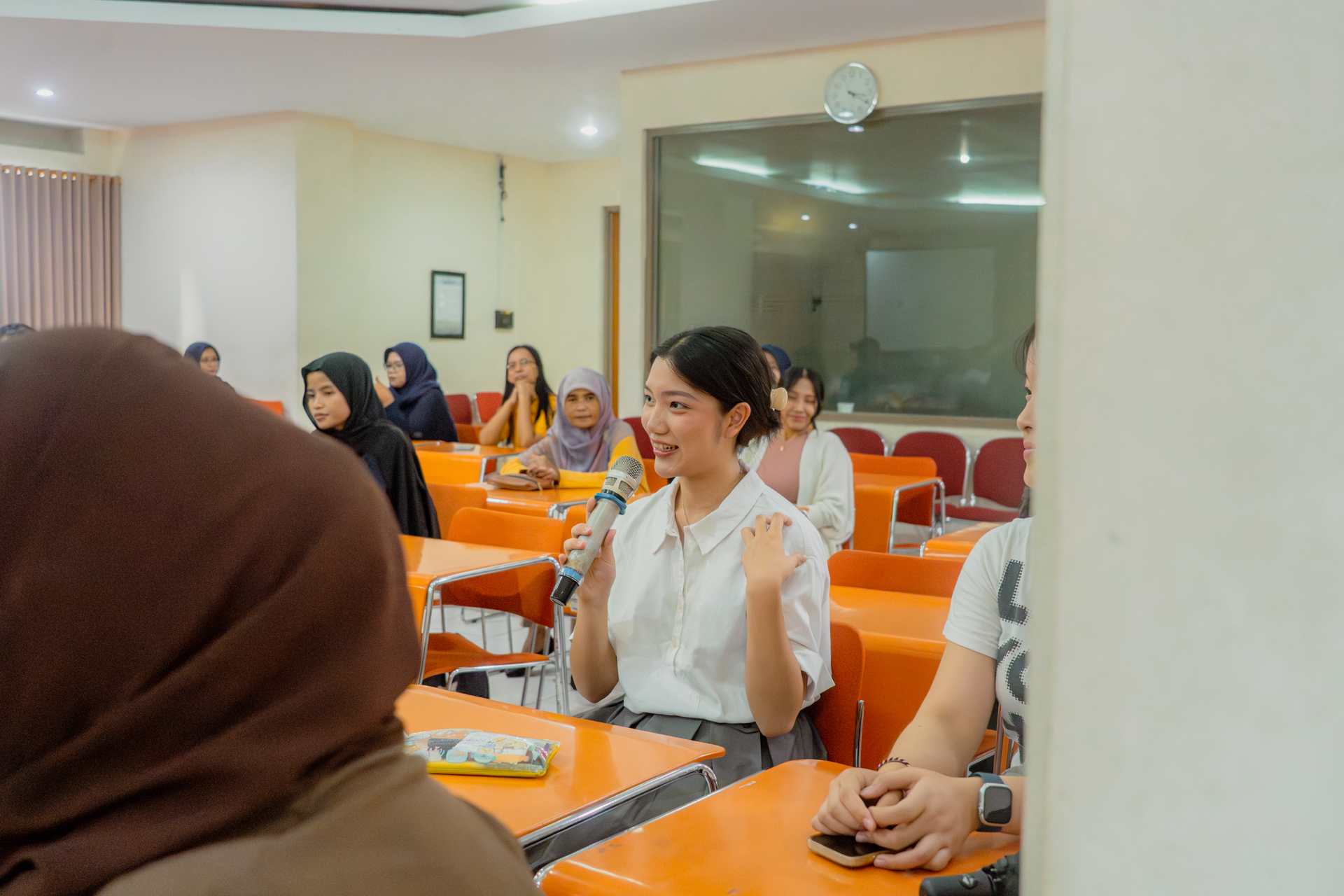
The event concluded with an interactive discussion session and a group photo. Participants actively asked questions regarding the implications of childism in literature and its impact on social life. This discussion reinforced the importance of basic literacy skills and critical education in understanding the complex realities of childhood.

In conclusion, the lecture provided significant insights into the representation of children in literature. Beyond enriching academic discourse, this event also supported the achievement of the Sustainable Development Goals (SDGs), particularly Goal 4 on quality education and Goal 10 on reducing inequality through the empowerment of children’s perspectives.

[Public Relation, Alma Syahwalani]

The Brandu Tradition Through the Lens of Medical Anthropology

News ReleaseSDG 4 (Quality Education)SDGs 17: Partnerships for the GoalsSDGs 3: Good health and well-beingSDGs 4: Quality EducationSDGs 8: Decent work and economic growth Friday, 20 June 2025

Yogyakarta, 12/06/2025 – The Department of Anthropology held a dissertation proposal seminar on June 12, 2025, featuring Tri Isnani’s research titled “The Existence of the Brandu Tradition Amid the Anthrax Outbreak in the Special Region of Yogyakarta (DIY).”

The brandu tradition is a community-based fundraising practice in which local residents collectively contribute money to ease the financial burden of livestock owners whose animals are either sick or have died. Livestock holds deep cultural and economic significance for the community. The term brandu originates from minterke anak—meaning “to support a child”—highlighting the role of animals such as cows and goats as a form of savings, often used to finance children’s education, weddings, and traditional ceremonies such as rasulan, ingkung sewu, nyumbang, and others.

However, Isnani noted growing public concern over the anthrax outbreak, which has become a serious public health crisis in the region. The issue has drawn the attention of not only the public but also government bodies and health agencies. In response, Isnani proposed a deeper investigation through the lens of medical anthropology.

Prof. Dr. Atik Triratnawati, M.A., as Isnani’s main supervisor, and Dr. M. Choirul Hidajat, SKM., M.Kes., both emphasized the need for anthropological research grounded in an emic perspective, employing ethnographic methods in the formulation of health-related programs and policies. They stressed that such an approach is crucial for effective disease control under the “One Health” framework—a multidisciplinary strategy encompassing both prevention and treatment.

The seminar also featured Dr. Elan A. Lazuardi, a faculty member in the Department of Anthropology with a focus on health studies. He underlined the importance of researcher positionality in fieldwork. Additional discussants—Ahriyadi Sofyan, Rizqi R., Ayu F., and Dyah Ayu—offered constructive feedback to help strengthen Isnani’s research. The event was also attended by students from the Master’s and Doctoral programs in Anthropology, as well as from the Doctoral Program in Humanities.

In closing, Prof. Dr. Atik Triratnawati reminded participants that doctoral research should arrive at a philosophical understanding rooted in community values—specifically, exploring the deeper meaning behind the brandu tradition. Once such a philosophy is grasped, it can shape the direction of the research more profoundly.

Furthermore, Dr. M. Choirul Hidajat, a researcher at BRIN (National Research and Innovation Agency), highlighted the relevance of anthropological perspectives in medical studies. He emphasized that the novelty of such research lies in anthropology’s ability to interpret health phenomena in culturally grounded ways. “This is crucial,” he said. “Perhaps the true contribution of this study is its potential to offer input into health programs that empower, rather than intimidate, the community—ultimately supporting inclusive program development.”

[Cultural Anthropology, Dewi Widyastuti]

Benchmark Visit of the Faculty of Social and Political Sciences Padjadjaran University to the Faculty of Cultural Sciences Universitas Gadjah Mada

News ReleaseSDGs 17: Partnerships for the GoalsSDGs 4: Quality Education Friday, 20 June 2025

Yogyakarta, 17/6/2025 – The Dean of the Faculty of Cultural Sciences—Prof. Dr. Setiadi, S.Sos., M.Si.—welcomed the delegation from the Faculty of Social and Political Sciences, Padjadjaran University, during the benchmarking visit of FISIP Unpad to the Faculty of Cultural Sciences, Universitas Gadjah Mada (FIB UGM). The event was held offline at the Margono Building, FIB UGM, in an atmosphere full of collaborative spirit and kinship.

This benchmarking activity was attended directly by the Dean of FISIP Unpad—Prof. Dr. Mohammad Benny Alexandri, S.E., M.M.—along with his entourage and warmly received by the Dean and Vice Deans of FIB UGM.

In his remarks, the Dean of FIB UGM presented various strategic programs currently being implemented by the faculty, including INCULS (Indonesian Culture and Language Program for Foreign Learners), one of FIB UGM’s initiatives in internationalization and in promoting the Indonesian language and culture to the world.

The Dean of FIB UGM also explained that the faculty offers complementary courses to fulfill students’ credit requirements, including practice-based courses such as soft skills and cultural practices. These are designed not only to enhance students’ theoretical understanding but also to develop their practical skills in the field.

On the same occasion, he also mentioned that an academic event from one of FIB UGM’s study programs—the Archaeology Exhibition—was being held as part of the learning program.

Furthermore, the discussion also touched upon the partnerships and cooperation networks that FIB UGM has established with various international universities. These networks continue to expand through mobility programs, student exchanges, collaborative research, and programs for teaching the Indonesian language and culture to foreign speakers.

The benchmarking visit concluded with a warm discussion and exchange of ideas between the two institutions, with the hope of opening up new opportunities to improve the quality of education within the faculties.


[Public Relations of FIB UGM, Candra Solihin]

Introduction to Bodies that Haunt: Rethinking the Political Economy of Racialized Death.

News ReleaseSDGs 16: Peace justice and strong institutionsSDGs 4: Quality Education Tuesday, 17 June 2025

Yogyakarta, 16/06/2025 – The Master’s Program in American Studies held a seminar titled “Introduction to Bodies that Haunt: Rethinking the Political Economy of Racialized Death.” Taking place in Room 709, 7th Floor of the Soegondo Building at the Faculty of Cultural Sciences, this event served as a platform for critical discussions on racial violence, politicized death, and cultural memory within a global context—particularly in the Americas and Southeast Asia.

Moderated by Achmad Munjid, Ph.D., the seminar featured two prominent speakers with strong backgrounds in cultural studies, feminism, and historical memory: Dr. Emily Itamura and Dr. Rachmi Diyah Larasati.

The discussion began with an introduction by the moderator, who drew parallels between horror films and everyday life, highlighting the mass production of ghosts in popular culture. From this point, the seminar explored the meaning of “bodies that haunt”—a term that goes beyond traditional ghostly figures, referring instead to collective trauma, unresolved death, and suppressed forms of knowledge.

Dr. Rachmi Diyah Larasati opened the first session by examining the concept of ghosts through a local Indonesian lens. She explained that in Indonesian culture, ghosts often emerge as warnings, memories, or connections to unresolved political violence. In her talk, titled “Train and Its Fugitive Rhythms: Reflecting on Political Violence through Sound Aesthetics,” Dr. Rachmi encouraged the audience to interpret sounds and rhythms—such as train noises—as invisible archives of political violence. These sounds, she argued, act like ghosts: ever-present and evocative, even if not always consciously perceived.

She emphasized the importance of seeing ghosts not simply as supernatural beings, but as a way of rereading history shaped by trauma. Ghosts become embodied through shadows, feelings, sounds, and memories that seep into our everyday lives.

Building on this, Dr. Emily Itamura led participants into the historical trauma of the Cambodian genocide through her presentation “Love Story, Ghost Story: The Cambodian Genocide, Labour Extraction, and Hout Bophana.” She highlighted how love stories can become ghost stories within the context of violence, and how female figures like Hout Bophana continue to haunt post-genocide development narratives.

Dr. Emily argued that the United States, as a modern imperial power, is a haunted space—saturated with the legacies of colonialism, racism, and capitalist extraction of nonwhite bodies. She pointed to Hmong, Laotian, and Vietnamese communities in Minnesota as groups who carry the “ghosts” of war and forced migration—now inextricably woven into the fabric of American cultural life.

The conversation between Dr. Rachmi and Dr. Emily unfolded into a rich cross-cultural dialogue, blending feminist theory, imperial critique, and ethnographic approaches to explore how haunted bodies continue to reappear in collective memory, art, and sound.

The event concluded with a powerful insight: ghosts are not simply objects of fear, but forms of alternative knowledge about trauma, violence, and histories left unresolved. Ghosts act as reminders that not all experiences can be archived or silenced by official historical narratives. They emerge through sound, shadows, and emotions—quietly shaping how we remember the past and envision the future.

This seminar served as a reflective space where theory met lived experience, popular culture intersected with violent histories, and Indonesian localities resonated with global traumas. A poignant reminder: haunted bodies are not meant to be dismissed—they are meant to be heard.

[Humas FIB, Alma Syahwalani]

Student of Javanese Language, Literature and Culture Study FIB UGM Directs the Theater “Sat-Set” in Prabusena 2025, Inspired by Javanese Literary Works

News ReleaseSDGs 11: Sustainable cities and communitiesSDGs 17: Partnerships for the GoalsSDGs 4: Quality Education Monday, 16 June 2025

Yogyakarta, 31/05/2025 – Another proud achievement came from mahadaya (students of Cultural Sciences). Nurcholish Ramadhan, a 2024 student from the Department of Javanese Language, Literature, and Culture, Faculty of Cultural Sciences UGM, successfully directed the production of a theater performance entitled Sat-Set. The show was performed by Teater Berdaya in Prabusena (Cultural, Art, and Islamic Appreciation Stage of PD IPM Bantul) 2025 on Saturday night, May 31, 2025 at 20.00 WIB, at the 1st Floor Hall of the Da’wah Building of PDM Bantul.

Sat-Set Theater tells the story of the love journey of Fikar, a 28-year-old man, the son of a panewu (sub-district head), who falls in love with Alya – the daughter of his late father’s best friend. An accidental meeting in the square is the beginning of Fikar’s love story. After some research, Fikar learns that Alya is the daughter of Paklik Pram, his father’s old friend. They stay close for a month, but Fikar never proposes. To provoke Fikar’s sincerity, Paklik Pram created the rumor that Alya would be married off. The plan worked. Although Fikar initially only expressed his feelings in front of Paklik and Bulik Pram, he finally received their blessing. Later, Fikar went to the park where he often visited with Alya. There they meet again after not seeing each other for several days. Finally, Fikar expresses his love and immediately asks Alya to marry him.


The uniqueness of Sat-Set theater lies in its source of inspiration. Nurcholish Ramadhan said that Sat-Set was inspired by Serat Riyanta, a Javanese literary work written by R. B. Soelardi in 1918. In an online interview conducted on June 12, 2025, Nurcholish explained that his interest in the fiber began with a course assignment. “After I read Serat Riyanta from beginning to end, I was interested and liked the story, so I had an idea to translate it into a performance,” he explained.


The production process of the performance was not free from challenges. Nurcholish mentioned that the limited duration required him to summarize the narrative of Serat Riyanta effectively, without losing the essence of the story. In addition, funding constraints were also an obstacle. Nevertheless, he was grateful that the performance could run optimally.

“Through this performance, I learned to go deeper into the work that was referred to when it was adapted into a theater script. Then, I feel happy to be able to accommodate the potential and talents of my fellow Muhammadiyah students in the arts,” he said.


Sat-Set Theater is a tangible form of nguri-uri ‘preserving’ and ngurip-urip ‘enlivening’ regional arts, literature, and culture. Past literary works hold a wealth of historical values, knowledge, moral and didactic teachings, and interesting stories to be revived. Through the excavation, preservation and utilization of these cultural treasures, the community not only benefits sustainably, but also builds a sense of pride in the nation’s noble identity. As Nurcholish said at the end of the interview. “A history and culture will always be preserved when there are people who want to nyinau (learn) and adum ilmu (share knowledge),” he concluded.

[Haryo Untoro]

1…3334353637…201

Video UGM

[shtmlslider name='shslider_options']
Universitas Gadjah Mada

Faculty of Cultural Sciences
Universitas Gadjah Mada
Jl. Nusantara 1, Bulaksumur Yogyakarta 55281, Indonesia
   fib@ugm.ac.id
   +62 (274) 513096
   +62 (274) 550451

Work Units

  • Office of Journal & Publishing
  • INCULS
  • Information Technology and Database
  • Language Learning Center
  • Library Unit
  • Public Relations
  • Research

Facilities

  • Computer Laboratory
  • Gamelan
  • Guest House
  • Language Library
  • Library
  • Phonetics Library
  • Self Access Unit
  • Student Internet Centre

Importan Links

  • Journal of Humaniora
  • Subscriber Journal
  • Alumni Portal
  • Career
  • Departmens News
  • UGM Streaming

Contacts

  • Academic
  • Administration
  • Dean’s Office
  • Departments / Study Programs
  • Public Relations

© 2024 Faculty of Cultural Sciences Universitas Gadjah Mada

KEBIJAKAN PRIVASI/PRIVACY POLICY

[EN] We use cookies to help our viewer get the best experience on our website. -- [ID] Kami menggunakan cookie untuk membantu pengunjung kami mendapatkan pengalaman terbaik di situs web kami.I Agree / Saya Setuju