
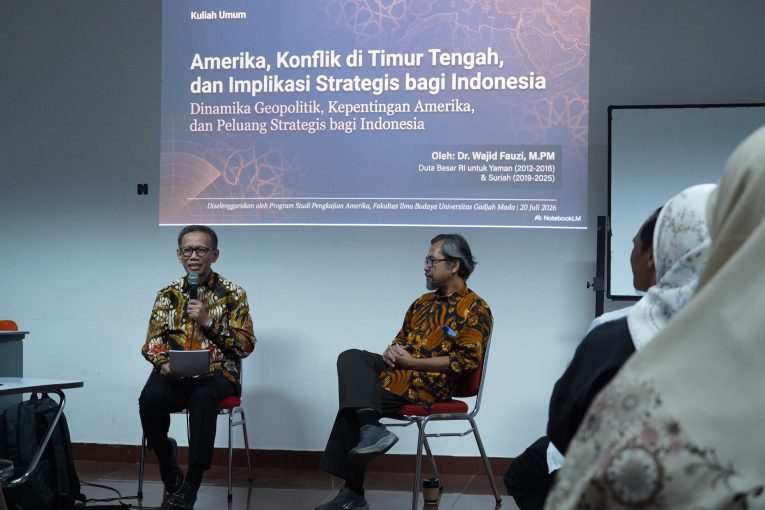
On Monday, July 20, 2026, the American Studies Program at the Faculty of Cultural Sciences, UGM, held a public lecture titled “The United States, the Middle East Conflict, and Implications for Indonesia: Geopolitical Dynamics, U.S. Interests, and Strategic Opportunities for Indonesia.” The public lecture featured Dr. Wajid Fauzi, M.PM., as the speaker. He is currently a Ph.D. student in American Studies and is set to graduate on July 22. He also served as Indonesia’s Ambassador Extraordinary and Plenipotentiary to Yemen (2012–2016) and Syria (2019–2025).
The lecture covered the Middle East as a region that has become a focal point for the study of international politics, the role of the United States in the region, and the strategic implications for Indonesia’s interests. The guest lecture was opened by Dr. Achmad Munjid, M.A., Ph.D., a lecturer in the American Studies Program. He emphasized that it is crucial for the public to recognize the significant impact that the current conflict between the United States and the Middle East has on Indonesia. This is also the reason why this public lecture was organized.
The presentation was then followed by a talk by Dr. Wajid Fauzi, M.PM. He encouraged participants to take a holistic view of the Middle East—not only through the lens of its wars and conflicts, but also by examining the layers beneath the surface. These include energy routes, trade routes, rivalries among regional powers, and competition among major nations with interests in the region.
Dr. Wajid Fauzi explained that the Middle East is not merely a region of conflict, but a geopolitical arena where global interests converge, power struggles unfold, and the quest for international legitimacy takes place. “Geopolitics teaches us that geography is not merely about the location of a country or the boundaries of a region, but rather a factor that shapes the distribution of power, economic interests, military strategies, and can even influence another country’s foreign policy toward that region,” he emphasized. He concluded that, in other words, geography is not a neutral factor but a source of advantage.
Conflicts in the Middle East also have implications for Indonesia, such as in foreign policy, the protection of Indonesian citizens, energy security, trade, food security, and national security. Indonesia is expected to continue pursuing an independent and active foreign policy and to serve as a “bridge builder” or diplomatic mediator in maintaining international peace.
[Humas FIB, Maylafaizza Nafisha Zifa]
