
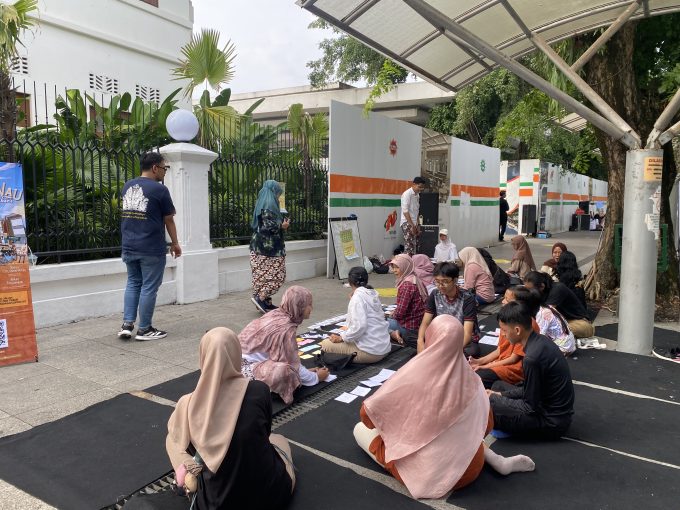
The Javanese Language, Literature, and Culture Study Program of the Faculty of Cultural Sciences, Universitas Gadjah Mada, collaborated with the Yogyakarta City Cultural Office in the regular program “Setu Sinau” or “Saturday Learning,” held at the Malioboro pedestrian area on Saturday, May 16, 2026. This activity became one of the efforts to preserve Javanese culture through educational and interactive approaches for the wider community.
“Setu Sinau” is a regular program organized by the Yogyakarta City Cultural Office aimed at introducing Javanese culture to the public. Various cultural activities were presented, including learning Javanese script, traditional dance, drawing, ngadi busana or traditional Javanese attire, traditional children’s games, and playing gamelan. The participation of the Javanese Language, Literature, and Culture Study Program of FIB UGM in this program represented a tangible contribution of higher education institutions in supporting cultural preservation and strengthening local literacy in public spaces.
On this occasion, the Javanese Language, Literature, and Culture Study Program conducted the “Sinau Aksara Jawa” session. Around 15 participants joined the activity after registering through the link that had previously been distributed. In addition, several visitors in Malioboro enthusiastically joined the session on the spot because they were interested in learning how to write Javanese script.
The session began with an introduction to the Javanese script from ꦲ to ꦜ, followed by an explanation of sandhangan as sound markers, such as ꦶ for the vowel sound “i,” ꦸ for “u,” ꦺ for “e,” and ꦺꦴ for “o.” Since the session focused on basic introduction, the material on pasangan (conjunct forms) was not yet discussed.
The atmosphere during Sinau Aksara was lively and engaging. Participants not only learned the theory but were also invited to play while learning through Javanese script card games. The instructors mentioned certain words, and participants were asked to arrange the script cards according to the spoken words. In addition, participants practiced writing words and simple sentences directly using Javanese script. This interactive method helped participants understand the material more easily while enjoying the learning process in a fun way.
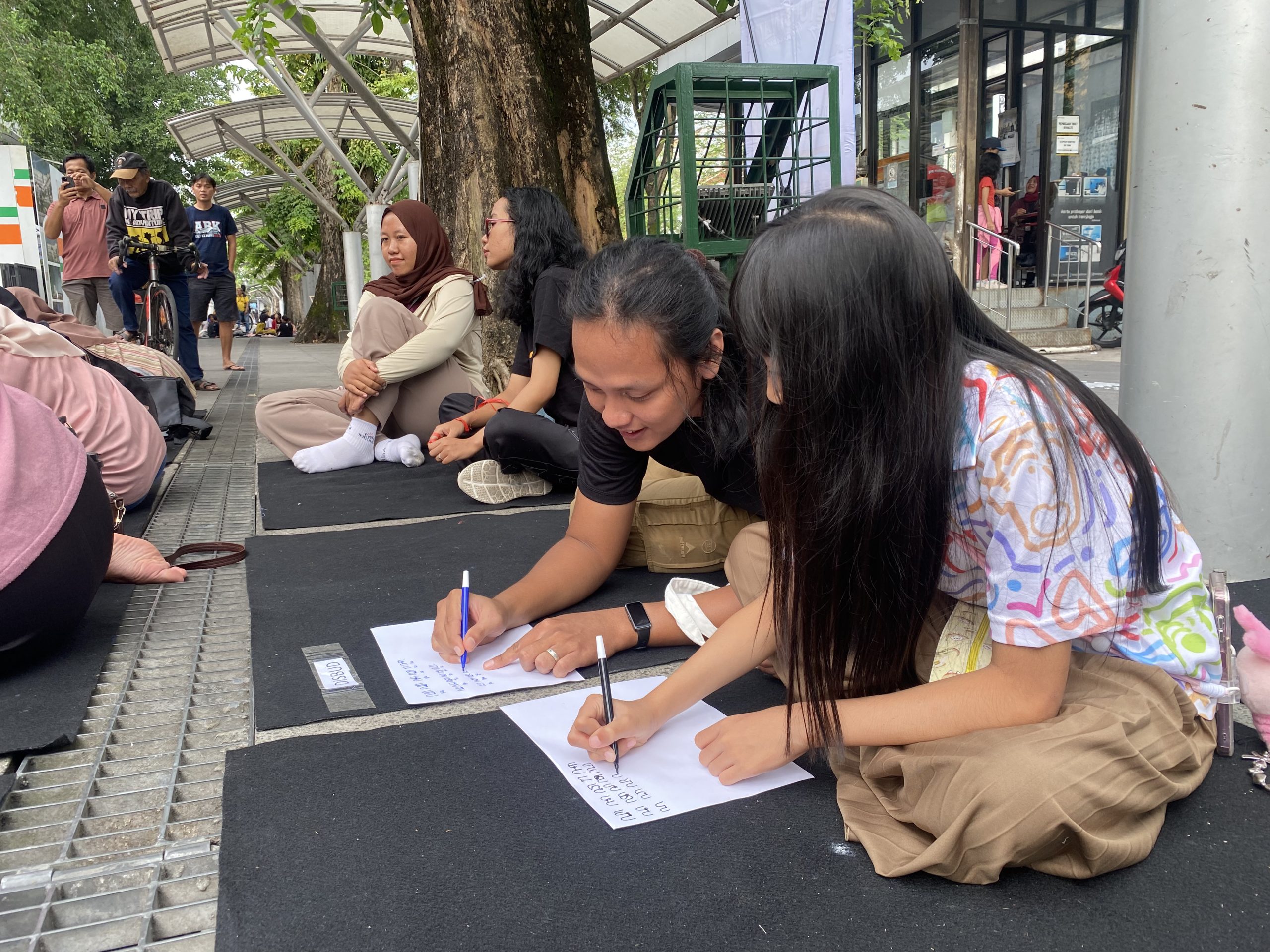
One of the participants, Mrs. Sahnaz, who attended with her sons, stated that this activity served as a positive alternative to reduce children’s dependence on gadgets. According to her, the program provided an experience of “playing while learning” Javanese culture directly. Meanwhile, Mrs. Lestari, who came all the way from Muntilan, expressed her interest in learning teaching methods for introducing Javanese script to beginner children. She found the card method used in the session very effective and enjoyable. Several participants from outside Java also mentioned that the activity was a fascinating new experience because they could directly try writing Javanese script.
The event concluded with the distribution of books from the Yogyakarta City Cultural Office and small souvenirs from the Javanese Language, Literature, and Culture Study Program of FIB UGM to all participants. This collaboration reflected a shared commitment to preserving local cultural sustainability while also supporting the Sustainable Development Goals (SDGs), particularly SDG 4 on Quality Education through inclusive and enjoyable cultural education, and SDG 11 on Sustainable Cities and Communities through the preservation of cultural heritage in Yogyakarta’s public spaces.
Through activities such as Setu Sinau, Javanese culture is not only introduced as a cultural heritage of the past but is also revitalized as a meaningful part of contemporary community life.
Literacy Greetings, Script Greetings.
Aksara Team
Javanese Language, Literature, and Culture Study Program
Faculty of Cultural Sciences, Universitas Gadjah Mada
(Arsanti, Zakaria, Ghibran, Dian, Bayu, Maysa)
Editor: Public Relations of FIB UGM, Alma Syahwalani
