• About UGM
  • Academic Portal
  • IT Center
  • Library
  • Research
  • Webmail
  • Informasi Publik
  • English
    • Indonesia
Universitas Gadjah Mada Faculty of Cultural Sciences
Universitas Gadjah Mada
  • Home
  • Profile
    • History
    • Vision and Mission
    • Organizational structure
    • Administration
    • Staff
    • Faculty Members
  • Academic
    • Academic Calendar
    • Undergraduate Programs
      • Bachelor of Cultural Antrophology
      • Bachelor in Archaeolagy
      • Bachelor in History
      • Bachelor in Tourism
      • Bochetor in Korean Language and Culture
      • Bachelor in Indonesian Language and Culture
      • Bachelor in English
      • Bachelor in Arabic
      • Bachelor in Japanese Language and Culture
      • Bachelor in Javanese Language, Literature and Culture
      • Bachelor in French language and literature
    • Graduate Programs
      • Master in Antrophology
      • Master in ArchaeoIogy
      • Master in History
      • Master in Linguistics
      • Master in Literature
      • Master In American Studies
      • Master in Middle Eastern Cultural Studies
    • Post-Graduate Programs / S3
      • Doctor in Antropology
      • Doctor in American Studies
      • Doctor in Humanities
    • Student Service
  • KPPM
    • Research Information
    • Scientific / Academic Publications
    • Community Service
    • International Cooperation
    • Domestic Cooperation
  • Student Organizations
    • Student Executive Council
    • Semi-Autonomous Organizations
      • KAPALASASTRA
      • Christian Student Alliance
      • LINCAK
      • Saskine
      • Catholic Student Family
      • Dian Budaya
      • Sastra Kanuragan (sasgan)
      • Family of Muslim Cultural Sciences Students (KMIB)
      • Bejo Mulyo
    • Autonomous Organizations
      • Family of Anthropology Students (KEMANT)
      • English Department Student Association
      • Tourism Students Association (HIMAPA)
      • Family of Indonesian Literature Students (KMSI)
      • West Asian Literature Student Association (IMABA)
      • Association of Korean-Language Students (HIMAHARA)
      • Family of Regional Indonesian Literatures Students (KAMASUTRA)
      • The Family Body of History Students (BKMS)
      • The French Literature Students Association (HMSP)
      • Family of Anthropology Students
      • Japanese Student Association (HIMAJE)
  • Admission
    • Student Evaluation
  • Home
  • HEADLINES
  • Exploring the Philosophy of Ketupat: FIB UGM Holds Syawalan and Halalbihalal Event

Exploring the Philosophy of Ketupat: FIB UGM Holds Syawalan and Halalbihalal Event

  • HEADLINES, News Release
  • 2 April 2026, 10.46
  • Oleh: Humas FIB
  • 0

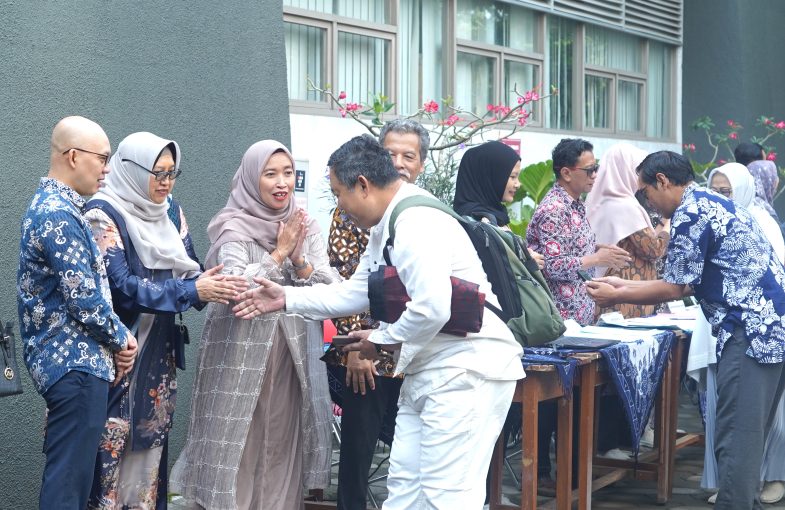
Yogyakarta, March 31, 2026 – The Faculty of Cultural Sciences at Universitas Gadjah Mada (FIB UGM) organized a Syawalan and Halalbihalal event to strengthen the bonds of kinship among the campus community. Various elements of the academic community, including lecturers and educational staff, both active and retired, participated in this Syawalan. The event was filled with various religious and cultural agendas that carried the spirit of togetherness following the fasting month.

The event began with the recitation of the Holy Quran by a student representative from the Arabic Literature Study Program. It was then followed by opening remarks from the Dean of the Faculty of Cultural Sciences. On this occasion, he invited all faculty members and invited guests to forgive one another to cleanse their hearts and begin a better new chapter.

The main agenda of this commemoration was the delivery of the Syawalan reflection by Professor Dr. Sangidu, M.Hum. He highlighted the history behind the use of the term halalbihalal, which has become a strong tradition for the Indonesian people every time they celebrate Eid al-Fitr. He also explained the symbolic meaning of ketupat through the approach of linguistic philosophy.

“The use of the word halalbihalal during Eid al-Fitr originated from President Soekarno’s request for advice and opinions from KH. Wahab regarding the unhealthy political conditions at that time. KH. Wahab suggested organizing a gathering for silaturahim. However, Soekarno refused because the term was considered too common,” explained Professor Sangidu as he shared his knowledge with the attendees.

In Professor Sangidu’s explanation, the word halalbihalal was proposed as an alternative to the word silaturahmi. History records that this term was born in the middle of Ramadan in 1948 when President Soekarno asked for advice from KH. Wahab Chasbullah to ease national political tensions. KH. Wahab initially proposed a silaturahmi event ahead of Eid al-Fitr, but Bung Karno wanted a fresher designation. KH. Wahab then coined the name halalbihalal, reasoning that political elites who blamed each other had committed sins or forbidden (haram) acts. Therefore, they needed to sit at the same table to forgive each other and “make halal” (resolve) the hostility.

In another explanation, Professor Sangidu also touched upon the philosophy of ketupat, which has become a signature Eid dish. Etymologically, the term “ketupat” or “kupat” is rooted in a Javanese phrase, namely ngaku lepat. This generational phrase literally means admitting one’s mistakes.

The philosophy of ngaku lepat carries a moral message that is highly relevant to the celebration of Eid al-Fitr. The presence of ketupat serves as a reminder medium for Muslims to be magnanimous and cast aside their respective egos. Every individual is encouraged to be brave enough to admit the mistakes they have made toward their fellow human beings.

The series of activities concluded with a prayer recitation session. This closing session was led by Dr. Nur Kholid, M.Pd. to pray for goodness, safety, and blessings for everyone in attendance.

This kind of tradition of forgiving each other and gathering together plays an important role in strengthening social harmony within the academic environment. A harmonious and respectful relationship between individuals is the main foundation for building a peaceful, inclusive, and resilient campus community to support collective well-being in the future.

[Public Relations of FIB UGM, Candra Solihin]

Tags: FIB UGM SDGs 16: Peace Justice and Strong Institution UGM Yogyakarta

Video UGM

[shtmlslider name='shslider_options']
Universitas Gadjah Mada

Faculty of Cultural Sciences
Universitas Gadjah Mada
Jl. Nusantara 1, Bulaksumur Yogyakarta 55281, Indonesia
   fib@ugm.ac.id
   +62 (274) 513096
   +62 (274) 550451

Work Units

  • Office of Journal & Publishing
  • INCULS
  • Information Technology and Database
  • Language Learning Center
  • Library Unit
  • Public Relations
  • Research

Facilities

  • Computer Laboratory
  • Gamelan
  • Guest House
  • Language Library
  • Library
  • Phonetics Library
  • Self Access Unit
  • Student Internet Centre

Importan Links

  • Journal of Humaniora
  • Subscriber Journal
  • Alumni Portal
  • Career
  • Departmens News
  • UGM Streaming

Contacts

  • Academic
  • Administration
  • Dean’s Office
  • Departments / Study Programs
  • Public Relations

© 2024 Faculty of Cultural Sciences Universitas Gadjah Mada

KEBIJAKAN PRIVASI/PRIVACY POLICY

[EN] We use cookies to help our viewer get the best experience on our website. -- [ID] Kami menggunakan cookie untuk membantu pengunjung kami mendapatkan pengalaman terbaik di situs web kami.I Agree / Saya Setuju