• About UGM
  • Academic Portal
  • IT Center
  • Library
  • Research
  • Webmail
  • Informasi Publik
  • English
    • Indonesia
Universitas Gadjah Mada Faculty of Cultural Sciences
Universitas Gadjah Mada
  • Home
  • Profile
    • History
    • Vision and Mission
    • Organizational structure
    • Administration
    • Staff
    • Faculty Members
  • Academic
    • Academic Calendar
    • Undergraduate Programs
      • Bachelor of Cultural Antrophology
      • Bachelor in Archaeolagy
      • Bachelor in History
      • Bachelor in Tourism
      • Bochetor in Korean Language and Culture
      • Bachelor in Indonesian Language and Culture
      • Bachelor in English
      • Bachelor in Arabic
      • Bachelor in Japanese Language and Culture
      • Bachelor in Javanese Language, Literature and Culture
      • Bachelor in French language and literature
    • Graduate Programs
      • Master in Antrophology
      • Master in ArchaeoIogy
      • Master in History
      • Master in Linguistics
      • Master in Literature
      • Master In American Studies
      • Master in Middle Eastern Cultural Studies
    • Post-Graduate Programs / S3
      • Doctor in Antropology
      • Doctor in American Studies
      • Doctor in Humanities
    • Student Service
  • KPPM
    • Research Information
    • Scientific / Academic Publications
    • Community Service
    • International Cooperation
    • Domestic Cooperation
  • Student Organizations
    • Student Executive Council
    • Semi-Autonomous Organizations
      • KAPALASASTRA
      • Christian Student Alliance
      • LINCAK
      • Saskine
      • Catholic Student Family
      • Dian Budaya
      • Sastra Kanuragan (sasgan)
      • Family of Muslim Cultural Sciences Students (KMIB)
      • Bejo Mulyo
    • Autonomous Organizations
      • Family of Anthropology Students (KEMANT)
      • English Department Student Association
      • Tourism Students Association (HIMAPA)
      • Family of Indonesian Literature Students (KMSI)
      • West Asian Literature Student Association (IMABA)
      • Association of Korean-Language Students (HIMAHARA)
      • Family of Regional Indonesian Literatures Students (KAMASUTRA)
      • The Family Body of History Students (BKMS)
      • The French Literature Students Association (HMSP)
      • Family of Anthropology Students
      • Japanese Student Association (HIMAJE)
  • Admission
    • Student Evaluation
  • Home
  • 2025
  • page. 16
Arsip:

2025

Workshop on Wayang Golek Menak: Preserving the Existence of Art, Literature, and History through Media Transfer

HEADLINESNews Release Friday, 7 November 2025

Yogyakarta, November 29, 2025 — The Department of Javanese Language, Literature, and Culture, Faculty of Cultural Sciences, Gadjah Mada University (FIB UGM), held an event titled “Dari Kertas Naik ke Pentas: Workshop Alih Wahana Epos Jawa-Islam dari Teks Sastra ke Lakon Pertunjukan” [From Paper to Stage: Workshop on Adapting Javanese-Islamic Epics from Literary Texts to Performance Play] in the Gamelan Room, Margono Building, 4th floor of FIB UGM. This public event attracted participants from various backgrounds, including students, academics, arts and culture enthusiasts, and the general public.

This workshop served as a cross-disciplinary discussion forum that combined perspectives from literature, history, and performing arts, particularly in the context of Menak puppet theater, a cultural heritage that represents a fusion of Islamic values, Javanese traditions, and puppet theater arts. Three speakers were present at this event, namely Dr. Drs. Sudibyo, M.Hum. (Head of the Department of Language and Literature, FIB UGM), Kusnanta Riwus Ginanjar, S.Sn. (actor, scriptwriter, director, and Menak puppet show puppeteer), and Rinal Khaidar Ali, ST., M.Eng. (Menak puppet show activist). The event was moderated by Dr. Rudy Wiratama, S.I.P., M.A., lecturer at the Javanese Language, Literature, and Culture Study Program.
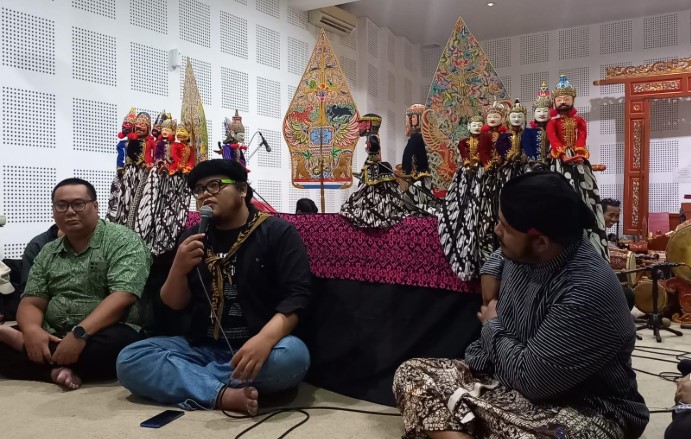
The first presentation was delivered by Kusnanta Riwus Ginanjar, S.Sn. He discussed the existence of Menak puppet theater from an artistic perspective and its function as a learning medium. In addition, Kusnanta emphasized the importance of adapting classical literary works so that they do not remain merely as written texts. This is done so that these works can continue to be preserved and known to the wider community.
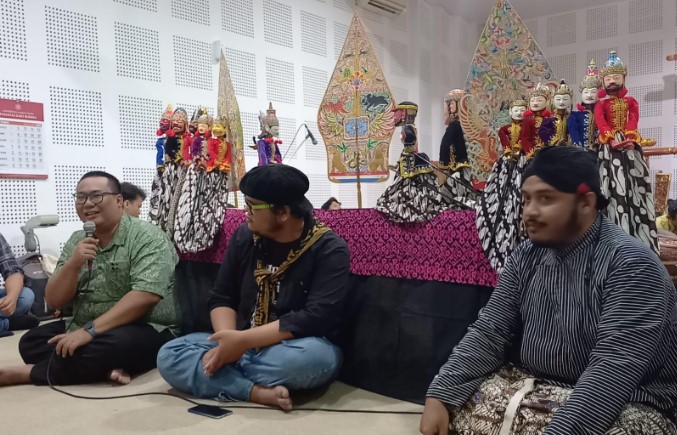
The second speaker, Rinal Khaidar Ali, ST., M.Eng., highlighted the current condition of Menak puppet theater in Indonesia, particularly in the Java region. He said that its existence is currently in decline. “There are no longer any Menak puppet craftsmen in Yogyakarta, located in the Sentolo area. Even in Kebumen, their numbers are dwindling,” he explained.
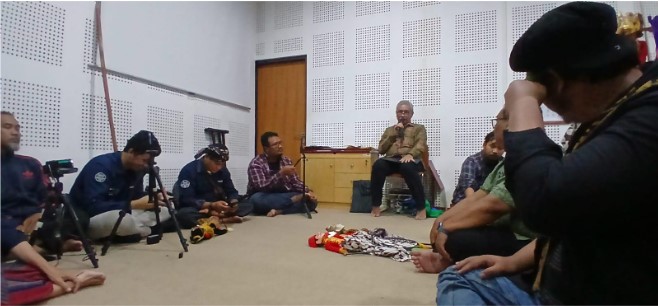
The third session was presented by Dr. Sudibyo, M.Hum., who discussed the historical dimensions of the Menak story. He explained that the Menak epic originated in Persia based on the heroic story of Amir Hamzah bin Abdul Muthalib, the uncle of the Prophet Muhammad. The story then spread to the Arab and Malay worlds before finally being adapted into Javanese culture. Later, during the Mataram Kartasura Sultanate, this story was rewritten in Javanese by carik Narawita and then updated by the poet Yasadipura. According to him, this adaptation process was not merely a translation, but also a creative form of cultural contextualization with the addition of interludes.

To conclude, this event featured a Menak golek puppet show entitled “Menak Iskandar” by Dr. Rudy Wiratama, S.I.P., M.A. The story is sourced from Serat Iskandar Jawi or Caritanira Iskandar, which was composed at the Kartasura Palace in 1729 AD by order of Kangjeng Ratu Mas Balitar, the queen consort of Pakubuwana I.
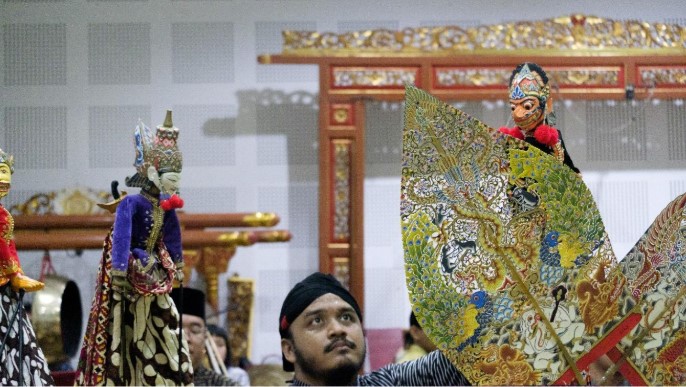
The story tells of the journey of Prabu Iskandar Zulkarnain, King of Ngerum, in his efforts to conquer the eastern and western worlds in order to spread the teachings of the Prophet Ibrahim. However, his struggle was hindered by King Ubur of Jabarsah and the army of giant worshippers Ya’juj and Ma’juj. Based on the advice of Prophet Kilir, Iskandar built a great wall that enclosed Ja-Makjuja until the end of time. Nevertheless, Iskandar was still worried that Ja-Makjuja would escape one day. He asked Prophet Kilir for the elixir of life. Prophet Kilir then departed for the land of Lulmat in the country of Jaminambar, where a lake called Ma’ul Hayat was located. Next, Prophet Kilir drank the water, performed ablution, and prayed at the edge of the lake. After finishing his prayers, by God’s will, Prophet Kilir gained immortality without having the chance to give the water to Iskandar. Iskandar, who was waiting for Prophet Kilir at the cave entrance, then realized that no power is eternal except that of Allah. He returned to the kingdom of Ngerum with his entire army.

This workshop is a tangible manifestation of academic and cultural efforts to revive Menak puppet theater as a literary and performing arts heritage in Indonesia. Through this activity, it is hoped that cross-disciplinary awareness can be built regarding the importance of preserving traditions while developing new forms that are relevant to the present day. Furthermore, the synergy between academics, artists, and the community is expected to continue to be encouraged so that Menak puppet theater art and literature remain a source of inspiration, cultural identity, and a living educational tool within the community.

Author : Haryo Untoro
Editor : Haryo Untoro

UGM Arabic Students Develop Personal Branding through Digital Content Creation in the Tenth Entrepreneurship Class

News Release Friday, 7 November 2025

Yogyakarta, November 3, 2025 – The Arabic Study Program, Faculty of Cultural Sciences, Universitas Gadjah Mada, continued its tenth session of the Entrepreneurship course with the theme “Optimizing Digital Potential in Business Development.” This session built upon the previous meeting’s topic, focusing on the use of digital media for business promotion but with a more practical and creative approach through a review of student group assignments.

In this meeting, lecturer and guest speaker Reisa Nurma Boruregar, S.S., centered the discussion on reviewing students’ creative video projects that illustrated their personal five-year life plans. Through this assignment, students were encouraged to project their future goals—such as graduation targets, plans for pursuing a master’s degree, or professional career aspirations—and transform these ideas into engaging and innovative visual content.

The assignment aimed to train students in building personal branding and self-promotion through digital media, aligning with the current professional landscape that values online presence and digital identity. Each group presented their video projects in class and received direct feedback from Reisa and their peers on aspects such as visual presentation, narrative flow, and communication strategy.

Through this tenth session, Arabic Literature students gained deeper insights into digital promotion strategies while applying them in a personal and reflective context. This project-based learning approach also demonstrated that the Entrepreneurship course in Arabic Literature UGM goes beyond theory, emphasizing hands-on creativity and digital literacy as essential skills for modern graduates.

The course also contributes to the advancement of the Sustainable Development Goals (SDGs), particularly SDG 4 (Quality Education) by fostering practical, 21st-century skill-based learning; SDG 8 (Decent Work and Economic Growth) by preparing students to thrive in creative and digital industries; and SDG 9 (Industry, Innovation, and Infrastructure) by promoting the use of technology and innovation in sustainable self-development and entrepreneurship.

[Arabic Literature, Muhammad Ardiansyah]

Students of the Javanese Language, Literature, and Culture Study Program Attend FGD on Mapping Ancient Manuscripts at the Salatiga City Library and Archives Office

News Release Wednesday, 5 November 2025

Yogyakarta, November, 4, 2025 – Students from the Javanese Language, Literature, and Culture Study Program participated in a Focus Group Discussion (FGD) on mapping ancient manuscripts organized by the Library and Archives Office (Dinpersip) of Salatiga City, Central Java, on Tuesday, October 28, 2025. The event took place in the Regional Secretariat room of the Salatiga City Library and Archives Office. The students were accompanied by their supervising lecturer, Yosephin Apriastuti Rahayu, S.S., M.Hum., a lecturer in the Javanese Language, Literature, and Culture Study Program who specializes in philology. 

The event began with an opening and remarks from the Mayor of Salatiga and the Head of the Library and Archives Office. In her remarks, the Head of the Library and Archives Office of Salatiga City, Sri Sarwanti, S.H., M.Si., said that there were 37 ancient manuscripts in the Salatiga area. Of these, five manuscripts have been transcribed and translated. All manuscript data has been digitized and stored in the Khastara system owned by the National Library of the Republic of Indonesia or Perpusnas.

The event was interspersed with macapat songs and continued with a presentation on the mapping and preservation of ancient manuscripts, especially those still stored in communities or non-institutions.

One of the interesting points was presented by Dr. Munawar Holil, S.S., M.Hum., a lecturer in philology from the Regional Literature Study Program for Javanese Literature, University of Indonesia. He provided information about the discovery of a manuscript containing the story of Sri Tanjung, with a different version of the story compared to the popular one. This manuscript was found by residents at an antique market.

This FGD activity was enthusiastically welcomed by the students. In an interview on November 4, 2025, one of the participants, Novia Hikmatul Mubarokah, said that this activity provided valuable experience regarding the process of archiving manuscripts. “I feel very happy and interested, because the FGD discussed ancient manuscripts from the city of Salatiga that have been documented by the archives office,” she said.

Mapping ancient manuscripts is considered an important step in preserving the nation’s cultural and intellectual heritage. Manuscripts are not only traces of culture, but also reflect the civilization of the archipelago, containing values, ideas, literary works, and religious knowledge from the past.

The participation of students from the Javanese Language, Literature, and Culture Study Program in this activity is expected to motivate the younger generation to continue preserving manuscripts, exploring the information contained within them, and developing this knowledge so that it can be useful to society. In addition, cooperation between various parties, from the government, academics, communities, to the public, is expected to continue as an effort to care for and preserve the cultural heritage of the Indonesian nation.

FIB UGM Participates in the Baseline Survey of the CDCSUI Project for Plant Biodiversity Conservation in Indonesia

News Release Wednesday, 5 November 2025

Yogyakarta, November 4, 2025 — The Faculty of Cultural Sciences (FIB) of Universitas Gadjah Mada received a request from the Center for Agricultural Biotechnology and Genetic Resources Assembly and Modernization (BRMP Biogen) to hold a discussion regarding the implementation of the Baseline Survey of the Crop Diversity Conservation for Sustainable Use in Indonesia (CDCSUI) in Central Java Province.

This survey is part of the GEF-7 Crop Diversity Conservation for Sustainable Use in Indonesia (CDCSUI) project, which aims to strengthen the conservation and sustainable utilization of Indonesia’s plant genetic resources, both in the wild and on agricultural lands. The project focuses on five key commodities: rice, cassava, taro, nutmeg, and clove.

The survey involves collecting baseline data on conservation conditions, local practices, and traditional knowledge related to these crops. In addition, the activity assesses policy aspects, value chains, and the roles of indigenous peoples and gender in the management of agricultural genetic resources.

The activities in Central Java Province were scheduled for October 27–31, 2025, with a discussion session between project representatives—Component 1 and 4 of CDCSUI, the Project Management Unit (PMU), BRMP Central Java, and FIB UGM—held on Wednesday, October 28, 2025, from 09.00 to 12.00 WIB.

FIB UGM’s involvement focuses on exploring aspects of traditional knowledge, gender, and indigenous communities, which play a vital role in plant genetic resource conservation and the strengthening of sustainable food systems.

This initiative supports sustainable development goals by enhancing the resilience of community food systems against climate change, preserving terrestrial biodiversity, and promoting environmentally friendly cultural practices. Moreover, the survey highlights the importance of empowering women and indigenous groups in natural resource management, recognizing their role in preserving traditional knowledge and maintaining local food security.

Through collaboration between research institutions and academic entities, this activity represents a concrete step toward ensuring that plant conservation efforts go beyond scientific and economic dimensions—integrating social and cultural perspectives that form the foundation of sustainability in Indonesia.

[Public Relations Office, FIB UGM – Alma Syahwalani]

Two Students from Arabic Study Program UGM Advance to the Semifinal Round of the Al-Istiqama International Arabic Public Speaking Competition 2025

HEADLINESNews ReleaseStudent's Activity Tuesday, 4 November 2025

Yogyakarta, October 24, 2025 – Two students from the Arabic Study Program, Faculty of Cultural Sciences, Universitas Gadjah Mada (UGM) — Sultan Amirul Muttaqin and Jibriel Sayyid Ishaq — have successfully advanced to the semifinal round of the Al-Istiqama International Arabic Public Speaking Competition 2025. They are two of only 17 participants selected from various countries who made it through after an intense and highly competitive preliminary stage.

In the semifinal round, the competition continues to be held online, with participants required to submit a new video speech addressing a different theme from the previous round. This stage serves as a crucial opportunity for Sultan and Jibriel to demonstrate their analytical depth, creative thinking, and contextual argumentation skills on pressing global issues.

The Arabic Study Program continues to provide comprehensive support for Sultan and Jibriel during this phase, including guidance in speechwriting, training in articulation, intonation, and body language, as well as assistance with video recording and editing. This ongoing support reflects the program’s strong commitment to nurturing students’ linguistic, rhetorical, and cultural competencies on the international stage.

Sultan and Jibriel’s participation in this competition also exemplifies the Arabic Study Program’s contribution to advancing the Sustainable Development Goals (SDGs) — particularly SDG 4 (Quality Education), SDG 16 (Peace, Justice, and Strong Institutions), and SDG 17 (Partnerships for the Goals). Their success not only brings pride to the university but also serves as an inspiration for fellow Arabic Literature students to continue developing their potential, engaging in international arenas, and representing Indonesia through language, intellect, and culture.


Author: Muhammad Ardiansyah

1…1415161718…84

Video UGM

[shtmlslider name='shslider_options']
Universitas Gadjah Mada

Faculty of Cultural Sciences
Universitas Gadjah Mada
Jl. Nusantara 1, Bulaksumur Yogyakarta 55281, Indonesia
   fib@ugm.ac.id
   +62 (274) 513096
   +62 (274) 550451

Work Units

  • Office of Journal & Publishing
  • INCULS
  • Information Technology and Database
  • Language Learning Center
  • Library Unit
  • Public Relations
  • Research

Facilities

  • Computer Laboratory
  • Gamelan
  • Guest House
  • Language Library
  • Library
  • Phonetics Library
  • Self Access Unit
  • Student Internet Centre

Importan Links

  • Journal of Humaniora
  • Subscriber Journal
  • Alumni Portal
  • Career
  • Departmens News
  • UGM Streaming

Contacts

  • Academic
  • Administration
  • Dean’s Office
  • Departments / Study Programs
  • Public Relations

© 2024 Faculty of Cultural Sciences Universitas Gadjah Mada

KEBIJAKAN PRIVASI/PRIVACY POLICY

[EN] We use cookies to help our viewer get the best experience on our website. -- [ID] Kami menggunakan cookie untuk membantu pengunjung kami mendapatkan pengalaman terbaik di situs web kami.I Agree / Saya Setuju