
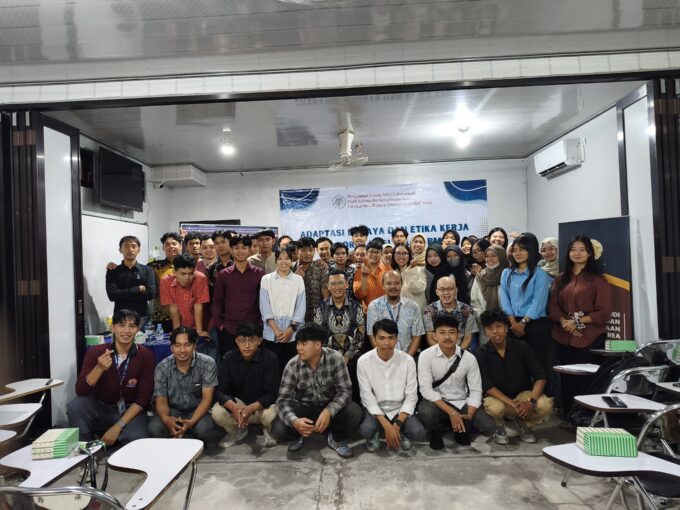
Yogyakarta – June 27, 2026 – In order to realize Universitas Gadjah Mada’s commitment to serving the interests of the nation and humanity, the Korean Language and Cultural Studies Program, Faculty of Cultural Sciences, consistently supports the efforts of the government and society in achieving a more prosperous and equitable social order. Therefore, to this day, the UGM Korean Language and Cultural Studies Program continues to proactively play a role as a strategic partner to the government in ensuring the success of flagship government programs, especially those related to improving the quality of human resources for prospective Indonesian Migrant Workers (PMI) who will work in South Korea.
Previously, together with the management of LPK Bina Insani MTC and the head of PELBAKORI (Association of Korean Language Training Institutions in Indonesia), a mapping of the problems generally faced by PMIs in Korea was conducted. It was found that despite having sufficient Korean language proficiency, upon arriving in Korea, many of them experienced difficulties in adapting. These problems are not only caused by language barriers but also by a lack of understanding of Korean social and cultural matters. This condition often leads to culture shock, communication misunderstandings, and even impacts work performance and the continuity of the PMIs’ employment contracts in Korea.
Against this background, on Saturday, June 27, 2026, a Community Service (PkM) program entitled “Workshop on Cultural Adaptation and Work Ethics in Korea for Prospective PMIs to Korea” was held at LPK Bina Insani MTC, Yogyakarta. The workshop, attended by 60 prospective PMIs to Korea and LPK instructors, involved five lecturers from the study program as speakers: Achmad Rio Dessiar, B.A., M.A., Ph.D., Suray Agung Nugroho, S.S., M.A., Ph.D., Yuliawati Dwi Widyaningrum, S.S., M.A., Sri Wahyuningsih, S.S., M.A., and Andri Saefudin, B.A., M.A.
In the first session, Suray Agung Nugroho, S.S., M.A., Ph.D. discussed “The Key to Success in Korea is Not Only Working Hard, but Working Smart by Understanding the Culture and Maintaining Personal Dignity”. Then, in the second session, Andri Saefudin, B.A., M.A. presented on “Essential Knowledge for PMIs in South Korea: Rights, Obligations, and Everyday Rules”. This was followed by an interactive discussion between the participants and all attending lecturers.
Through this workshop, it is hoped that all participants will gain a more comprehensive understanding of Korean work culture, including the fast-paced work characteristic (pali-pali), the hierarchical system, workplace communication ethics, the rights and obligations of PMIs, as well as the ability to adapt to the social and physical environment in Korea. This Community Service serves as tangible proof that the Korean Language and Cultural Studies Program, Faculty of Cultural Sciences, UGM, does not merely act as a provider of formal education on Korean Studies, but also directly participates in providing solutions to real problems faced by society.
Translation by Alma Naya Kamila
