
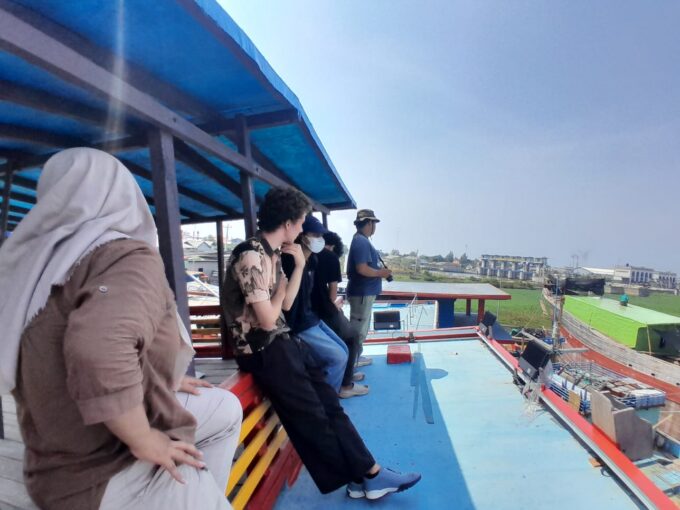
On Saturday, October 17, 2026, the Department of Cultural Anthropology
organized a fieldwork trip to Wonokerto, Pekalongan, as part of an effort to apply in
practice the theories discussed in class. Participants in this fieldwork included
undergraduate students in Cultural Anthropology taking the course “Maritime
Anthropology,” taught by Dr. Des Christy, and graduate students in Cultural
Anthropology taking the course “Rhetoric of Development,” taught by Prof. Pujo Semedi
Hargo Yuwono, along with a guest lecturer from UIN Pekalongan, Mochammad Najmul
Afad. The fieldwork activity was organized by selecting destinations for the participants
to visit that aligned with the learning objectives set in class.
That morning, while having breakfast, participants were not only provided with
logistical support but also attended a general lecture as part of their exposure to local
knowledge, featuring a local village official who explained the context of Wonokerto
Kulon. Mr. Jodi, a village official, explained several fundamental aspects of the area,
such as its social, cultural, economic, and ecological contexts from the perspective of
coastal life. One of the points Mr. Jodi emphasized most was the tidal flooding that
continues to affect Wonokerto, which in turn impacts the social and economic contexts
of the surrounding community.
The class continued with a visit to the Wonokerto Fish Auction Site. There, the
students directly observed the process by which fishermen auctioned their catch. Dr.
Des Christy, a professor of Maritime Anthropology, gave the students the freedom to
gather data during the assignment, with the goal of producing a descriptive account of
community life. The students employed various approaches, such as participant
observation, interviews, and ethno-photography. For two hours, the students and faculty closely observed the fish auction activities before finally taking their leave to head to the next destination.
The next destination in the series of fieldwork activities was a visit to the
shipyard—an area where ships are “parked” while they are out of service or serving as
a waiting area for vessels preparing to set sail. At the shipyard, students from both the
Maritime Anthropology and Development Rhetoric courses had the primary objective of
exploring the personal lives of the fishermen. The students were allowed to explore the
boats lined up in the parking area, which included various types ranging from
small-scale fishing vessels to large-scale ones. In between exploring the vessels and
interacting with the fishermen, students and faculty were treated to smoked stingray and vegetables, specially prepared by local residents.
The final leg of the fieldwork took place during a brief stop at the Setono Batik Market
area. The students were invited to explore the market area while viewing Pekalongan’s
signature batik fabrics, which embody a strong sense of local identity. Not only were
they invited to explore, but some students also purchased goods from batik artisans as
a form of support for Pekalongan’s batik UMKM community. Purchasing batik also
serves as a means of passing on cultural heritage to younger generations. With a
deeper understanding of batik, this traditional Pekalongan fabric holds its own
significance within the broader cultural landscape. Shopping and browsing for unique
Pekalongan souvenirs brought the entire series of trips and fieldwork conducted by the
students and faculty members to a close, leaving them with many experiences and
joyful memories from every encounter, as well as the coastal ambiance that will shape
their future academic journeys.
Author: Danumurti
Editor: Leonard Dimas
