• About UGM
  • Academic Portal
  • IT Center
  • Library
  • Research
  • Webmail
  • Informasi Publik
  • English
    • Indonesia
Universitas Gadjah Mada Faculty of Cultural Sciences
Universitas Gadjah Mada
  • Home
  • Profile
    • History
    • Vision and Mission
    • Organizational structure
    • Administration
    • Staff
    • Faculty Members
  • Academic
    • Academic Calendar
    • Undergraduate Programs
      • Bachelor of Cultural Antrophology
      • Bachelor in Archaeolagy
      • Bachelor in History
      • Bachelor in Tourism
      • Bochetor in Korean Language and Culture
      • Bachelor in Indonesian Language and Culture
      • Bachelor in English
      • Bachelor in Arabic
      • Bachelor in Japanese Language and Culture
      • Bachelor in Javanese Language, Literature and Culture
      • Bachelor in French language and literature
    • Graduate Programs
      • Master in Antrophology
      • Master in ArchaeoIogy
      • Master in History
      • Master in Linguistics
      • Master in Literature
      • Master In American Studies
      • Master in Middle Eastern Cultural Studies
    • Post-Graduate Programs / S3
      • Doctor in Antropology
      • Doctor in American Studies
      • Doctor in Humanities
    • Student Service
  • KPPM
    • Research Information
    • Scientific / Academic Publications
    • Community Service
    • International Cooperation
    • Domestic Cooperation
  • Student Organizations
    • Student Executive Council
    • Semi-Autonomous Organizations
      • KAPALASASTRA
      • Christian Student Alliance
      • LINCAK
      • Saskine
      • Catholic Student Family
      • Dian Budaya
      • Sastra Kanuragan (sasgan)
      • Family of Muslim Cultural Sciences Students (KMIB)
      • Bejo Mulyo
    • Autonomous Organizations
      • Family of Anthropology Students (KEMANT)
      • English Department Student Association
      • Tourism Students Association (HIMAPA)
      • Family of Indonesian Literature Students (KMSI)
      • West Asian Literature Student Association (IMABA)
      • Association of Korean-Language Students (HIMAHARA)
      • Family of Regional Indonesian Literatures Students (KAMASUTRA)
      • The Family Body of History Students (BKMS)
      • The French Literature Students Association (HMSP)
      • Family of Anthropology Students
      • Japanese Student Association (HIMAJE)
  • Admission
    • Student Evaluation
  • Home
  • News Release
  • Transformation of Arabic Language Learning in the AI Era Highlighted in International Seminar

Transformation of Arabic Language Learning in the AI Era Highlighted in International Seminar

  • News Release
  • 20 May 2026, 14.38
  • Oleh: Humas FIB
  • 0

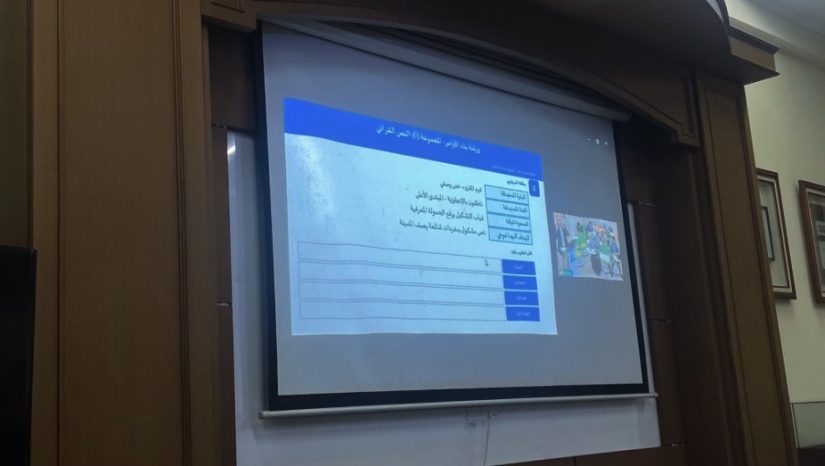
 Efforts to strengthen the integration of technology in Arabic language education were once again highlighted through an international seminar titled “Arabic Linguistic Analysis and Instructional Design.” Held virtually on Thursday, April 30, 2026, the seminar brought together educators, academics, and Arabic language practitioners from various countries. The event served as a discussion forum to explore the development of Arabic language teaching methods in the era of Artificial Intelligence (AI). Through this forum, participants were encouraged to understand the importance of utilizing technology in education while still maintaining scientific and pedagogical foundations in language learning.

Throughout the seminar, participants were introduced to a five-hour learning roadmap consisting of three main stages: theoretical reinforcement, hands-on practice, and professional development for educators. Through this approach, participants gained a broader understanding of how AI can be implemented effectively and sustainably in Arabic language learning. One of the main highlights of the seminar was the introduction of “Mubeen,” an AI model specifically designed for Arabic linguistic needs. Compared to general AI models, Mubeen is considered more capable of handling the complexities of the Arabic language, including accurate tashkil (diacritical marks), morphological structure analysis, and understanding cultural contexts embedded in Arabic usage.

In addition to the presentation sessions, the seminar also featured interactive activities where participants were directly involved in prompt engineering practices. During this session, participants created descriptive Arabic texts, which were later analyzed using the Pedagogical Judge (القاضي البيداغوجي) approach to evaluate their educational quality. The discussions became increasingly engaging, particularly when addressing the role of AI in education. Some participants viewed AI as a tool that could help educators reduce repetitive administrative and planning tasks. Others, however, expressed concerns that excessive reliance on AI could make the learning process overly mechanical. These differing perspectives enriched the discussion and broadened participants’ understanding of technology’s role as a supporting tool in education.

Although conducted virtually, participants remained highly enthusiastic throughout the seminar. This was reflected in the active question-and-answer sessions, discussions, and exchanges of experiences regarding the use of technology in Arabic language learning. As the seminar concluded, the event not only became a platform for sharing knowledge and insights, but also encouraged participants to commit to implementing the training outcomes in their respective institutions. Through this initiative, participants are expected to develop Arabic language teaching methods that are more innovative, adaptive, and relevant to technological advancements in the digital era.

Author : Indana Zulfa Maulida

Tags: Fakultas Ilmu Budaya UGM SDG 4: Quality Education SDGs 10: Berkurangnya kesenjangan SDGs 10: Reduced Inequalities SDGs 17: Kemitraan Untuk Mencapai Tujuan SDGs 17: Partnerships for the Goals SDGs 4 Pendidikan Berkualitas

Video UGM

[shtmlslider name='shslider_options']
Universitas Gadjah Mada

Faculty of Cultural Sciences
Universitas Gadjah Mada
Jl. Nusantara 1, Bulaksumur Yogyakarta 55281, Indonesia
   fib@ugm.ac.id
   +62 (274) 513096
   +62 (274) 550451

Work Units

  • Office of Journal & Publishing
  • INCULS
  • Information Technology and Database
  • Language Learning Center
  • Library Unit
  • Public Relations
  • Research

Facilities

  • Computer Laboratory
  • Gamelan
  • Guest House
  • Language Library
  • Library
  • Phonetics Library
  • Self Access Unit
  • Student Internet Centre

Importan Links

  • Journal of Humaniora
  • Subscriber Journal
  • Alumni Portal
  • Career
  • Departmens News
  • UGM Streaming

Contacts

  • Academic
  • Administration
  • Dean’s Office
  • Departments / Study Programs
  • Public Relations

© 2024 Faculty of Cultural Sciences Universitas Gadjah Mada

KEBIJAKAN PRIVASI/PRIVACY POLICY

[EN] We use cookies to help our viewer get the best experience on our website. -- [ID] Kami menggunakan cookie untuk membantu pengunjung kami mendapatkan pengalaman terbaik di situs web kami.I Agree / Saya Setuju