
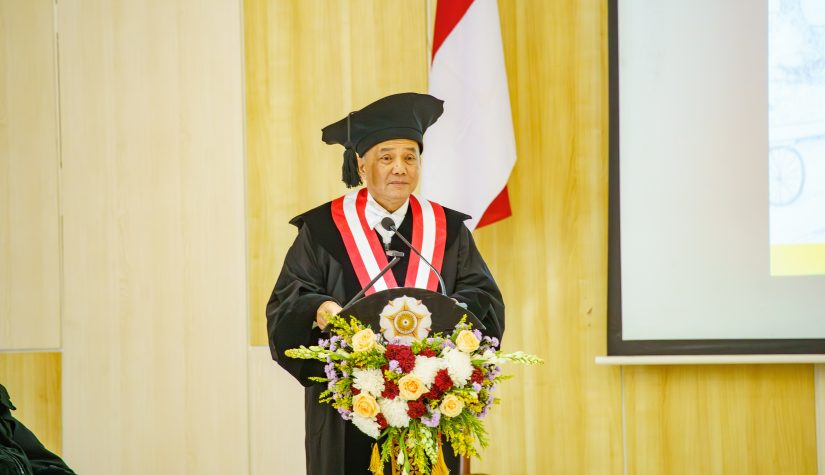
Yogyakarta, March 3, 2026 – The Head of the Department of Languages and Literature at the Faculty of Cultural Sciences, Universitas Gadjah Mada (FIB UGM), Professor Suhandano, highlighted the developments and challenges of language studies in the digital era. This scientific speech was delivered during the Open Senate Meeting commemorating the 80th Anniversary of the UGM Faculty of Cultural Sciences. In his address, he emphasized that linguistic studies possess a vast scope and significant potential to contribute to understanding various societal issues.
Professor Suhandano explained that contemporary language studies do not only focus on the internal structure of language but also on its relationship with various aspects of life. In micro-linguistics, research covers fields such as phonology, morphology, syntax, and semantics. Meanwhile, macro-linguistics examines language in connection with other disciplines, such as discourse analysis, sociolinguistics, neurolinguistics, anthropological linguistics, computational linguistics, and forensic linguistics.
According to Professor Suhandano, language as an object of study is dynamic and constantly evolves alongside societal changes. Consequently, perspectives in language study continue to expand as new issues emerge within social life.
He also touched upon the evolution of linguistic thought dating back to Ancient Greece. The philosopher Plato, for instance, questioned the relationship between words and the objects they name. From these thoughts, two distinct views emerged: one that perceives the relationship between words and objects as logical, and another that views it as arbitrary—formed through the consensus of the speech community.
Meanwhile, Aristotle viewed language as a tool for thought. He identified three main components in a proposition: onoma, rema, and logos, which in modern linguistic studies are equivalent to nouns, verbs, and sentences.
Professor Suhandano emphasized that language functions not only as a system of signs but also as a means to understand the world. “Language reflects how its speakers perceive the world and how they think about their surroundings,” he stated during the scientific speech.
This perspective opens opportunities for linguistic studies to contribute to various research themes relevant to societal needs. He cited that food security—a theme that might initially seem far removed from language studies—can actually be analyzed through a linguistic lens to understand how society perceives and discusses food.
To develop such studies, Professor Suhandano believes that cross-disciplinary collaboration is a vital step. “Linguistics needs to work hand-in-hand with other sciences to address these themes,” he noted.
On that occasion, he also highlighted the position of FIB UGM, which has long been recognized as a primary reference for the development of language studies in Indonesia. Numerous academic works produced by the faculty have become benchmarks in linguistic research, including M. Ramlan’s work on Indonesian morphology and syntax.
Interest in language studies at the faculty continues to grow. Students from various regions in Indonesia, and even from abroad, come to study linguistics with a diverse range of research topics.
As the faculty enters its 80th year, the construction of new buildings at FIB UGM is expected to support increasingly developing academic activities. With more adequate facilities, it is hoped that education, research, and community service activities can be carried out more optimally.
Amidst the rapid changes of the digital era, Professor Suhandano believes that language studies still hold great potential for growth. Through research and cross-disciplinary collaboration, linguistic studies are expected to provide meaningful contributions to understanding societal dynamics and encourage the development of knowledge that benefits collective life.
[Public Relations of FIB UGM, Candra Solihin]
