• About UGM
  • Academic Portal
  • IT Center
  • Library
  • Research
  • Webmail
  • Informasi Publik
  • English
    • Indonesia
Universitas Gadjah Mada Faculty of Cultural Sciences
Universitas Gadjah Mada
  • Home
  • Profile
    • History
    • Vision and Mission
    • Organizational structure
    • Administration
    • Staff
    • Faculty Members
  • Academic
    • Academic Calendar
    • Undergraduate Programs
      • Bachelor of Cultural Antrophology
      • Bachelor in Archaeolagy
      • Bachelor in History
      • Bachelor in Tourism
      • Bochetor in Korean Language and Culture
      • Bachelor in Indonesian Language and Culture
      • Bachelor in English
      • Bachelor in Arabic
      • Bachelor in Japanese Language and Culture
      • Bachelor in Javanese Language, Literature and Culture
      • Bachelor in French language and literature
    • Graduate Programs
      • Master in Antrophology
      • Master in ArchaeoIogy
      • Master in History
      • Master in Linguistics
      • Master in Literature
      • Master In American Studies
      • Master in Middle Eastern Cultural Studies
    • Post-Graduate Programs / S3
      • Doctor in Antropology
      • Doctor in American Studies
      • Doctor in Humanities
    • Student Service
  • KPPM
    • Research Information
    • Scientific / Academic Publications
    • Community Service
    • International Cooperation
    • Domestic Cooperation
  • Student Organizations
    • Student Executive Council
    • Semi-Autonomous Organizations
      • KAPALASASTRA
      • Christian Student Alliance
      • LINCAK
      • Saskine
      • Catholic Student Family
      • Dian Budaya
      • Sastra Kanuragan (sasgan)
      • Family of Muslim Cultural Sciences Students (KMIB)
      • Bejo Mulyo
    • Autonomous Organizations
      • Family of Anthropology Students (KEMANT)
      • English Department Student Association
      • Tourism Students Association (HIMAPA)
      • Family of Indonesian Literature Students (KMSI)
      • West Asian Literature Student Association (IMABA)
      • Association of Korean-Language Students (HIMAHARA)
      • Family of Regional Indonesian Literatures Students (KAMASUTRA)
      • The Family Body of History Students (BKMS)
      • The French Literature Students Association (HMSP)
      • Family of Anthropology Students
      • Japanese Student Association (HIMAJE)
  • Admission
    • Student Evaluation
  • Home
  • News Release
  • Exploring the Types and Meanings of Sesajen Culture in the Javanese Language, Literature, and Culture Study Program Workshop

Exploring the Types and Meanings of Sesajen Culture in the Javanese Language, Literature, and Culture Study Program Workshop

  • News Release
  • 3 December 2025, 11.50
  • Oleh: Humas FIB
  • 0

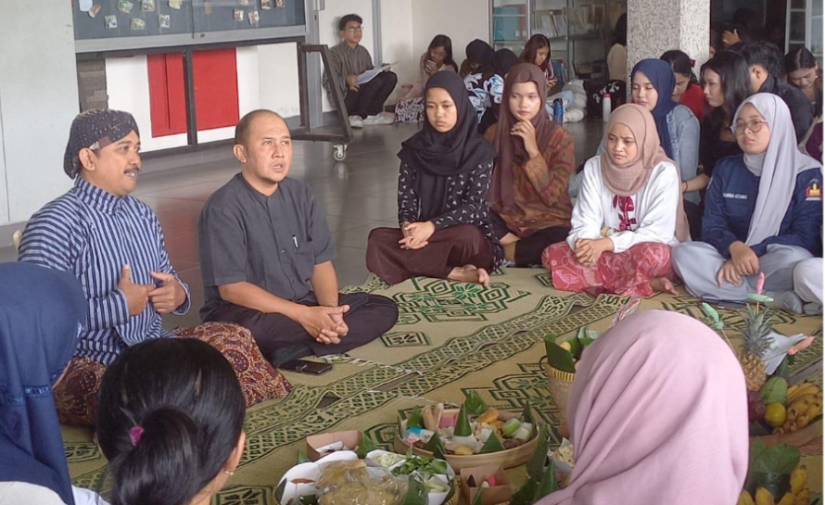
The Javanese Language, Literature, and Culture Study Program held a workshop titled “Exploring the Types and Meanings of Culture from Sesajen” on Thursday, November 27, 2025, at the Margono 4th floor lobby. This event was attended by Dr. R. Bima Slamet Raharja, S.S., M.A., as the lecturer in charge of the course, as well as students from the Javanese Language, Literature, and Culture Study Program and various other study programs. The guest speaker was Faizal Noor Singgih, S.T.P., a cultural practitioner and ceremonial master of ceremonies.

In his presentation, Faizal Noor Singgih explained various aspects of offerings, ranging from types and functions to cultural meanings. He emphasized that offerings in Javanese tradition are essentially a form of prayer or hope to God Almighty through a series of symbols contained within them. In addition to being a spiritual tool, offerings also serve as a medium of social communication, a form of respect from the Javanese people towards their environment, and an expression of the local community’s culture.

The participants were enthusiastic, saying that this activity provided them with new insights into offerings as part of Javanese culture. The workshop was closed with a prayer and a meal together.

Through this workshop, it is hoped that students will gain a deeper understanding of Javanese culture. The presence of speakers from the cultural sector is considered to enrich perspectives, both in terms of theory and practice. Thus, cooperation from various parties is essential to continue studying, preserving, and reviving Javanese culture.

Author : Haryo Untoro
Editor : Haryo Untoro

Tags: Bahasa Sastra dan Budaya Jawa FIB UGM SDGs 17: Partnerships for the Goals SDGs 4: Quality Education UGM Yogyakarta

Video UGM

[shtmlslider name='shslider_options']
Universitas Gadjah Mada

Faculty of Cultural Sciences
Universitas Gadjah Mada
Jl. Nusantara 1, Bulaksumur Yogyakarta 55281, Indonesia
   fib@ugm.ac.id
   +62 (274) 513096
   +62 (274) 550451

Work Units

  • Office of Journal & Publishing
  • INCULS
  • Information Technology and Database
  • Language Learning Center
  • Library Unit
  • Public Relations
  • Research

Facilities

  • Computer Laboratory
  • Gamelan
  • Guest House
  • Language Library
  • Library
  • Phonetics Library
  • Self Access Unit
  • Student Internet Centre

Importan Links

  • Journal of Humaniora
  • Subscriber Journal
  • Alumni Portal
  • Career
  • Departmens News
  • UGM Streaming

Contacts

  • Academic
  • Administration
  • Dean’s Office
  • Departments / Study Programs
  • Public Relations

© 2024 Faculty of Cultural Sciences Universitas Gadjah Mada

KEBIJAKAN PRIVASI/PRIVACY POLICY

[EN] We use cookies to help our viewer get the best experience on our website. -- [ID] Kami menggunakan cookie untuk membantu pengunjung kami mendapatkan pengalaman terbaik di situs web kami.I Agree / Saya Setuju