• About UGM
  • Academic Portal
  • IT Center
  • Library
  • Research
  • Webmail
  • Informasi Publik
  • English
    • Indonesia
Universitas Gadjah Mada Faculty of Cultural Sciences
Universitas Gadjah Mada
  • Home
  • Profile
    • History
    • Vision and Mission
    • Organizational structure
    • Administration
    • Staff
    • Faculty Members
  • Academic
    • Academic Calendar
    • Undergraduate Programs
      • Bachelor of Cultural Antrophology
      • Bachelor in Archaeolagy
      • Bachelor in History
      • Bachelor in Tourism
      • Bochetor in Korean Language and Culture
      • Bachelor in Indonesian Language and Culture
      • Bachelor in English
      • Bachelor in Arabic
      • Bachelor in Japanese Language and Culture
      • Bachelor in Javanese Language, Literature and Culture
      • Bachelor in French language and literature
    • Graduate Programs
      • Master in Antrophology
      • Master in ArchaeoIogy
      • Master in History
      • Master in Linguistics
      • Master in Literature
      • Master In American Studies
      • Master in Middle Eastern Cultural Studies
    • Post-Graduate Programs / S3
      • Doctor in Antropology
      • Doctor in American Studies
      • Doctor in Humanities
    • Student Service
  • KPPM
    • Research Information
    • Scientific / Academic Publications
    • Community Service
    • International Cooperation
    • Domestic Cooperation
  • Student Organizations
    • Student Executive Council
    • Semi-Autonomous Organizations
      • KAPALASASTRA
      • Christian Student Alliance
      • LINCAK
      • Saskine
      • Catholic Student Family
      • Dian Budaya
      • Sastra Kanuragan (sasgan)
      • Family of Muslim Cultural Sciences Students (KMIB)
      • Bejo Mulyo
    • Autonomous Organizations
      • Family of Anthropology Students (KEMANT)
      • English Department Student Association
      • Tourism Students Association (HIMAPA)
      • Family of Indonesian Literature Students (KMSI)
      • West Asian Literature Student Association (IMABA)
      • Association of Korean-Language Students (HIMAHARA)
      • Family of Regional Indonesian Literatures Students (KAMASUTRA)
      • The Family Body of History Students (BKMS)
      • The French Literature Students Association (HMSP)
      • Family of Anthropology Students
      • Japanese Student Association (HIMAJE)
  • Admission
    • Student Evaluation
  • Home
  • UGM
  • UGM
  • page. 25
Arsip:

UGM

Department of History Successfully Held History Master Colloquium

News Release Wednesday, 13 March 2024

SGDs 4: Quality Education

On Thursday, February 22, 2024, the Faculty of Cultural Sciences Department of History successfully held a colloquium for Masters in History with two presenters, namely Indriyani and Nur Fadilah Yusuf. Meanwhile, Dr. Mutiah Amini, M.Hum. and Dr. Wildan Sena Utama, S.S., M.A. served as discussants. The event was also attended by the Head of the Department of History and students of S2-S3 History which took place from 13.30 to 15.30 WIB in room 709 Soegondo Building, Faculty of Arts UGM.

Indriyani with a thesis plan entitled “The King’s Symbol Becomes the City’s Symbol: Sriwedari Park in Surakarta 1901-1987” became the first presenter in the colloquium. In general, her thesis explains that Sriwedari Park has experienced a change from an exclusive space to an inclusive space. Initially, Sriwedari Park was established by Pakubuwana X in 1901 as a private space of the palace, so ordinary people often referred to the park as “Bon Raja” or “Kebon Raja” which means “King’s Park”. Later, this condition changed when the commercialization of Sriwedari Park occurred through the implementation of entrance tickets or tickets. Eventually, the park became a public space. After Indonesia’s independence, Sriwedari Park became a revolutionary space where the majority of the ticket sales were used for the cause of independence. After the revolution, there was an assumption in the community that “you haven’t been to Solo if you haven’t been to Sriwedari”, so according to Indriyani, Sriwedari Park eventually became a kind of symbol of Solo.

The second speaker, Nur Fadilah Yusuf with a thesis plan entitled “Taman Ismail Marzuki: The Life of Art and Politics 1968-1998” generally discussed the relationship between art and politics in which the state influenced the running of activities at TIM (Taman Ismail Marzuki). Initially, the establishment of TIM in 1968 was the result of discussions between people known as the Cultural Manifesto group and Governor Ali Sadikin. It can be said to be a grant because of the support of the artists at that time towards the New Order rulers. Nur Fadilah Yusuf also talked about how TIM changed not only spatially, but also in terms of thought (from the representation of art for art’s sake to socialist realism brought by Lekra). In 1998, TIM functioned as a discussion space for activists and students who were going to carry out the reform movement at the Jakarta parliament building.

This colloquium is certainly a golden opportunity for the presenters to get progressive criticism and suggestions for the improvement of their work. Moreover, as Wildan Sena Utama said, the tradition of peer review in Indonesia is still relatively rare.

“People in Indonesia, one of the reasons why many of them turn their attention to predatory publishers like that is because they avoid the peer-review tradition. They are antipathetic to the peer-review tradition because they are afraid, so they think of it as a kind of killing field, you know, not as an opportunity to improve your work, (to) improve your quality,” said Wildan Sena Utama.

In addition, Wildan Sena Utama also provided tips for dealing with peer review.

“There are tips, when you get a complex peer review, don’t do it right away, just let it sit for a day or two because sometimes you also have to prepare your brain first to work on it. That’s one of the tips for dealing with peer review,” he said.

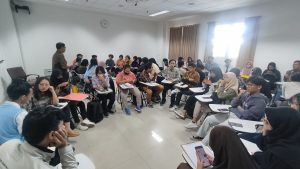
Collaboration of Faculty of Cultural Sciences UGM Japanese Language and Culture Study with Ferris Women University

News Release Wednesday, 13 March 2024

SGDs 4: Quality Education | SGDs 17: Partnerships For The Goals

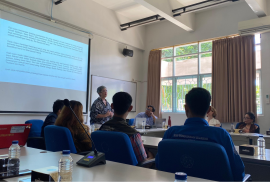
On Thursday, February 22, 2024, at 10:00-15:00 WIB, the Japanese Language and Culture Study Program (BKJ) UGM held an Educational Collaboration activity with Ferris Women University (FWU) from Yokohama, Japan. The activity which became a means of cultural exchange was attended by Sato Akira, Ph.D. as an accompanying lecturer along with 3 Ferris Women University students, as well as lecturers and students of the Japanese Language and Culture Study Program. After the reception by the Head of the Department of Japanese Language and Culture UGM, Tatang Hariri, M.A., Ph.D., lecturers and students of FWU entered the lecture class to conduct discussions and exchange information with UGM students.

The collaboration was divided into two sessions. The first session was with first-year students and the second session was with third-year students. In both sessions, FWU students and BKJ UGM students were divided into three groups to discuss several themes using Japanese. For the first session, the topic of discussion was the differences in student life in Indonesia and Japan, while the second session with third-year students, they discussed the culture and work system in Indonesia and Japan. After the discussion, each group presented the results or important points of their respective discussions using Japanese.

For the academic community, knowledge of cultural differences in various aspects of life is considered important. This is because in addition to being a means to enrich knowledge, knowing cultural differences also increases students’ ability to adapt to other cultures. This educational collaboration activity is expected to train critical thinking skills and encourage students to innovate from the perspectives gained in group discussions. As stated in the Sustainable Development Goals (SDGs), this collaboration can be a means to build quality education and as a foundation for creating global partnerships.


Japanese Language and Culture Study in discussion with Ferris Women University students

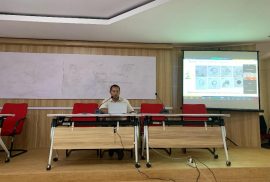
Presentation of Thesis Writing Progress of UGM Archaeology Master Program Students Program by Research

News Release Wednesday, 13 March 2024

SGDs 4: Quality Education|SGDs 17: Partnerships For The Goals

Yogyakarta, 30th January 2024 – The thesis writing progress seminar is one of the activities that must be carried out by students of the Program by Research in the Archaeology Master Program at FIB UGM. This activity is carried out to monitor the progress of research that has been carried out in the context of completing the thesis. In a seminar attended by students and thesis supervisors, students who are preparing a thesis get useful input to enrich the thesis that will be produced and at the same time provide solutions to the obstacles faced.

The Program by Research at the Master of Archaeology Study Program at FIB UGM provides opportunities for researchers or prospective non-research students who already have quite a lot of experience in research and publication. Two other programs offered by the Archaeology Master’s Program at FIB UGM are the regular Master’s program and the Double Degree program.

More information about the programs offered by the Master of Archaeology Study Program and related scholarships can be seen on the website: https://arkeologi.ugm.ac.id/

Tracing the Footsteps of Indo-Descendants through Jane Vogel Mantiri’s Story

News Release Wednesday, 13 March 2024

SDGs 16: Peace, Justice, and Strong Institutions

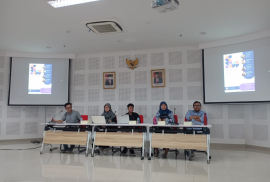
Yogyakarta, Monday, February 19th, 2024 (UGM) – The Malam Museum Community, in collaboration with See Jane Run Team and the Department of History at the Faculty of Cultural Sciences, Universitas Gadjah Mada, successfully organized a historical discussion titled “Where is Home? Stories of Indonesian after World War II by Jane Vogel Mantiri.” The event took place from 09:00 to 11:30 AM in Meeting Room 1 of Poerbatjaraka Building, Faculty of Cultural Sciences, UGM. Dr. Wildan Sena Utama served as the moderator, with Jean Vogel Mantiri and Tedy Hernawan, S.S., M.A., as the speakers. In addition to UGM students, the event was attended by members of the general public and students from other universities around UGM.

Jane Vogel Mantiri shared her life story, particularly the history of her family as descendants of Indo (mixed Dutch and Native) heritage. Genealogical studies revealed that Jane’s Dutch ancestors arrived in Indonesia in the 18th century. Jane herself was born in Jakarta, eight years after the end of World War II. For hundreds of years since the arrival of her ancestors, Jane’s family grew and settled in Indonesia. However, during the erosion of colonial heritage in the decolonization period (1950s to 1960s), Jane and her family faced bitter realities and had to leave Indonesia.

One of the bitter stories that will always be remembered by Jane is about her beloved father’s sister, Deetje. In late October 1945, Deetje was on a train journey after visiting her father, Jane’s grandfather, who was ill due to malnutrition after being detained by the Japanese army. The train was stopped by “Indonesian rebels,” and Deetje was raped, and her head was severed. Her body has never been found to this day. The trauma of Deetje’s death continues to haunt Jane’s family, especially her father. Eventually, Jane’s family left Indonesia in September 1954 and moved to the Netherlands. Unfortunately, their arrival in the Netherlands was not met with open arms due to their non-European complexion. In 1960, Jane’s family migrated to America through sponsorship from a church. There, they obtained American citizenship.

For years, Jane grew up with a sense of shame as a foreigner in America without a country she could call “home.” The turning point that led Jane to rediscover her identity as an Indo descendant was the death of both her parents. Moreover, Jane is convinced that if the tragic events that happened to Deetje had not occurred, her parents would not have been willing to leave Indonesia and accept Dutch citizenship. After all, their daily meals consisted of rice, vegetables, and sambal. Therefore, for Jane, family is not always about lineage but can also be defined by culture.

To this day, Jane admits to still being traumatized by the events that befell her family in the past. She states that there is no cure for trauma. However, someone who is now a trauma psychologist turns that trauma into a reason to strengthen herself. She proves this by revisiting Indonesia and sharing her family’s story in a book. The question “Where is home?” for Jane is finally answered. For her, America is her adopted home. Meanwhile, Indonesia, as the motherland, will always be her homeland.

“When talking about the experiences of Indo people and how they are outsiders, instead of insiders, and also those who are uncategorized or cannot be categorized, it’s quite complex from that perspective because, in my opinion, stories like Bu Jane’s open up new discussions, new spaces where suffering or how Bu Jane feels in peeling off her own identity, and also she doesn’t feel belonging in just one community but can be defined in various or multi-identities,” said Tamim, a History student from the class of 2021.

Wildan Sena Utama stated that racial discrimination was indeed a global issue in the 20th century. He added that the Indo group is marginalized and forgotten. In the Indonesian context, according to Tedy Hernawan, the change in the concept of “Indonesianness” between the pre-20th century and the 20th century also influenced the changing views on the Indo group. Discussions about the Indo group certainly contribute to new discourses related to marginalized groups because not all mixed Dutch-Native descendants live in luxury.

Faculty of Cultural Sciences UGM Korean Language and Culture Study Program Collaborates with Yeungnam University

News Release Wednesday, 13 March 2024

SDGs 4: Quality Education | SDGs 17: Partnerships for the Goals

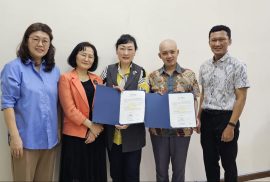
Yogyakarta, February 6, 2024 (UGM) – The Korean Language and Culture Study Program, Faculty of Cultural Sciences UGM, signed a Memorandum of Agreement (MoA) with the Department of Global Education, Yeungnam University, South Korea, in the field of education on February 2, 2024, at the Dean’s Office of FIB UGM. The agreement was signed by Mr. Suray Agung Nugroho, M.A., Ph.D., representing the Dean of FIB UGM, and Mr. Achmad Rio Dessiar, M.A., Ph.D., as the program coordinator, and Prof. Lee Mihyang, Head of the Department of Global Education, Yeungnam University.

This agreement is a form of commitment to collaboration between the Korean Language and Culture Study Program FIB UGM and the Department of Global Education Yeungnam University Korea, to collaborate in teaching Korean language. The implementation of the teaching collaboration will begin with the teaching of the course “Academic Korean Language”, which is a compulsory course for the major that teaches academic writing skills in Korean.

1…2324252627…29

Video UGM

[shtmlslider name='shslider_options']
Universitas Gadjah Mada

Faculty of Cultural Sciences
Universitas Gadjah Mada
Jl. Nusantara 1, Bulaksumur Yogyakarta 55281, Indonesia
   fib@ugm.ac.id
   +62 (274) 513096
   +62 (274) 550451

Work Units

  • Office of Journal & Publishing
  • INCULS
  • Information Technology and Database
  • Language Learning Center
  • Library Unit
  • Public Relations
  • Research

Facilities

  • Computer Laboratory
  • Gamelan
  • Guest House
  • Language Library
  • Library
  • Phonetics Library
  • Self Access Unit
  • Student Internet Centre

Importan Links

  • Journal of Humaniora
  • Subscriber Journal
  • Alumni Portal
  • Career
  • Departmens News
  • UGM Streaming

Contacts

  • Academic
  • Administration
  • Dean’s Office
  • Departments / Study Programs
  • Public Relations

© 2024 Faculty of Cultural Sciences Universitas Gadjah Mada

KEBIJAKAN PRIVASI/PRIVACY POLICY

[EN] We use cookies to help our viewer get the best experience on our website. -- [ID] Kami menggunakan cookie untuk membantu pengunjung kami mendapatkan pengalaman terbaik di situs web kami.I Agree / Saya Setuju