• About UGM
  • Academic Portal
  • IT Center
  • Library
  • Research
  • Webmail
  • Informasi Publik
  • English
    • Indonesia
Universitas Gadjah Mada Faculty of Cultural Sciences
Universitas Gadjah Mada
  • Home
  • Profile
    • History
    • Vision and Mission
    • Organizational structure
    • Administration
    • Staff
    • Faculty Members
  • Academic
    • Academic Calendar
    • Undergraduate Programs
      • Bachelor of Cultural Antrophology
      • Bachelor in Archaeolagy
      • Bachelor in History
      • Bachelor in Tourism
      • Bochetor in Korean Language and Culture
      • Bachelor in Indonesian Language and Culture
      • Bachelor in English
      • Bachelor in Arabic
      • Bachelor in Japanese Language and Culture
      • Bachelor in Javanese Language, Literature and Culture
      • Bachelor in French language and literature
    • Graduate Programs
      • Master in Antrophology
      • Master in ArchaeoIogy
      • Master in History
      • Master in Linguistics
      • Master in Literature
      • Master In American Studies
      • Master in Middle Eastern Cultural Studies
    • Post-Graduate Programs / S3
      • Doctor in Antropology
      • Doctor in American Studies
      • Doctor in Humanities
    • Student Service
  • KPPM
    • Research Information
    • Scientific / Academic Publications
    • Community Service
    • International Cooperation
    • Domestic Cooperation
  • Student Organizations
    • Student Executive Council
    • Semi-Autonomous Organizations
      • KAPALASASTRA
      • Christian Student Alliance
      • LINCAK
      • Saskine
      • Catholic Student Family
      • Dian Budaya
      • Sastra Kanuragan (sasgan)
      • Family of Muslim Cultural Sciences Students (KMIB)
      • Bejo Mulyo
    • Autonomous Organizations
      • Family of Anthropology Students (KEMANT)
      • English Department Student Association
      • Tourism Students Association (HIMAPA)
      • Family of Indonesian Literature Students (KMSI)
      • West Asian Literature Student Association (IMABA)
      • Association of Korean-Language Students (HIMAHARA)
      • Family of Regional Indonesian Literatures Students (KAMASUTRA)
      • The Family Body of History Students (BKMS)
      • The French Literature Students Association (HMSP)
      • Family of Anthropology Students
      • Japanese Student Association (HIMAJE)
  • Admission
    • Student Evaluation
  • Home
  • SDGs 13: Climate Action
Arsip:

SDGs 13: Climate Action

Spirituality, Ecological Trauma, and Critiques of Modernity in ASN 2026 Literary Discussions

News Release Tuesday, 3 November 2026

YOGYAKARTA — Ghosts, yellow wallpaper, mobile phones, and Malay manuscripts became entry points for exploring spirituality in literature. Through these diverse objects and experiences, presenters at Academic Student Networking (ASN) 2026, held on Wednesday (October 7), demonstrated that literature is not merely concerned with the beauty of language, but also offers critiques of environmental destruction, power relations, and modern human life.

These discussions emerged during the second and third sessions of ASN 2026, which brought together presenters from Universitas Gadjah Mada (UGM), Universitas Diponegoro (Undip), and Universitas Andalas (Unand). Through analyses of novels, short stories, poetry, and Malay manuscripts, the presenters explored how spiritual experiences and various forms of strangeness in literature relate to social and cultural issues.

During the second session, moderated by Dinda Aura Putri, Jusmawati from UGM’s Master’s Program in Literature presented a paper titled “Ghosts as the Personification of Climate Trauma in Ayu Welirang’s Jejak Balak.” She interpreted the ghost figure in the novel as a representation of climate trauma, particularly the anxiety arising from environmental destruction and the threat of ecological disasters.

Jusmawati applied E. Kaplan’s (2015) concept of climate trauma to examine the relationship between forest destruction, land ownership conflicts, and the traumatic experiences of local communities. In her reading, environmental damage not only transforms natural conditions but also disrupts communities’ relationships with customary land, traditions, and their living spaces.

One of the issues highlighted was the conversion of customary forest land into oil palm plantations by PT Zamrud Bumi through bureaucratic manipulation. This practice triggered land tenure conflicts and illustrated how economic pressures could push communities to relinquish their ancestral land.

The logging of teak trees also created an ecological space that had lost its function and meaning for the community. This was interpreted as a form of place alienation, in which an environment that had once been integral to community life became an unfamiliar space.

The threat of flash floods, known locally as galodo, intensified this collective anxiety. In the novel, forest destruction is understood as part of a chain of problems that could lead to wider disasters.

Amid this situation, the figure of Inyak emerges as a spiritual figure whose meaning undergoes a transformation. The appearance of a pair of white beads in the customary forest serves as a warning of impending danger before an ecological catastrophe occurs. Initially understood as a sacred ancestor who safeguards moral values, Inyak later appears as a spectral figure who punishes and spreads death in the disputed territory.

Jusmawati also examined the characters’ past trauma, including an experience in which a character’s father slaughtered animals. This trauma becomes intertwined with violence when the figure of Inyak seems to be appropriated through the killing of loggers using artificial claws. In this interpretation, unresolved trauma develops into destructive terror.

Through this analysis, Jusmawati presents the ghost not merely as a source of fear, but as a personification of climate trauma and the social conflicts accompanying environmental destruction.

Horror and the Weird as Critiques of Power

Horror was explored from a different perspective by a team of presenters from Undip, consisting of Nugrahaning Anindita C., Dennis Audria Permana, and Zainab Al Awwahah. In their paper, “Something Queer: Mark Fisher’s Weird Entities in Charlotte Perkins Gilman’s ‘The Yellow Wallpaper’,” they traced the shift from Gothic horror to weird fiction, particularly through Charlotte Perkins Gilman’s 1892 short story “The Yellow Wallpaper.”

The story follows an unnamed female narrator who undergoes the rest cure, a treatment that restricts a patient’s physical and mental activities. She is confined to a room by her husband, John, a physician, and can express her anxiety only through a hidden diary.

In the presenters’ interpretation, the house and its wallpaper are more than mere settings. The long-vacant house, with its history of inheritance disputes, becomes a space that harbors strangeness. Meanwhile, the room, which should provide shelter, instead becomes a space that restricts the narrator’s freedom.

The yellow wallpaper becomes the center of attention when the narrator begins to see a figure behind its patterns. This strangeness gradually expands, seemingly spreading beyond the room and disturbing other spaces in the house.

This reading demonstrates how something considered irrational can challenge rational explanations. John continues to prioritize medical logic, but the narrator’s experiences reveal that the rational framework he uses to understand her may not be sufficient to explain everything she experiences.

The situation is also connected to power relations within the household. As both the narrator’s husband and physician, John has the authority to determine what is considered true about his wife’s condition. By contrast, the narrator has limited opportunities to communicate her experiences and determine her own needs.

By the end of the story, the narrator increasingly abandons her social roles as a wife and mother. Her apparent madness can be interpreted as a form of resistance to a world that restricts her freedom, although the story offers no entirely conclusive resolution.

The discussion then expanded to the relevance of literature in social life. Wahyu Agung Ramdani questioned the extent to which literature can still be used to address political ecology, particularly when literary works remain inaccessible to many regions and book prices pose barriers to readers. He also raised the question of how readers can avoid becoming mere spectators amid the ecological crisis.

Meanwhile, Muhamad Ferdian Syah from UGM questioned the relationship between the narrator’s psychological condition in “The Yellow Wallpaper” and the weird experiences she undergoes. He suggested that the pressure caused by the rest cure and John’s treatment should not necessarily be separated from her experience of the weird; instead, the two may develop together and shape one another.

These questions extended the discussion beyond textual interpretation to broader issues of how humans understand trauma, the environment, and experiences that cannot always be explained through established frameworks of thought.

Prayer, Mobile Phones, and the Spirituality of Modern Humans

The discussion of spirituality continued during the third session, moderated by Ann Evelin Rahajeng. Awabeen Samsuding from UGM’s Master’s Program in Literature presented a paper titled “Reading Prayer in Joko Pinurbo’s Poetry: The Aesthetics of Irony as a Critique of Modern Human Spirituality.”

Awabeen examined how poet Joko Pinurbo presents prayer through everyday objects and activities. While religious poetry is often associated with solemn and sacred atmospheres, Pinurbo’s poems bring spirituality into spaces closer to modern life, including mobile phones, the human body, and cosmetics.

The research examined three poems: “Doa Orang Sibuk yang 24 Jam Sehari Berkantor di Ponselnya” (2018), “Doa Sebelum Mandi” (2000), and “Doa Seorang Pesolek” (2001).

For Awabeen, irony in these poems is not merely a linguistic device, but an aesthetic strategy for exposing contradictions in human life. Through irony, readers are encouraged to move beyond literal meanings and reconsider habits and beliefs that have long been taken for granted.

In “Doa Orang Sibuk yang 24 Jam Sehari Berkantor di Ponselnya,” for example, the protagonist loses all their contact numbers when their phone breaks but still has God’s number saved. The irony emerges when God reveals that His number is, in fact, the only one the protagonist never calls.

This situation critiques a modern life in which people have unlimited access to communication but may fail to maintain their spiritual connections. The mobile phone, a symbol of connectivity, also reveals the possibility of alienation from what is considered the most fundamental relationship.

Meanwhile, “Doa Sebelum Mandi” was examined through the issues of the body and violence. In Awabeen’s presentation, experiences of violence embedded in the body cannot necessarily be erased through physical cleansing alone.

“Doa Seorang Pesolek,” meanwhile, explores the relationship between the body, cosmetics, and mortality. Through irony, excessive attention to physical appearance is juxtaposed with the reality that human life remains finite.

To examine these issues, Awabeen drew on Y.B. Mangunwijaya’s concept of religiosity and Wayne C. Booth’s theory of stable irony. Using a qualitative approach and close reading, the study sought to demonstrate how poetry can critique modern spirituality without abandoning the everyday objects that are familiar to contemporary life.

Spirituality and Locality in the Malay Manuscript Syair Kupu-Kupu

Also during the third session, Afifah Chairunnisa and Aditya Fiandra from Unand presented a paper titled “Negotiating Spirituality and Locality in the Manuscript Syair Kupu-Kupu.” Their research applied Roland Barthes’s semiotic approach to examine the ideology embedded in the Malay manuscript, identified as Schoemann V 40.

Recognizing the importance of preserving the values contained in ancient manuscripts, the study examined their allegorical and symbolic dimensions, which allow them to be interpreted as more than written texts. The relationship between spirituality and locality was a central concern, particularly in understanding how cultural symbols and values intertwine within a literary work.

Using Roland Barthes’s semiotic approach, the researchers identified several local symbols. Mount Ledang and Mount Anta Sujana, for instance, are interpreted as sacred spaces, while songket textiles, keris daggers, betel leaves, and scarves represent honor, social status, and commitment. Meanwhile, references to Allah and the phrase “with Allah as the reason,” alongside various rituals, demonstrate how spirituality serves as a foundation for human actions and everyday life.

The study also examined how customs, etiquette, and honorific forms of address, such as Datuk, Tuanku, Kakanda, and Adinda, reinforce social structures. These findings indicate that spirituality and locality do not exist independently; rather, they shape one another in maintaining the values, ethics, and worldview of Malay society. Thus, Syair Kupu-Kupu preserves not only literary heritage but also records how Malay society understands the relationship between belief, tradition, and social life.

The discussions in the second and third sessions of ASN 2026 demonstrated various ways of interpreting spirituality in literature. Through ghosts in novels, weird phenomena in horror fiction, irony in poetry, and symbols in Malay manuscripts, the presenters showed that literary works can serve as spaces for questioning the relationships between humans and nature, power, the body, belief, and cultural traditions.

Through their diverse approaches, the discussions positioned literature not merely as an object of aesthetic study, but also as a means of understanding persistent issues in society.


Author: Khotibul Umam
Learning from the Coast: Cultural Anthropology Department Conducts Fieldwork in Wonokerto, Pekalongan

News Release Wednesday, 28 October 2026

On Saturday, October 17, 2026, the Department of Cultural Anthropology
organized a fieldwork trip to Wonokerto, Pekalongan, as part of an effort to apply in
practice the theories discussed in class. Participants in this fieldwork included
undergraduate students in Cultural Anthropology taking the course “Maritime
Anthropology,” taught by Dr. Des Christy, and graduate students in Cultural
Anthropology taking the course “Rhetoric of Development,” taught by Prof. Pujo Semedi
Hargo Yuwono, along with a guest lecturer from UIN Pekalongan, Mochammad Najmul
Afad. The fieldwork activity was organized by selecting destinations for the participants
to visit that aligned with the learning objectives set in class.

That morning, while having breakfast, participants were not only provided with
logistical support but also attended a general lecture as part of their exposure to local
knowledge, featuring a local village official who explained the context of Wonokerto
Kulon. Mr. Jodi, a village official, explained several fundamental aspects of the area,
such as its social, cultural, economic, and ecological contexts from the perspective of
coastal life. One of the points Mr. Jodi emphasized most was the tidal flooding that
continues to affect Wonokerto, which in turn impacts the social and economic contexts
of the surrounding community.

The class continued with a visit to the Wonokerto Fish Auction Site. There, the
students directly observed the process by which fishermen auctioned their catch. Dr.
Des Christy, a professor of Maritime Anthropology, gave the students the freedom to
gather data during the assignment, with the goal of producing a descriptive account of
community life. The students employed various approaches, such as participant
observation, interviews, and ethno-photography. For two hours, the students and faculty closely observed the fish auction activities before finally taking their leave to head to the next destination.

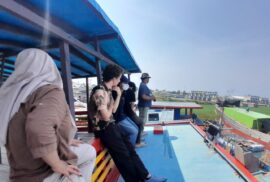
The next destination in the series of fieldwork activities was a visit to the
shipyard—an area where ships are “parked” while they are out of service or serving as
a waiting area for vessels preparing to set sail. At the shipyard, students from both the
Maritime Anthropology and Development Rhetoric courses had the primary objective of
exploring the personal lives of the fishermen. The students were allowed to explore the
boats lined up in the parking area, which included various types ranging from
small-scale fishing vessels to large-scale ones. In between exploring the vessels and
interacting with the fishermen, students and faculty were treated to smoked stingray and vegetables, specially prepared by local residents.

The final leg of the fieldwork took place during a brief stop at the Setono Batik Market
area. The students were invited to explore the market area while viewing Pekalongan’s
signature batik fabrics, which embody a strong sense of local identity. Not only were
they invited to explore, but some students also purchased goods from batik artisans as
a form of support for Pekalongan’s batik UMKM community. Purchasing batik also
serves as a means of passing on cultural heritage to younger generations. With a
deeper understanding of batik, this traditional Pekalongan fabric holds its own
significance within the broader cultural landscape. Shopping and browsing for unique
Pekalongan souvenirs brought the entire series of trips and fieldwork conducted by the
students and faculty members to a close, leaving them with many experiences and
joyful memories from every encounter, as well as the coastal ambiance that will shape
their future academic journeys.

Author: Danumurti
Editor: Leonard Dimas

Universitas Gadjah Mada Strengthens International Academic Collaboration through Participation in CHSS 2026 in Lahore

News Release Monday, 5 October 2026

Universitas Gadjah Mada (UGM) reaffirmed its commitment to international academic collaboration and knowledge exchange through its active participation in the CHSS 2026 Conference held at Lahore University of Management Sciences (LUMS), Pakistan, from 23 to 27 September 2026. The conference brought together scholars, researchers, policymakers, and practitioners from across Asia and beyond to discuss contemporary challenges and opportunities facing societies in the region.

UGM was represented by Prof. Dr. Wening Udasmoro, Dr. Aprillia Firmonasari, and Dr. Merry Andriani from the Faculty of Cultural Sciences, who participated in a range of academic and networking activities throughout the conference. Their involvement contributed to scholarly discussions on issues affecting Asia and the Global South while strengthening partnerships between UGM and international institutions. Prof. Dr. Wening Udasmoro also serves as the Hub Leader for UGM in the academic cooperative project among Association for Asian Studies (AAS), Cultivating the Humanities and Social Sciences and Supporting Underrepresented Scholars of Asia (CHSS), and Universitas Gadjah Mada (UGM).

The conference featured an extensive program consisting of pre-conference workshops, panel presentations, roundtable discussions, exhibitions, cultural activities, and networking forums. Participants explored a wide range of topics, including migration, education, governance, gender studies, climate resilience, public health, cultural heritage, and regional cooperation. Through these sessions, attendees exchanged perspectives and research findings while identifying opportunities for future collaborative initiatives.

In addition to academic presentations, the conference emphasized intercultural engagement through exhibitions and cultural showcases that highlighted the diversity and dynamism of Asian societies. These activities provided participants with valuable opportunities to connect across disciplines and national boundaries. UGM’s participation in the conference reflects the university’s ongoing efforts to promote internationally engaged scholarship and foster meaningful partnerships that address global and regional challenges. The event also served as a platform for expanding academic networks and exploring collaborative research opportunities with institutions across Asia and beyond.

Building on the momentum generated in Lahore, Universitas Gadjah Mada will host a similar international workshop in Yogyakarta, Indonesia, from 19 to 23 October 2026. The workshop is designed as an inclusive academic forum that welcomes participants from diverse disciplinary, institutional, cultural, and geographical backgrounds. In line with UGM’s commitment to social equality and inclusivity, the program will provide a platform for scholars, researchers, practitioners, and community representatives to engage in dialogue, share perspectives, and exchange knowledge on issues of societal relevance. Through this initiative, UGM seeks to foster an academic environment that values diversity, promotes equitable participation, and encourages cross-cultural and interdisciplinary engagement.

Through its participation in CHSS 2026 and its forthcoming role as host, UGM continues to demonstrate its commitment to advancing impactful research, fostering international dialogue, and contributing to the development of inclusive and sustainable solutions to contemporary global challenges. For Universitas Gadjah Mada, these engagements represent not only opportunities for scholarly exchange but also strategic efforts to strengthen the university’s position as a leading institution in facilitating regional and global academic collaboration.

Understanding Forests Amidst the Climate Crisis: Prof. Pujo Semedi Speaks at the University of Freiburg, Germany 

News Release Monday, 3 August 2026

On June 14, 2026, Professor of Anthropology at Universitas Gadjah Mada, Prof. Pujo Semedi, had the opportunity to serve as a speaker in the public lecture series titled “Wissen über den Wald im Wandel” (Knowledge About the Forest in Transition). This academic event, which runs throughout the 2026 summer semester, is part of the prestigious Studium Generale program at the University of Freiburg, Germany.

This international-scale event is collaboratively organized by the WWW 4.0 research project and the Cluster of Excellence “Future Forests — Adapting Complex Social-ecological Forest Systems to Global Change.” The forum specifically brings together leading scientists and practitioners from various disciplines to present their research perspectives on forest landscapes. Its primary focus is examining the diversity of approaches to knowledge in addressing the profound changes and challenges that the global climate crisis brings to forest ecosystems and their ecological services, as well as exploring viable adaptation strategies.

During the forum, Prof. Pujo Semedi presented alongside Prof. Michaela Haug from the University of Freiburg. Together, they delivered a presentation adopting a socio-ecological anthropological perspective, titled “Meanings of Forests: A Collaborative Comparative Ethnography Between Indonesia and Germany.”

This study highlights a comparison of how forests are culturally, socially, and economically conceptualized by communities in two distinct national contexts. Through collaborative comparative ethnography, they invited the audience to explore the dynamic relationship between humans and nature, as well as how communities practically respond to ecological transformations on the ground.

Author: Daiva Keefe Kalimasadha

FIB UGM Provides Staff with IoT Scale Training

News Release Friday, 17 July 2026

Yogyakarta, July 17, 2026 — On Friday, July 17, 2026, the Faculty of Cultural Sciences at UGM held an informational session on IoT scales as part of the 2026 UGM Sustainability Campus Action program. The event took place in the Multimedia Room of the Margono Building and featured Dr. Ir. Thomas Oka Pratama, S.T., M.Eng., IPP, from UGM’s Sensor and Controlled Systems Laboratory. This session served as training for educational support staff on managing the faculty’s waste using IoT scales.

IoT scales are devices that measure the weight of waste generated at collection points (pick-up points) in real time, integrated with the Internet of Things (IoT) system. The weight data is used for digital monitoring, evaluation, and planning of waste management policies. During the session, participants were instructed on how to use the IoT scales to manage waste generation. FIB support staff were also asked to practice using the IoT scales.

Through the implementation of IoT scales, FIB UGM aims to strengthen a waste management system that is more accurate, measurable, and data-driven. The use of this technology is expected to enhance the capacity of support staff to support sustainable waste management while also contributing to UGM’s Sustainability Campus Action 2026 commitment. This initiative aligns with efforts to achieve the Sustainable Development Goals (SDGs), particularly SDGs point 12: Responsible Consumption and Production, and also supports SDGs point 11: Sustainable Cities and Communities and SDGs point 13: Climate Action.

[Humas FIB, Maylafaizza Nafisha Zifa]

123…5

Video UGM

[shtmlslider name='shslider_options']
Universitas Gadjah Mada

Faculty of Cultural Sciences
Universitas Gadjah Mada
Jl. Nusantara 1, Bulaksumur Yogyakarta 55281, Indonesia
   fib@ugm.ac.id
   +62 (274) 513096
   +62 (274) 550451

Work Units

  • Office of Journal & Publishing
  • INCULS
  • Information Technology and Database
  • Language Learning Center
  • Library Unit
  • Public Relations
  • Research

Facilities

  • Computer Laboratory
  • Gamelan
  • Guest House
  • Language Library
  • Library
  • Phonetics Library
  • Self Access Unit
  • Student Internet Centre

Importan Links

  • Journal of Humaniora
  • Subscriber Journal
  • Alumni Portal
  • Career
  • Departmens News
  • UGM Streaming

Contacts

  • Academic
  • Administration
  • Dean’s Office
  • Departments / Study Programs
  • Public Relations

© 2024 Faculty of Cultural Sciences Universitas Gadjah Mada

KEBIJAKAN PRIVASI/PRIVACY POLICY

[EN] We use cookies to help our viewer get the best experience on our website. -- [ID] Kami menggunakan cookie untuk membantu pengunjung kami mendapatkan pengalaman terbaik di situs web kami.I Agree / Saya Setuju