• About UGM
  • Academic Portal
  • IT Center
  • Library
  • Research
  • Webmail
  • Informasi Publik
  • English
    • Indonesia
Universitas Gadjah Mada Faculty of Cultural Sciences
Universitas Gadjah Mada
  • Home
  • Profile
    • History
    • Vision and Mission
    • Organizational structure
    • Administration
    • Staff
    • Faculty Members
  • Academic
    • Academic Calendar
    • Undergraduate Programs
      • Bachelor of Cultural Antrophology
      • Bachelor in Archaeolagy
      • Bachelor in History
      • Bachelor in Tourism
      • Bochetor in Korean Language and Culture
      • Bachelor in Indonesian Language and Culture
      • Bachelor in English
      • Bachelor in Arabic
      • Bachelor in Japanese Language and Culture
      • Bachelor in Javanese Language, Literature and Culture
      • Bachelor in French language and literature
    • Graduate Programs
      • Master in Antrophology
      • Master in ArchaeoIogy
      • Master in History
      • Master in Linguistics
      • Master in Literature
      • Master In American Studies
      • Master in Middle Eastern Cultural Studies
    • Post-Graduate Programs / S3
      • Doctor in Antropology
      • Doctor in American Studies
      • Doctor in Humanities
    • Student Service
  • KPPM
    • Research Information
    • Scientific / Academic Publications
    • Community Service
    • International Cooperation
    • Domestic Cooperation
  • Student Organizations
    • Student Executive Council
    • Semi-Autonomous Organizations
      • KAPALASASTRA
      • Christian Student Alliance
      • LINCAK
      • Saskine
      • Catholic Student Family
      • Dian Budaya
      • Sastra Kanuragan (sasgan)
      • Family of Muslim Cultural Sciences Students (KMIB)
      • Bejo Mulyo
    • Autonomous Organizations
      • Family of Anthropology Students (KEMANT)
      • English Department Student Association
      • Tourism Students Association (HIMAPA)
      • Family of Indonesian Literature Students (KMSI)
      • West Asian Literature Student Association (IMABA)
      • Association of Korean-Language Students (HIMAHARA)
      • Family of Regional Indonesian Literatures Students (KAMASUTRA)
      • The Family Body of History Students (BKMS)
      • The French Literature Students Association (HMSP)
      • Family of Anthropology Students
      • Japanese Student Association (HIMAJE)
  • Admission
    • Student Evaluation
  • Home
  • SDGs 1
  • SDGs 1
Arsip:

SDGs 1

Prof. Setiadi Discusses Humanitarian and Justice Reflections on Refugee Issues at Masjid Mardliyah Study Session Yogyakarta, Februar

News Release Friday, 27 February 2026

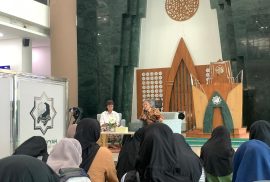
Yogyakarta, February 25, 2026 – The Dean of the Faculty of Cultural Sciences (FIB) at Universitas Gadjah Mada (UGM), Prof. Setiadi, S.Sos., M.Si., delivered a lecture at the Masjid Mardliyah UGM study session under the theme “Humanitarian and Justice Reflections on Refugee Issues.” . The discussion invited participants to examine forced migration not only from a policy perspective, but also through the lens of humanity and social justice.

In his presentation, Prof. Setiadi emphasized that the phenomenon of forced migration cannot be separated from social structures and power relations that often generate marginalization. He noted that when refugee issues arise, public discourse frequently shifts toward debates over who has the authority to address the matter, rather than focusing on substantive solutions and the protection of refugees themselves.

According to him, refugees are individuals striving to rebuild their life histories after being disconnected from their jobs, education, aspirations, and communities. Forced displacement can occur at both micro and macro levels due to conflict, discrimination, political pressure, or natural disasters. In this context, “fleeing” is fundamentally an act of survival in order to secure safety and continuity of life.

Conceptually, the term refugee in the international framework refers to the definition established by the United Nations High Commissioner for Refugees (UNHCR), which describes a refugee as a person who is outside their country of nationality due to a well-founded fear of persecution based on race, religion, nationality, membership in a particular social group, or political opinion, and who is unable or unwilling to return to that country. The definition also extends to individuals forced to leave their habitual residence due to external aggression, occupation, foreign domination, or events seriously disturbing public order. In addition, there are internally displaced persons who are compelled to relocate but remain within their country’s borders.

Prof. Setiadi further encouraged participants to view refugee issues as part of the broader historical dynamics of human life. Refugees are not merely statistical figures; they are individuals with dreams, hopes, and the right to rebuild a dignified future. The greatest challenges are not only administrative in nature, but also social barriers such as stigma, discrimination, and limited access to education and employment.

The study session also underscored the relevance of refugee issues to the Sustainable Development Goals (SDGs). Efforts to ensure protection and justice for refugees align with the global commitment to reducing inequalities (SDG 10) and promoting peace, justice, and strong institutions (SDG 16). Guaranteeing refugees’ access to quality education and decent livelihoods also supports the goals of ending poverty (SDG 1) and ensuring quality education (SDG 4), while international cooperation in addressing refugee crises reflects the importance of global partnerships (SDG 17).

Through this forum, the Dean of FIB UGM reaffirmed that reflecting on refugee issues is a moral imperative to build a more just and compassionate society, placing humanity at the core of policy and social action.

[Public Relation of FIB UGM, Alma Syahwalani]

Soft Launching Book “Reimagining Development in Southeast Asia: Alternative Practices from the Grassroots and Social Movements”

News Release Wednesday, 15 October 2025

Monday, October 6, 2025 – What if development did not have to repeat the same failed models?

This question is the main premise of the book Reimagining Development in Southeast Asia: Alternative Practices from the Grassroots and Social Movements. On Monday, October 6, 2025, the Department of Anthropology held a soft launch of the book Reimagining Development in Southeast Asia: Alternative Practices from the Grassroots and Social Movements. This book is the result of collaboration between a number of researchers who highlight various social, political, and geographical contexts in the Southeast Asian region. Through various field studies and theoretical reflections, this book places alternative development as its main focus, while inviting readers to reimagine the meaning of progress from the perspective of communities that have often been marginalized in mainstream development discourse.

Furthermore, the authors also invite us to question the perspective that limits people’s experiences within the framework of the nation-state. The division of regions such as “Southeast Asia” is in fact inseparable from the excesses of colonialism, which sought to compartmentalize social and cultural spaces into separate entities. Through this lens, Reimagining Development in Southeast Asia not only discusses alternative forms of development, but also how we can reimagine cross-border relationships—both historical and cultural—which are in fact a vital source for the emergence of grassroots development practices.

At the book’s soft launch on Monday, two of its authors, Ananeza P. Aban, PhD Researcher from Ghent University, and Jose Monfred C. Sy, PhD Researcher from the University of Hong Kong, were present to give a brief presentation on the outline of the book and the main topics discussed. Both highlighted how local initiatives and social movements in various Southeast Asian countries can become forms of alternative development that seek to break away from colonial formats and renegotiate power relations in the global context.

This event also provided a space for participants to revisit the concept of development, which has been dominated by global perspectives and mainstream economic policies. Through this launch, the authors hope to open a broader conversation about the future of development in the region, how grassroots experiences can be a source of inspiration for a more inclusive and sustainable direction of development, and encourage researchers to participate in documenting local development practices—especially in Southeast Asia.

[Antropologi Budaya, Daiva Keefe Kalimasadha]

Video UGM

[shtmlslider name='shslider_options']
Universitas Gadjah Mada

Faculty of Cultural Sciences
Universitas Gadjah Mada
Jl. Nusantara 1, Bulaksumur Yogyakarta 55281, Indonesia
   fib@ugm.ac.id
   +62 (274) 513096
   +62 (274) 550451

Work Units

  • Office of Journal & Publishing
  • INCULS
  • Information Technology and Database
  • Language Learning Center
  • Library Unit
  • Public Relations
  • Research

Facilities

  • Computer Laboratory
  • Gamelan
  • Guest House
  • Language Library
  • Library
  • Phonetics Library
  • Self Access Unit
  • Student Internet Centre

Importan Links

  • Journal of Humaniora
  • Subscriber Journal
  • Alumni Portal
  • Career
  • Departmens News
  • UGM Streaming

Contacts

  • Academic
  • Administration
  • Dean’s Office
  • Departments / Study Programs
  • Public Relations

© 2024 Faculty of Cultural Sciences Universitas Gadjah Mada

KEBIJAKAN PRIVASI/PRIVACY POLICY

[EN] We use cookies to help our viewer get the best experience on our website. -- [ID] Kami menggunakan cookie untuk membantu pengunjung kami mendapatkan pengalaman terbaik di situs web kami.I Agree / Saya Setuju