• About UGM
  • Academic Portal
  • IT Center
  • Library
  • Research
  • Webmail
  • Informasi Publik
  • English
    • Indonesia
Universitas Gadjah Mada Faculty of Cultural Sciences
Universitas Gadjah Mada
  • Home
  • Profile
    • History
    • Vision and Mission
    • Organizational structure
    • Administration
    • Staff
    • Faculty Members
  • Academic
    • Academic Calendar
    • Undergraduate Programs
      • Bachelor of Cultural Antrophology
      • Bachelor in Archaeolagy
      • Bachelor in History
      • Bachelor in Tourism
      • Bochetor in Korean Language and Culture
      • Bachelor in Indonesian Language and Culture
      • Bachelor in English
      • Bachelor in Arabic
      • Bachelor in Japanese Language and Culture
      • Bachelor in Javanese Language, Literature and Culture
      • Bachelor in French language and literature
    • Graduate Programs
      • Master in Antrophology
      • Master in ArchaeoIogy
      • Master in History
      • Master in Linguistics
      • Master in Literature
      • Master In American Studies
      • Master in Middle Eastern Cultural Studies
    • Post-Graduate Programs / S3
      • Doctor in Antropology
      • Doctor in American Studies
      • Doctor in Humanities
    • Student Service
  • KPPM
    • Research Information
    • Scientific / Academic Publications
    • Community Service
    • International Cooperation
    • Domestic Cooperation
  • Student Organizations
    • Student Executive Council
    • Semi-Autonomous Organizations
      • KAPALASASTRA
      • Christian Student Alliance
      • LINCAK
      • Saskine
      • Catholic Student Family
      • Dian Budaya
      • Sastra Kanuragan (sasgan)
      • Family of Muslim Cultural Sciences Students (KMIB)
      • Bejo Mulyo
    • Autonomous Organizations
      • Family of Anthropology Students (KEMANT)
      • English Department Student Association
      • Tourism Students Association (HIMAPA)
      • Family of Indonesian Literature Students (KMSI)
      • West Asian Literature Student Association (IMABA)
      • Association of Korean-Language Students (HIMAHARA)
      • Family of Regional Indonesian Literatures Students (KAMASUTRA)
      • The Family Body of History Students (BKMS)
      • The French Literature Students Association (HMSP)
      • Family of Anthropology Students
      • Japanese Student Association (HIMAJE)
  • Admission
    • Student Evaluation
  • Home
  • SDG 4: Quality Education
  • SDG 4: Quality Education
  • page. 29
Arsip:

SDG 4: Quality Education

Linguistics Students Gathering and the KALINGGA Handover Ceremony 2024

HEADLINESNews Release Wednesday, 28 February 2024

SDG 4: Quality education | SDGs 4: Education for sustainability | SDG 9: Industry, innovation and infrastructure | SDGs 9: Affordable credit | SDG 10: Reduced inequality | SDGs 10: Education | SDG 11: Sustainable cities and communities | SDGs 11: Community

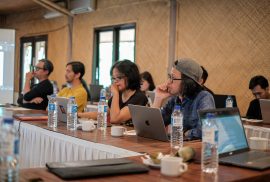
Dr. Suhandano, Dr. Sailal Arimi, and Drs. Tatang Hariri along with Master of Linguistics students across generations, carried out a ‘Students Gathering’ as well as the ‘The KALINGGA Handover Ceremony 2024’ on Friday, 23 February 2024. In this activity, various discussions related to academic activity in the Master of Linguistics UGM took place actively, such as transparency of student assessments and holding a prayer room in the Soegondo building so that lectures took place more efficiently. On this occasion, Dr. Suhandano also said that there would be a new application related to assessment, namely ‘Sioba’. Furthermore, final semester assignments also need to provide options other than articles and there is also a need for thesis research mentoring by lecturers. It is hoped that through this activity students will be more motivated to publish journals and be big on writing their theses so they can complete it on time.

The system of the Sustainable Development Goals (SDGs) embraced in September 2015 by the UN, the worldwide improvement motivation for the primary time alludes to culture. The benefits of keeping up and progressing culture are accomplished through socially educated and viable execution of advancement objectives. Thus, discussion forums between lecturers and students can be a good culture to support and improve the quality of the learning environment.

In this activity, the stewardship of KALINGGA for the next 1 year was also officially appointed by Dr. Suhandano, witnessed by the previous year’s KALINGGA Management and students from across generations who were present. In the next 1 year, KALINGGA is expected to become a forum that can accommodate the aspirations of Master of Linguistics students, support the growth of student achievement and innovation, including creating useful activities in the field of Linguistics and society.

BOOK REVIEW OF [R]EVOLUSI SASTRA DI ERA DIGITAL

News Release Monday, 26 February 2024

SDG 4: Quality Education | SDGs 4: Education for sustainability | SDG 9: Industry, innovation and infrastructure | SDGs 9: Affordable access | SDG 10: Reduced inequalities | SDGs 10: Education | SDG 11: Sustainable cities and communities | SDGs 11: Adaptation 

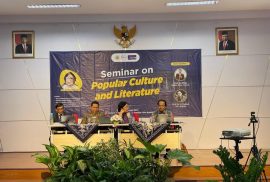
Apart from the Seminar in Popular Culture and Literature, another agenda that attracts literature enthusiasts in the Retirement Period Event of Prof. Ida Rochadi Adi, S.U. was a Book Review of the book entitled [R]EVOLUTION OF LITERARY IN THE DIGITAL ERA: Theoretical and Historical Perspectives whose author is none other than Prof. Ida. The agenda started at 10.30 am on Monday 19th of February 2024 and lasted for approximately 45 minutes at the same place as the other series of agendas, it was in the Auditorium of the Faculty of Cultural Sciences, Gadjah Mada University. On this occasion, the speaker was Dr. Anna Sriastuti, M. Hum. and Dr. Rif’ah Innayati, M.A.

The book was written with the aim of responding to technological developments that are capable of changing the mature structure of a scientific discipline. The author tried to capture the lament of a scientific discipline facing the dilemma of technological change. From a theoretical and historical perspective, the book tried to offer a framework for responding to developments in the digital world in the world of literature. This book could provide thought, reflection and development of new ideas regarding the phenomenon of literary works in the development of the digital world in the current modern era. Finally, both speakers strongly recommended reading the book because it can really open up thinking about literature in the digital era.

SOFT SKILL TRAINING DEVELOPMENT OF BACHELOR GRADUATION CANDIDATES AT FACULTY OF CULTURAL SCIENCES UGM, 2ND PERIOD OF 2023/2024 ACADEMIC YEAR

HEADLINESNews Release Wednesday, 21 February 2024

SDG 4: Quality Education | SDGs 4: Education for sustainability | SDG 9: Industry, innovation and infrastructure | SDGs 9: Economic development | SDG 10: Reduced inequalities | SDGs 10: Business | SDG 17: Partnerships for goals | SDGs 17: Fostering innovation

All prospective graduates will definitely feel happy and relieved because they have completed the difficult tasks they undertook during college, especially their thesis. However, they will face the next struggle after graduating from college. They will start a new life which of course will have increasingly difficult and numerous challenges. The reality of life that does not always match what they want requires fresh graduates to really prepare themselves by planning what they will do after graduating. Realizing the anxiety felt by prospective alumni, the Faculty of Cultural Sciences, Gadjah Mada University held soft skills training for prospective graduates the day before graduation day to prepare human resources who are ready to face the world outside campus.

Tania Nugraheni Ayuningtyas, is a successful young entrepreneur who graduated from the Tourism study program at the Faculty of Cultural Sciences who is currently continuing her postgraduate studies at the Agribusiness Management study program at Gadjah Mada University with an LPDP scholarship. The twists and turns of her journey in achieving success can be a motivation and lesson for anyone who just wants to start a business, this is what makes her worthy of being a speaker at this training in front of undergraduate graduate candidate which will be held on Tuesday, February 20 2024 at the Faculty of CulturalScience Auditorium, Gadjah Mada University. Before finally she succeeded as owner & director of CV. Slamet Jogjamu Indonesia and also Co-Founder & Finance Manager of PT. Waturanda Destination, she experienced failure and even fraud. But that didn’t make her give up, in fact these incidents encouraged her to continue learning and thinking to be better.

That afternoon, she shared her valuable knowledge about how to start a business. According to her, there are three important things that must be done, namely Learn, Build and Measure. Learn, namely gathering understanding about the target market, customers and problems that need to be solved, as well as creating hypotheses to test on the market. Build is building a product or service simply and quickly. And the last thing that entrepreneurs rarely remember but is very important is Measure, which is actively collecting data and feedback from users so that it is possible to measure product performance. With the knowledge she shared, she hoped that prospective graduates will be ready to face the new world after graduating and can plan carefully for the future.

WHAT’S HAPPENING WITH TRANSLATION? Uncertainty and Failure Theory in the Humanities

HEADLINESNews Release Wednesday, 21 February 2024

SDG 4: Quality education | SDGs 4: Education | SDG 8: Decent work and economic growth | SDGs 8: Culture | SDG 11: Sustainable cities and communities | SDGs 11: Adaptable | SDG 16: Peace, justice, and strong institutions | SDGs 16: Education | SDG 17: Partnerships for the goals | SDGs 17: Fostering Innovation

The title of this Public Lecture succeeded in attracting the attention of students from the Faculty of Cultural Sciences, Gadjah Mada University who were interested in concentrating on translation to attend the Multimedia Room on the 2nd floor of the Margono Building on Tuesday 20th of February 2024. Students from various levels and classes as well as lecturers filled the room from 9 am to gain new knowledge about translation from extraordinary sources in their field. The resource person is the Head of Pacific and Asian Students from the University of Victoria (British Columbia, Canada). Before presenting his material, he expressed his deepest gratitude to the Faculty of Cultural Sciences for supporting his research and to the students who were willing to take the time to attend the general lecture.

The material opened by explaining the meaning of translation so that public lecture participants knew the basic knowledge first before discussing translation and its problems in more depth. The use of differentiation in each concept of religion and atma was one of the problems in translation where there might be a language transformation adapted from the old concept to the new constitution. On the issue of religion and atma, there were a number of terms and other languages that were trapped in language transformation efforts. The presenter delivered the material in a way that was easy to understand, namely by relating it to examples found in everyday life based on the presenter’s personal experience. From the presentation given, he concluded that the use of linguistics, especially in the field of translation, could not be separated from concepts in everyday life.

Prof. Dr. Faruk HT., moderator at this public lecture, closed by providing a simpler conclusion that there were three important points that could be noted. First, translation as a crossing of meaning. This does not only apply to interlanguage translations but also between languages, for example between one group and another. Second, the concept of metaphor is conveying something with another meaning. This meaning can also be reversed, that is, conveying the meaning with a different name or sign. Third, meaning is a fluid process that can change from one place to another, from one case to another, such as in the case of religion and atma. Finally, the question and answer session was led by a different moderator, namely Dr. Arsanti Wulandari, M. Hum.

THE VISIT OF SMA WACHID HASYIM 1 SURABAYA

News Release Monday, 12 February 2024

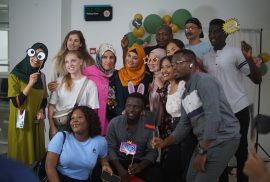
Long distance travel from Surabaya to Yogyakarta apparently did not prevent them from continuing to show their enthusiasm when listening, watching, and discussing everything about the Faculty of Cultural Sciences, Gadjah Mada University on Wednesday, February 7th 2024. Starting from the quiz session to the question and answer session, they were very enthusiastic about fighting to be appointed. The questions they asked were insightful and very varied, some asked about scholarships, the registration system, and the activities they would do if they were the students here. These high school students have had an interest in the social sector from the start, seeing from the major they take which is social studies, many of them dream of continuing their education at this faculty. The majors they wanted were very diverse, there were tourism, archaeology, Korean language and culture, Japanese literature, and others.

One of the teacher representatives who gave the opening speech repeatedly expressed his gratitude and thanks for the warm welcome they received, and hoped that in the future they would produce many superior generations who were able to compete and were worthy of being part of Gadjah Mada University student. Two other teachers who were also in the group were very humble enough to take the time to shake hands and joke around for a while before leaving the room. Apart from warm greetings, they also gave souvenirs and large parcels in the form of typical Surabaya souvenirs which they brought from far away. After having a light chat before going back, a group photo session was held. This visit ended with a very pleasant impression. The students and accompanying teachers continued their visit by going around to see the environment in the Faculty of Cultural Sciences while occasionally capturing the moment with their cell phone cameras.

1…2728293031…34

Video UGM

[shtmlslider name='shslider_options']
Universitas Gadjah Mada

Faculty of Cultural Sciences
Universitas Gadjah Mada
Jl. Nusantara 1, Bulaksumur Yogyakarta 55281, Indonesia
   fib@ugm.ac.id
   +62 (274) 513096
   +62 (274) 550451

Work Units

  • Office of Journal & Publishing
  • INCULS
  • Information Technology and Database
  • Language Learning Center
  • Library Unit
  • Public Relations
  • Research

Facilities

  • Computer Laboratory
  • Gamelan
  • Guest House
  • Language Library
  • Library
  • Phonetics Library
  • Self Access Unit
  • Student Internet Centre

Importan Links

  • Journal of Humaniora
  • Subscriber Journal
  • Alumni Portal
  • Career
  • Departmens News
  • UGM Streaming

Contacts

  • Academic
  • Administration
  • Dean’s Office
  • Departments / Study Programs
  • Public Relations

© 2024 Faculty of Cultural Sciences Universitas Gadjah Mada

KEBIJAKAN PRIVASI/PRIVACY POLICY

[EN] We use cookies to help our viewer get the best experience on our website. -- [ID] Kami menggunakan cookie untuk membantu pengunjung kami mendapatkan pengalaman terbaik di situs web kami.I Agree / Saya Setuju