• About UGM
  • Academic Portal
  • IT Center
  • Library
  • Research
  • Webmail
  • Informasi Publik
  • English
    • Indonesia
Universitas Gadjah Mada Faculty of Cultural Sciences
Universitas Gadjah Mada
  • Home
  • Profile
    • History
    • Vision and Mission
    • Organizational structure
    • Administration
    • Staff
    • Faculty Members
  • Academic
    • Academic Calendar
    • Undergraduate Programs
      • Bachelor of Cultural Antrophology
      • Bachelor in Archaeolagy
      • Bachelor in History
      • Bachelor in Tourism
      • Bochetor in Korean Language and Culture
      • Bachelor in Indonesian Language and Culture
      • Bachelor in English
      • Bachelor in Arabic
      • Bachelor in Japanese Language and Culture
      • Bachelor in Javanese Language, Literature and Culture
      • Bachelor in French language and literature
    • Graduate Programs
      • Master in Antrophology
      • Master in ArchaeoIogy
      • Master in History
      • Master in Linguistics
      • Master in Literature
      • Master In American Studies
      • Master in Middle Eastern Cultural Studies
    • Post-Graduate Programs / S3
      • Doctor in Antropology
      • Doctor in American Studies
      • Doctor in Humanities
    • Student Service
  • KPPM
    • Research Information
    • Scientific / Academic Publications
    • Community Service
    • International Cooperation
    • Domestic Cooperation
  • Student Organizations
    • Student Executive Council
    • Semi-Autonomous Organizations
      • KAPALASASTRA
      • Christian Student Alliance
      • LINCAK
      • Saskine
      • Catholic Student Family
      • Dian Budaya
      • Sastra Kanuragan (sasgan)
      • Family of Muslim Cultural Sciences Students (KMIB)
      • Bejo Mulyo
    • Autonomous Organizations
      • Family of Anthropology Students (KEMANT)
      • English Department Student Association
      • Tourism Students Association (HIMAPA)
      • Family of Indonesian Literature Students (KMSI)
      • West Asian Literature Student Association (IMABA)
      • Association of Korean-Language Students (HIMAHARA)
      • Family of Regional Indonesian Literatures Students (KAMASUTRA)
      • The Family Body of History Students (BKMS)
      • The French Literature Students Association (HMSP)
      • Family of Anthropology Students
      • Japanese Student Association (HIMAJE)
  • Admission
    • Student Evaluation
  • Home
  • FIB UGM
  • (Page 2)
Arsip:

FIB UGM

Community Service Program on Social Media Etiquette Among Teenagers Enters Its Second Phase at SMA Negeri 1 Depok

News Release Friday, 28 August 2026

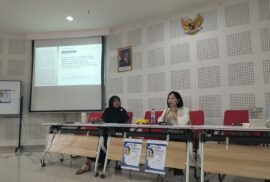
The Community Service Program (PkM) entitled “Social Media Etiquette Among Teenagers”, organized by the Master’s Program in Linguistics, Faculty of Cultural Sciences, Universitas Gadjah Mada (FIB UGM), has continued into its second phase. The activity was held at SMA Negeri 1 Depok, Sleman, as part of an educational series aimed at raising students’ awareness of the importance of practicing politeness in digital communication.

Following the first phase, during which students received instruction on social media etiquette and participated in group activities, the second phase focused on group presentations showcasing the students’ creative projects. This stage provided an opportunity for participants to apply the knowledge they had gained by producing works related to the theme of respectful communication on social media.

During the presentations, each group presented the projects they had prepared in advance. These works took various forms, including flyers and video content conveying messages about the importance of using social media wisely, respectfully, and responsibly. Through their projects, the students illustrated situations commonly encountered by teenagers on social media and demonstrated how polite language and respectful behavior can be applied in digital interactions.

The presentations served not only as a platform for students to demonstrate their creativity but also as an opportunity to engage in discussion and reflect on their own communication habits on social media. The activity encouraged students to recognize that effective social media use extends beyond creating and sharing content; it also involves carefully considering language choices, attitudes, and the potential impact of communication on others.

In addition to the project presentations, students also completed a post-test as part of the overall evaluation of the Community Service Program. The post-test was administered after the completion of all instructional sessions and activities to assess students’ understanding of social media etiquette following both theoretical learning and hands-on experience throughout the program.

The “Social Media Etiquette Among Teenagers” Community Service Program is expected to provide meaningful and contextual learning experiences for students of SMA Negeri 1 Depok, particularly in fostering awareness of the importance of using polite language and demonstrating respectful behavior in digital spaces. By integrating lectures, collaborative activities, creative projects, and evaluation, the program aims not only to deepen students’ understanding of social media etiquette but also to encourage them to apply these principles in their daily lives.

The students’ enthusiasm and creativity in producing and presenting their projects became one of the key indicators of the program’s success. Furthermore, the collaboration between the Master’s Program in Linguistics, Faculty of Cultural Sciences, Universitas Gadjah Mada, and SMA Negeri 1 Depok is expected to continue contributing positively to the enhancement of language literacy and responsible social media awareness among teenagers.

With the completion of its second phase, the “Social Media Etiquette Among Teenagers” Community Service Program has become a shared learning space for both academics and students, highlighting that politeness is essential not only in face-to-face communication but also in every interaction within the digital environment.

First-Year Lecture of the Undergraduate Program at FIB UGM 2026: Cultivating Empathy and Ethics Through “Be Kind: Because ‘Just Kidding’ Isn’t Always Kind”

News Release Thursday, 27 August 2026

Faculty of Cultural Sciences, Universitas Gadjah Mada (FIB UGM) held the First-Year Lecture for the Undergraduate Program for the 2026/2027 Academic Year on Tuesday (18/8). The event, which took place in the main hall of the Soegondo Auditorium at FIB UGM, was attended by approximately 800 new students from the class of 2026.

For this year’s lecture, FIB UGM invited a speaker from the Faculty of Medicine, Public Health, and Nursing (FK-KMK) UGM, dr. Bagas Suryo Bintoro, Ph.D. He is a lecturer from the Department of Health Behavior, Environment, and Social Medicine. On this occasion, dr. Bagas presented an important topic titled “Be Kind: Because ‘Just Kidding’ Isn’t Always Kind”.

In his presentation, dr. Bagas highlighted the prevalence of mental health issues affecting adolescents in Indonesia. These issues are often triggered by feelings of loneliness, a lack of someone to talk to, and past trauma. One trigger that often goes unnoticed in social environments is jokes that cross the line. He reminded the audience that in many cases, people intend to joke, but unknowingly end up hurting others’ feelings.

To prevent this, dr. Bagas emphasized the importance of applying basic interpersonal attitudes, such as the habit of saying thank you, apologizing, and building genuine empathy toward others.

The atmosphere of the lecture was warm and interactive. Dr. Bagas occasionally incorporated fresh, relatable humor that resonated with the younger generation, sparking laughter among the attending FIB UGM freshmen.

Through this lecture, the faculty hopes that the core values and materials presented will serve as a valuable foundation for the new students. Consequently, they will be able to navigate their university life well, ethically, and contribute to creating an inclusive and mutually respectful campus environment.


[Author: Humas FIB, Zaidan Abdurrahman]

Unggunan Cerita: Inside Mahfud Ikhwan’s Creative Process

News Release Monday, 24 August 2026

Yogyakarta — The night at Pondok A. Salam, Kalimasada, grew warmer during Unggunan Cerita, a session featuring writer Mahfud Ikhwan as part of the 2026 Literary Camp with Nature and the Universe. In an informal and intimate atmosphere, Mahfud shared stories from his writing journey, discussed his creative process and research, reflected on his fascination with popular culture, and offered his thoughts on literary criticism.

The session gave participants a glimpse into the “creative kitchen” of a writer who has spent years developing his work through persistence, research, and close attention to everyday life.

Mahfud began his literary journey with the novel Ulid Tak Ingin ke Malaysia (2009). His name became increasingly recognized through Kambing dan Hujan: Sebuah Roman (2015) and Dawuk: Kisah Kelabu dari Rumbuk Randu (2017). These works reflect his sustained interest in ordinary people, particularly rural communities and those living on the margins of mainstream society.

During Unggunan Cerita, Mahfud spoke at length about the way he works. Writing a novel, he explained, is not necessarily something that can be completed in a matter of months. Some projects take years—up to nine years for a single novel.

For Mahfud, every novel calls for its own treatment, working process, method, and research. There is no universal formula that can be applied to every book. Literary research, he noted, cannot simply be treated in the same way as academic or scientific research. Its approach depends on the story being written, the world the writer wants to create, and what the work seeks to convey.

He also referred to Haruki Murakami’s writing routine as an example of how a writer can cultivate creative discipline through repetition. Murakami is well known for combining regular running with a disciplined writing practice. For Mahfud, the example demonstrates that creative work also demands consistency and persistence rather than simply waiting for inspiration to arrive.

One of Mahfud’s most interesting suggestions was that writers should not necessarily begin a story with a grand idea or grand narrative. A story can instead emerge from something seemingly small: an incident, a scene, an exchange, or a compelling piece of dialogue.

Such small details can become an entry point into a much larger story. What matters is whether the scene or event can draw readers in, make them want to stay with the story, and leave them curious about what comes next.

This approach means that writers do not have to impose a grand idea on a story from the outset. A seemingly ordinary conversation or minor incident can grow into a complex fictional world when handled with care.

The same sensibility can be seen in Mahfud’s attention to forms of culture outside the established cultural mainstream. He is comfortable engaging with what he calls “low culture and entertainment”—forms of popular culture that are often dismissed or looked down upon.

The lives of ordinary people and communities on the margins, for instance, have become the raw material for his fiction. One example is Dawuk: Kisah Kelabu dari Rumbuk Randu, a novel about life in a rural community that went on to receive a prestigious literary award.

Mahfud’s fascination with popular culture does not remain merely a matter of personal consumption. Dangdut, Indian films, and football have all found their way into his writing.

His interest in football, for example, inspired the novel Bek: Sebuah Novel (2024). His love of Indian cinema became the subject of the essay collection Aku dan Film India Melawan Dunia (2017). His fascination with dangdut and other forms of popular culture later found expression in Kepikiran Dangdut dan Hal-hal Pop Lainnya (2024).

These works demonstrate that literary material does not always have to come from what is considered “high culture.” Everyday life, popular entertainment, social habits, and things that are often dismissed as trivial can all become sources of literary creativity.

For Mahfud, it is precisely in such seemingly ordinary spaces that stories can retain a strong connection to concrete human experience.

Toward the end of the session, the conversation turned to literary criticism. Mahfud explained that good criticism serves a purpose far beyond simply judging a work or pointing out its weaknesses.

He compared literary criticism to singing practice and singing off-key. A singer may not realize that a particular note is slightly out of tune. In much the same way, a writer may not be aware of everything taking place within their own work.

“There are things that even the writer does not know or realize.”

Literary criticism, therefore, can reveal possibilities that remain invisible to the writer. With the right perspective, theory, and method, criticism can become a productive way of reading a work more closely and thoughtfully.

For Mahfud, literary criticism should not be reduced to what is increasingly associated with arguments on social media: sniping at others, trading personal attacks, or creating noise without a clear intellectual basis.

Mahfud has also practiced criticism himself through his book Melihat Pengarang Tidak Bekerja (2022). The book reflects his own approach to criticism: staying close to the literary work while examining authorship and the creative process from a critical perspective.

Ultimately, Unggunan Cerita became more than a conversation about writing techniques. From the long gestation of a novel to his enthusiasm for dangdut, Indian cinema, and football, Mahfud showed that a writer’s creative kitchen can be found almost anywhere.

Stories can grow out of villages, marginal spaces, football fields, Indian films, dangdut stages, or even a seemingly insignificant line of dialogue. What matters is how a writer observes, processes, researches, and gives form to what they encounter.

Under the night sky of Kalimasada, Unggunan Cerita offered a reminder that literature does not always emerge from grand ideas. Sometimes, it begins with something small that someone takes the time to notice—and then patiently works on for years.


Author: Khotibul Umam


Preserving Independence and Human Character through a Literary Camp

News Release Friday, 21 August 2026

Yogyakarta — The Master’s Program in Literary Studies at the Faculty of Cultural Sciences, Universitas Gadjah Mada (UGM), held the 2026 Literary Camp with Nature at Pondok A. Salam, Kalimasada, from August 14 to 15. Conceived as a community-oriented and collaborative initiative, the camp brought together writers and literary enthusiasts in an informal setting while inviting them to reflect on what literature means—and what it can do—in everyday life.

The camp was intentionally modest and non-commercial. For Prof. Dr. Aprinus Salam, M.Hum., Head of UGM’s Master’s Program in Literary Studies and one of the event’s facilitators, this simplicity was part of the point. At its heart, he argues, literature should help people remain independent and hold on to their sense of humanity.

“What matters in literature, including an event like this Literary Camp, is the effort to preserve independence and uphold our character. And perhaps the chances of failing are greater.”

For Aprinus, independence is never easy to maintain. Throughout its history, literature has often occupied a distinctive position in relation to political and economic power, as well as to social and cultural structures built on hierarchy and inequality.

Literature, he suggests, has a critical responsibility: to examine the world we inhabit and distinguish what has been compromised from what remains worth defending.

“Ethically and aesthetically, literature is a continuing effort to discern what in life has been corrupted and what ought to be defended.”

This perspective helps explain the spirit behind the Literary Camp. It was not conceived as a commercial event, nor as a gathering defined by elaborate facilities. Instead, it sought to create a space where people could meet, exchange ideas, and reconnect through literature.

Aprinus acknowledges that maintaining independence is a difficult undertaking and that failure is always a real possibility. Independent initiatives, he observes, are becoming increasingly difficult to sustain, particularly in a society where many people live under significant constraints and have had few opportunities to cultivate self-reliance.

For him, however, literature’s concern with independence goes hand in hand with something deeper: preserving the human capacity for empathy, integrity, and conscience.

“Historically, literature has also been a space for reaffirming our essential humanity. It is a space where we struggle to preserve what is genuine in being human. Literature is one way of keeping our conscience alive.”

Participants in the 2026 Literary Camp were selected through a literary curation process. Applicants were asked to submit either at least one short story or five poems. Around 40 percent of the submissions—roughly 40 participants—were ultimately selected.

Their works will be compiled into an anthology of short stories and poetry. Initially, the anthology will be produced as a photocopied edition according to the number of copies needed. If the collection proves worthy of further development, the organizers plan to pursue an ISBN for a subsequent edition.

In this sense, the Literary Camp was more than a gathering. It brought together several dimensions of literary life—writing, reading, curation, discussion, and exchange—within an intentionally modest setting.

The program began on Friday afternoon with the arrival of participants and the formation of groups, followed by communal prayer and a briefing. The afternoon unfolded informally, with introductions, conversations, walks, light exercise, and time spent exploring the gardens around Kalimasada. As evening fell, participants gathered to watch the sunset before beginning the main evening program.

After dinner came Literary Oration, featuring Muhammad Lutfi Dwi Kurniawan and Rini Febriani Hauri, followed by a reading of Curatorial Notes. The evening continued with a relaxed conversation with writer Mahfud Ikhwan, titled Unggunan Cerita, before moving into poetry and short-story readings.

The night eventually gave way to rest, and the program resumed on Saturday morning with dawn prayers, a morning walk, coffee and tea, breakfast, a group photograph, and preparations for departure.

For Aprinus, the significance of the camp lies partly in its brevity. The event lasted only about 18 hours, but even such a short encounter can offer a temporary space in which participants attempt to live out the values they associate with literature.

Yet he is careful not to romanticize the experience. The real test, he suggests, begins after everyone leaves.

“The Literary Camp is one example. During those hours, it may seem that we are trying to preserve our independence and hold on to our humanity. But unfortunately, it lasts only 18 hours.”


Once the camp is over, participants return to their separate lives. The temporary community dissolves, and each person must once again negotiate the pressures of everyday existence.

“After the Literary Camp, we have to struggle on our own again—caught up in noisy political routines, anxious economic pressures, and a social and cultural routine that can become tedious.”

Seen in this light, the camp is not an escape from reality so much as a brief interruption of it. It offers participants a chance to step away from the noise, even momentarily, and to read, write, talk, listen, and reflect.

The limited facilities at Pondok A. Salam are part of that experience. The camp does not promise comfort or convenience. Participants share simple spaces, adjust to limited resources, exchange stories, and learn to take responsibility for their own needs.

That simplicity also reinforces the event’s broader ethos: literature does not necessarily require elaborate infrastructure to create meaningful encounters.

With a relatively full schedule, participants were expected to respect time and remain attentive to one another. But discipline was not meant to undermine the camp’s convivial spirit. On the contrary, the organizers hoped that the event would be a joyful occasion—a place where literature could be experienced rather than merely talked about.

Ultimately, as Aprinus Salam suggests, literature is about more than texts, literary technique, or aesthetics. It is also about the ongoing struggle to preserve something more fundamental: our independence, our humanity, and our conscience.


Author: Khotibul Umam

Entering Their Third Semester, Arabic Literature UGM Encourages 2025 Students to Plan Ahead and Seize Opportunities

News Release Friday, 21 August 2026

YOGYAKARTA – As they enter their third semester, students of the Arabic Literature Study Program at Universitas Gadjah Mada (UGM) took part in an orientation session to prepare for the upcoming semester while planning their academic and personal development. The session covered curriculum updates, academic planning, time management, and opportunities for students to develop their skills both inside and outside the classroom. The session began with a presentation by Dr. Zulfa Purnamawati, S.S., M.Hum., who explained the transition between the 2021 and 2026 curricula. Students learned about course mapping and the points they need to consider when planning their studies, including courses from previous semesters that they may still need to complete.

The discussion then moved beyond academic matters through a sharing session with Pandhita Hapsari, an Arabic Literature student from the 2023 intake. She encouraged the 2025 students to be willing to try new things and take opportunities they may not have considered before. Drawing from her own experiences, Pandhita highlighted the importance of stepping outside one’s comfort zone and being open to failure as part of the learning process. She also encouraged students to take part in organizations, competitions, and other activities that can help them develop their soft skills. These experiences, she explained, can become valuable preparation for entering the professional world. At the same time, students were reminded to manage their time well and maintain a balance between academic responsibilities and other activities.

The session continued with discussions between students and their respective Academic Advisors (DPA): Dr. Mahmudah, S.S., M.Hum., Dr. Nur Kholid, S.Pd.I., M.Pd.I., and Dr. Muhammad Zakki Masykur, S.S., M.Pd.I. The discussion provided students with an opportunity to consult directly about their academic plans and prepare for the upcoming semester. It also allowed students to discuss their study progress and receive guidance based on their individual academic needs. Through the session, students gained not only a clearer understanding of their academic plans but also new perspectives on how to make the most of their university experience. Entering their third semester, the 2025 students are encouraged to take greater initiative, explore new opportunities, and develop experiences and skills that can support their academic journey and future careers.

Author : Indana Zulfa Maulida

1234…124

Video UGM

[shtmlslider name='shslider_options']
Universitas Gadjah Mada

Faculty of Cultural Sciences
Universitas Gadjah Mada
Jl. Nusantara 1, Bulaksumur Yogyakarta 55281, Indonesia
   fib@ugm.ac.id
   +62 (274) 513096
   +62 (274) 550451

Work Units

  • Office of Journal & Publishing
  • INCULS
  • Information Technology and Database
  • Language Learning Center
  • Library Unit
  • Public Relations
  • Research

Facilities

  • Computer Laboratory
  • Gamelan
  • Guest House
  • Language Library
  • Library
  • Phonetics Library
  • Self Access Unit
  • Student Internet Centre

Importan Links

  • Journal of Humaniora
  • Subscriber Journal
  • Alumni Portal
  • Career
  • Departmens News
  • UGM Streaming

Contacts

  • Academic
  • Administration
  • Dean’s Office
  • Departments / Study Programs
  • Public Relations

© 2024 Faculty of Cultural Sciences Universitas Gadjah Mada

KEBIJAKAN PRIVASI/PRIVACY POLICY

[EN] We use cookies to help our viewer get the best experience on our website. -- [ID] Kami menggunakan cookie untuk membantu pengunjung kami mendapatkan pengalaman terbaik di situs web kami.I Agree / Saya Setuju