• About UGM
  • Academic Portal
  • IT Center
  • Library
  • Research
  • Webmail
  • Informasi Publik
  • English
    • Indonesia
Universitas Gadjah Mada Faculty of Cultural Sciences
Universitas Gadjah Mada
  • Home
  • Profile
    • History
    • Vision and Mission
    • Organizational structure
    • Administration
    • Staff
    • Faculty Members
  • Academic
    • Academic Calendar
    • Undergraduate Programs
      • Bachelor of Cultural Antrophology
      • Bachelor in Archaeolagy
      • Bachelor in History
      • Bachelor in Tourism
      • Bochetor in Korean Language and Culture
      • Bachelor in Indonesian Language and Culture
      • Bachelor in English
      • Bachelor in Arabic
      • Bachelor in Japanese Language and Culture
      • Bachelor in Javanese Language, Literature and Culture
      • Bachelor in French language and literature
    • Graduate Programs
      • Master in Antrophology
      • Master in ArchaeoIogy
      • Master in History
      • Master in Linguistics
      • Master in Literature
      • Master In American Studies
      • Master in Middle Eastern Cultural Studies
    • Post-Graduate Programs / S3
      • Doctor in Antropology
      • Doctor in American Studies
      • Doctor in Humanities
    • Student Service
  • KPPM
    • Research Information
    • Scientific / Academic Publications
    • Community Service
    • International Cooperation
    • Domestic Cooperation
  • Student Organizations
    • Student Executive Council
    • Semi-Autonomous Organizations
      • KAPALASASTRA
      • Christian Student Alliance
      • LINCAK
      • Saskine
      • Catholic Student Family
      • Dian Budaya
      • Sastra Kanuragan (sasgan)
      • Family of Muslim Cultural Sciences Students (KMIB)
      • Bejo Mulyo
    • Autonomous Organizations
      • Family of Anthropology Students (KEMANT)
      • English Department Student Association
      • Tourism Students Association (HIMAPA)
      • Family of Indonesian Literature Students (KMSI)
      • West Asian Literature Student Association (IMABA)
      • Association of Korean-Language Students (HIMAHARA)
      • Family of Regional Indonesian Literatures Students (KAMASUTRA)
      • The Family Body of History Students (BKMS)
      • The French Literature Students Association (HMSP)
      • Family of Anthropology Students
      • Japanese Student Association (HIMAJE)
  • Admission
    • Student Evaluation
  • Home
  • News Release
  • Seputar Jawa: The Digital Javanese Script Keyboard System

Seputar Jawa: The Digital Javanese Script Keyboard System

  • News Release
  • 3 June 2026, 14.37
  • Oleh: Humas FIB
  • 0

Typing Javanese script on digital devices is often not as easy as imagined. Instead of displaying the expected letters, the screen often displays a row of blank squares or tofu, a sign that the font is not legible. This problem is not isolated. In addition to font limitations, the differences in typing systems between the Latin alphabet and Javanese script also make it difficult for users to adapt. Furthermore, keyboard layouts vary across operating systems, from Windows to Macintosh to Android. This directly complicates the use and preservation of Javanese script, especially in the digital realm.

A number of Javanese script fonts are already available and can be used freely, such as NyK Ngayogyan and NyK Ngayogyan Jejeg, developed by the Yogyakarta Special Region Cultural Office. However, the problems don’t stop at visual appearance. Without a uniform keyboard system, users continue to face obstacles in their daily typing practices.

This situation prompted the development of a Javanese script keyboard system based on the Indonesian script keyboard (SNI 9048). This system was designed with reference to the Serat Wulangreh manuscript as a cultural basis, while also being adapted to the needs of use on various digital devices. Through this standardization, it is hoped that uniformity in typing Javanese script will be achieved, eliminating the need for users to adapt to different systems.

This keyboard system is now available for various devices and is freely accessible to the public. Users can download and install it according to their operating system, whether Windows, Macintosh, or Android. The Javanese script keyboard system can be downloaded from https://wongsayuk.webnode.page/my-work/ or https://wongsaayuk.webnode.page by selecting the download menu. On the page, there is a “Javanese Aksara Keyboard” section, then select the SNI Nataksara system in various formats depending on the device: .exe file for Windows, .dmg file for Macintosh, and .apk file for Android.

After downloading and installing, users are advised to restart their device if the system is not immediately usable. An installation guide (pitoedoeh) is also provided to facilitate the installation process and ensure optimal system use.

Once the system is installed, understanding the keyboard layout is the next important step. Users need to understand the differences between the SNI 9048-based system and the device’s native system, particularly on Windows devices. These differences can be seen in the image below.
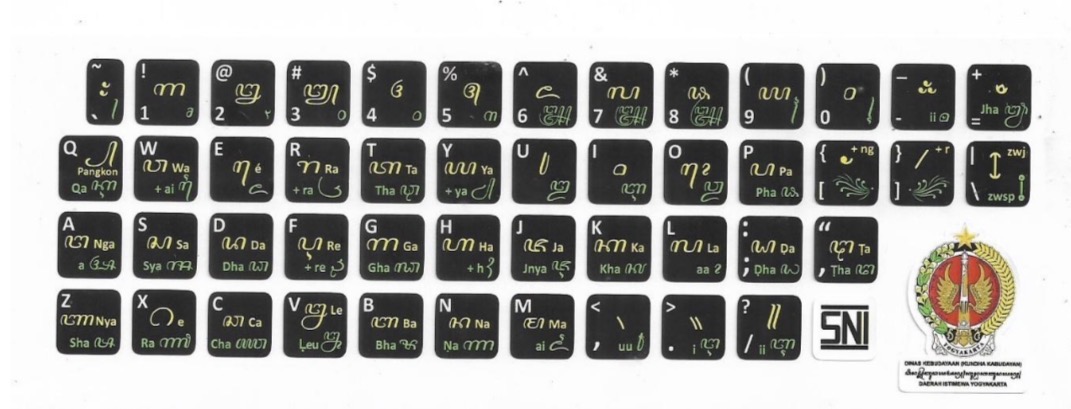
Javanese script keyboard version SNI 9048
Downloaded from Javanese script keyboard version SNI 9048, by S.A. Prasaja, n.t. wongsayuk (https://wongsayuk.webnode.page/my-work/).
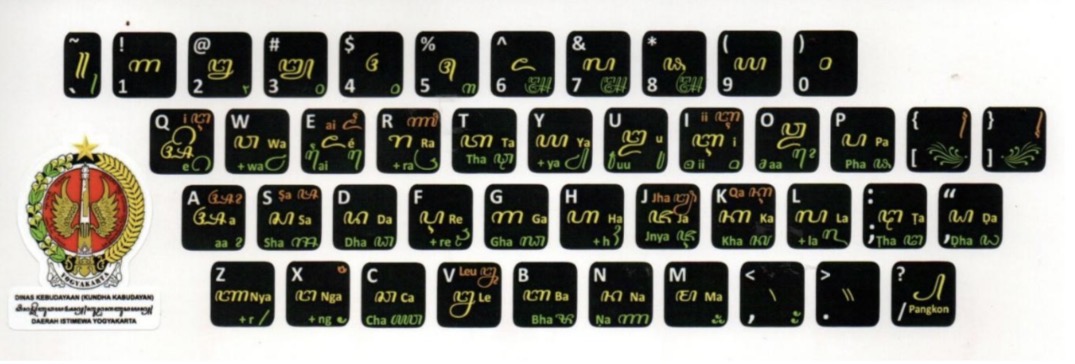
 

Javanese script keyboard version Windows
Downloaded from Javanese script keyboard version Windows, by S.A. Prasaja, n.t. wongsayuk (https://wongsayuk.webnode.page/my-work/).


The implementation of this standardized keyboard system is a crucial step in addressing the various technical challenges users have faced. Furthermore, the presence of Javanese script in the digital space serves not only as a visual element but also as part of efforts to maintain cultural continuity amidst technological advancements.

Ultimately, preserving Javanese script is not simply a matter of maintaining it; it also requires the courage to develop and adapt it to the times. Continuous support from various parties is key to ensuring that Javanese script not only remains alive but also remains present and empowered within the ever-changing digital ecosystem.


Author : Haryo Untoro

Editor : Haryo Untoro


Bibliography

Prasaja, S.A. (t.t.) Papan Tombol Aksara Djawa Versi SNI 9048. Wongsayuk. https://wongsayuk.webnode.page/my-work/

Prasaja, S.A. (t.t.) Papan Tombol Aksara Djawa Versi Windows. Wongsayuk. https://wongsayuk.webnode.page/my-work/


Tags: Fakultas Ilmu Budaya UGM SDG 4: Quality Education SDGs 11: Kota dan Pemukiman yang berkelanjutan SDGs 11: Sustainable Cities and Communities SDGs 17: Kemitraan Untuk Mencapai Tujuan SDGs 17: Partnerships for the Goals SDGs 4 Pendidikan Berkualitas

Video UGM

[shtmlslider name='shslider_options']
Universitas Gadjah Mada

Faculty of Cultural Sciences
Universitas Gadjah Mada
Jl. Nusantara 1, Bulaksumur Yogyakarta 55281, Indonesia
   fib@ugm.ac.id
   +62 (274) 513096
   +62 (274) 550451

Work Units

  • Office of Journal & Publishing
  • INCULS
  • Information Technology and Database
  • Language Learning Center
  • Library Unit
  • Public Relations
  • Research

Facilities

  • Computer Laboratory
  • Gamelan
  • Guest House
  • Language Library
  • Library
  • Phonetics Library
  • Self Access Unit
  • Student Internet Centre

Importan Links

  • Journal of Humaniora
  • Subscriber Journal
  • Alumni Portal
  • Career
  • Departmens News
  • UGM Streaming

Contacts

  • Academic
  • Administration
  • Dean’s Office
  • Departments / Study Programs
  • Public Relations

© 2024 Faculty of Cultural Sciences Universitas Gadjah Mada

KEBIJAKAN PRIVASI/PRIVACY POLICY

[EN] We use cookies to help our viewer get the best experience on our website. -- [ID] Kami menggunakan cookie untuk membantu pengunjung kami mendapatkan pengalaman terbaik di situs web kami.I Agree / Saya Setuju