• About UGM
  • Academic Portal
  • IT Center
  • Library
  • Research
  • Webmail
  • Informasi Publik
  • English
    • Indonesia
Universitas Gadjah Mada Faculty of Cultural Sciences
Universitas Gadjah Mada
  • Home
  • Profile
    • History
    • Vision and Mission
    • Organizational structure
    • Administration
    • Staff
    • Faculty Members
  • Academic
    • Academic Calendar
    • Undergraduate Programs
      • Bachelor of Cultural Antrophology
      • Bachelor in Archaeolagy
      • Bachelor in History
      • Bachelor in Tourism
      • Bochetor in Korean Language and Culture
      • Bachelor in Indonesian Language and Culture
      • Bachelor in English
      • Bachelor in Arabic
      • Bachelor in Japanese Language and Culture
      • Bachelor in Javanese Language, Literature and Culture
      • Bachelor in French language and literature
    • Graduate Programs
      • Master in Antrophology
      • Master in ArchaeoIogy
      • Master in History
      • Master in Linguistics
      • Master in Literature
      • Master In American Studies
      • Master in Middle Eastern Cultural Studies
    • Post-Graduate Programs / S3
      • Doctor in Antropology
      • Doctor in American Studies
      • Doctor in Humanities
    • Student Service
  • KPPM
    • Research Information
    • Scientific / Academic Publications
    • Community Service
    • International Cooperation
    • Domestic Cooperation
  • Student Organizations
    • Student Executive Council
    • Semi-Autonomous Organizations
      • KAPALASASTRA
      • Christian Student Alliance
      • LINCAK
      • Saskine
      • Catholic Student Family
      • Dian Budaya
      • Sastra Kanuragan (sasgan)
      • Family of Muslim Cultural Sciences Students (KMIB)
      • Bejo Mulyo
    • Autonomous Organizations
      • Family of Anthropology Students (KEMANT)
      • English Department Student Association
      • Tourism Students Association (HIMAPA)
      • Family of Indonesian Literature Students (KMSI)
      • West Asian Literature Student Association (IMABA)
      • Association of Korean-Language Students (HIMAHARA)
      • Family of Regional Indonesian Literatures Students (KAMASUTRA)
      • The Family Body of History Students (BKMS)
      • The French Literature Students Association (HMSP)
      • Family of Anthropology Students
      • Japanese Student Association (HIMAJE)
  • Admission
    • Student Evaluation
  • Home
  • 2025
  • page. 11
Arsip:

2025

UNDIP Master’s Program in Literary Studies Visits UGM’s Master’s Program in Literature to Exchange Insights and Deepen Academic Collaboration

News Release Tuesday, 25 November 2025

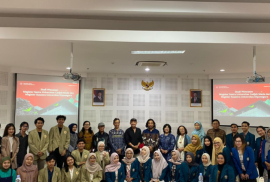
Yogyakarta, 13 November 2025 — The Master’s Program in Literature, Faculty of Cultural Sciences, Universitas Gadjah Mada, welcomed an academic visit from the Master’s Program in Literary Studies, Faculty of Cultural Sciences, Universitas Diponegoro at Room 709, Soegondo Building, FIB UGM. The event was part of the ongoing implementation of the cooperation agreement between the two faculties in education, research, and community engagement.

The visit began with a warm welcome from the UGM Master’s in Literature team, who greeted the UNDIP delegation of lecturers and students. From the outset, the atmosphere was relaxed and friendly, reflecting the longstanding relationship between the two institutions.

The first remarks were delivered by the Head of UGM’s Master’s Program in Literature, Prof. Dr. Aprinus Salam, M.Hum. In his address, he expressed his delight in receiving the academic visit. He emphasized the personal and academic closeness he shares with UNDIP, stating that the meeting felt like a family gathering. “I feel very close to UNDIP. I once taught there, and several of the lecturers are my close friends. So today truly feels like meeting family,” he said, receiving warm responses from attendees.

This was followed by remarks from the Head of the Master’s Program in Literary Studies at Universitas Diponegoro, Dr. Sukarjo Waluyo, M.Hum. He conveyed his enthusiasm for the opportunity to visit UGM in person and observe firsthand the learning atmosphere and academic dynamics of UGM’s Master’s Program in Literature. He noted that the visit was valuable for gaining insights into program management and for strengthening inter-faculty collaboration.

The event continued with presentations of study program profiles from both institutions. Representatives from UGM’s Master’s in Literature and UNDIP’s Master’s in Literary Studies shared information on curriculum structures, research focuses, teaching models, and recent developments within their programs. The session was interactive, with each institution exchanging insights and experiences. UNDIP presented several interesting points regarding learning strategies and curriculum innovation, while UGM elaborated on its academic management approach, including how the program operates with six specialization tracks.

The discussion grew livelier during the Q&A session. One UNDIP lecturer inquired about how UGM manages to open six specializations at the master’s level—namely Indonesian Literature, Javanese Literature, English Literature, French Literature, Japanese Literature, and Arabic Literature. In response, Prof. Aprinus explained that launching a specialization requires at least ten interested students and available faculty members. If no students register for a specialization in a particular semester, the track will not be opened for that term. He emphasized that this system has been implemented for a long time.

Students from both universities were equally active in the discussion. A UNDIP student asked about the forms of assignments and examinations used in the UGM Master’s program. UGM students from various specializations then shared their experiences. Nada from Arabic Literature explained, “In the first semester, we study many theoretical foundations as preparation for writing the thesis later on, such as sociology of literature, feminism, post-structuralism, and postcolonialism. In the second semester we continue with specialization courses, and in the third and fourth semesters we focus on the thesis.”

Nai from English Literature added, “For final assessments or examinations, they are usually in the form of academic papers, and in some English Literature specialization courses, we also have weekly essay assignments.”. Meanwhile, Marsya from French Literature shared her experience as the only student in her specialization that year. “In my cohort, I happened to be the only one taking the French Literature specialization. However, the classes were still conducted, and the lecturers continued to provide materials. As for the final assignment, it is similar to other specializations—either a draft article or a submitted article to a SINTA-indexed or Scopus-indexed journal,” she explained.

The Q&A session created an intimate academic atmosphere as lecturers and students from both institutions exchanged questions, perspectives, and reflections. The interaction demonstrated a strong enthusiasm for learning from one another and building a broader academic network.

The academic visit concluded with hopes that the collaboration between UGM’s Master’s in Literature and UNDIP’s Master’s in Literary Studies will continue to grow through similar activities in the future. The meeting not only strengthened institutional ties but also opened meaningful avenues for knowledge exchange, enriching the academic experience for all participants.

[Master’s Program in Literature, Marsya Kamila]

Archaeology Study Program of FIB UGM Ranks 151–200 Globally in QS WUR by Subject 2025

News Release Monday, 24 November 2025

Yogyakarta, 21 November 2025 – The Archaeology Study Program of the Faculty of Cultural Sciences, Universitas Gadjah Mada, has once again achieved global recognition. In the QS World University Rankings (WUR) by Subject 2025, the program secured a position within the 151–200 global range — a significant rise compared to the previous year. This improvement is primarily reflected in the indicators of academic reputation, H-index citation, and employer reputation. Among the 261 universities listed under the Archaeology category, UGM is the only institution from Indonesia included in this year’s ranking.

The Dean of the Faculty of Cultural Sciences, Prof. Dr. Setiadi, S.Sos., M.Si., stated that UGM’s Archaeology Study Program is the only archaeology program in Indonesia included in the QS WUR by Subject 2025. He explained that the academic reputation indicator represents a global assessment that measures academic quality and excellence in archaeological research through international surveys. “This year, the Archaeology Program achieved a score of 68.8 for academic reputation, and this is a remarkable accomplishment,” he said.

To strengthen academic reputation, the Department of Archaeology has implemented various collaborative strategies. These initiatives include encouraging lecturers and students to participate in international research funding competitions, engaging in joint research with global partners, and publishing research findings in reputable international journals and conferences. The faculty also provides in-kind support and co-funding to ensure balanced contributions in cross-country research collaborations.

In terms of employer reputation, the Archaeology Study Program earned a score of 57.7, reflecting strong trust from institutions and organizations that employ UGM archaeology graduates. This indicator also evaluates the extent to which graduates can contribute as researchers, professionals, or postgraduate students in global institutions. To strengthen alumni reputation, the department conducts benchmarking with archaeology programs both domestically and internationally to ensure that the curriculum and academic activities remain relevant to evolving disciplinary trends.

Guest lecturer exchange activities, conducted both online and offline, continue to expand opportunities for knowledge exchange regarding recent research developments. Students are also supported through opportunities to serve as international research assistants, participate in global seminars, and receive training in language and public speaking. These efforts aim to enhance students’ confidence when engaging in international academic forums.

Meanwhile, the Archaeology Program’s H-index score reached 50.4 this year, which, according to Setiadi, still requires further improvement. To enhance this indicator, lecturers and students are encouraged to publish their research in reputable national and international journals and to be active in global research networks and professional associations to increase the visibility and citations of their work.

These development efforts align with FIB UGM’s commitment to supporting the Sustainable Development Goals (SDGs), particularly in improving the quality of higher education, strengthening research, and expanding sustainable global partnerships. Through these strategic initiatives, the Archaeology Study Program of FIB UGM is committed to enhancing academic contributions and broadening the impact of archaeological research for society and the international community.

[Public Relations of FIB UGM, Alma Syahwalani]

Anthropology Study Program of FIB UGM Ranks 101–170 Globally in QS WUR by Subject 2025

News Release Monday, 24 November 2025

Yogyakarta, 21 November 2025 — The Anthropology Study Program of the Faculty of Cultural Sciences, Universitas Gadjah Mada, has once again achieved international recognition. In the QS World University Rankings by Subject 2025, the program secured a position within the 101–170 global range, making it the highest-ranked anthropology program in Indonesia and surpassing various other institutions in the same field.

This accomplishment marks the third consecutive year that UGM’s Anthropology Study Program has been listed among the world’s top 100, demonstrating consistent academic quality and the scholarly contributions of its academic community.

In the previous year, the program ranked within the 51–110 range globally. A comprehensive evaluation is currently underway to identify ranking indicators that have not yet performed optimally. The academic environment in the Anthropology Study Program is characterized by strong solidarity, enabling all members to contribute to improving academic performance.

One of the indicators receiving particular attention is publication citation, which has not been fully recorded. Several faculty publications were not captured in the citation tracking system. Despite this, the collaboration indicator shows positive development, with 15 international partnerships and 10 domestic collaborations successfully established. In addition, the program is committed to strengthening alumni tracking, increasing scholarly publications in the form of books and articles, and supporting faculty career development toward professorship.

As part of its contribution to global sustainability, this achievement aligns with efforts to support the Sustainable Development Goals (SDGs), particularly in enhancing the quality of education, strengthening research and scientific publication, and fostering international collaboration that contributes to a sustainable academic ecosystem. The Anthropology Study Program of UGM remains committed to advancing the quality of education and research to generate positive impacts for society, scientific development, and the global academic community.

[Public Relations of FIB UGM, Alma Syahwalani]

FIB UGM Welcomes Visit from SMA Plus Pembangunan Tangerang Selatan and MAN 2 Ponorogo

News Release Monday, 24 November 2025

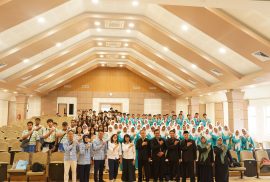
Yogyakarta, 17 November 2025 – The Faculty of Cultural Sciences (FIB) Universitas Gadjah Mada once again welcomed a visit from SMA Plus Pembangunan Tangerang Selatan and MAN 2 Ponorogo, with a total of 128 participating students and accompanying teachers. This activity aimed to introduce the academic environment, cultural atmosphere, and student activities at FIB UGM, as well as to provide insights for students regarding the campus life at Universitas Gadjah Mada.

The visit was guided by the UGM Campus Tour team in collaboration with the Public Relations Office of FIB UGM. The program began with the screening of profile videos of Universitas Gadjah Mada and the Faculty of Cultural Sciences, followed by a presentation from the FIB Public Relations team on various admission pathways to UGM, the Single Tuition Fee (UKT) system, and an introduction to Autonomous Arts Bodies (BSO) and the student organizations within FIB.

After the presentation session, participants were taken on a tour to get a closer look at the facilities and learning environment at FIB UGM, followed by a campus tour of the Central Building (GSP), one of the main landmarks of Universitas Gadjah Mada. The visit proceeded interactively and enthusiastically, both from the participants and the guides.

This school visit aligns with the Sustainable Development Goals (SDGs), particularly Goal 4: Quality Education and Goal 17: Partnerships for the Goals. Through this activity, FIB UGM actively contributes to expanding access to information on higher education and strengthening collaboration between universities and secondary schools to support the development of excellent and competitive human resources.

[FIB UGM Public Relations, Alma Syahwalani]

Muslim Cultural Studies Community Holds Blood Donation Event to Promote Health Awareness and Social Solidarity

News Release Monday, 24 November 2025

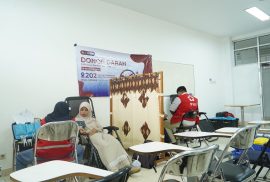
Yogyakarta, 19 November 2025 — The Muslim Cultural Studies Community (KMIB) of the Faculty of Cultural Sciences, Universitas Gadjah Mada, organized a Blood Donation event on the 2nd floor of the Poerbatjaraka Building. This initiative is part of KMIB’s ongoing efforts to foster social awareness and enhance the health of the campus community through humanitarian action.

Before donating blood, participants were advised to ensure they were in good physical condition, including getting at least four hours of sleep, drinking plenty of water, and maintaining overall health. These reminders were provided to ensure the donation process could proceed safely and smoothly.

Upon arrival, participants were required to fill out their personal data. They then underwent a health validation process, including blood pressure checks, blood type identification, and other medical examinations. Only participants who met the established health standards were allowed to proceed with the donation.

Through this activity, KMIB contributes to supporting the Sustainable Development Goals (SDGs), particularly those related to improving health and well-being. The spirit of blood donation aligns with efforts to cultivate a health-conscious campus environment, strengthen humanitarian initiatives, and encourage collaboration in helping others. This event reflects the campus community’s concrete commitment to supporting a better quality of life for the wider society.

[Public Relations of FIB UGM, Alma Syahwalani]

1…910111213…84

Video UGM

[shtmlslider name='shslider_options']
Universitas Gadjah Mada

Faculty of Cultural Sciences
Universitas Gadjah Mada
Jl. Nusantara 1, Bulaksumur Yogyakarta 55281, Indonesia
   fib@ugm.ac.id
   +62 (274) 513096
   +62 (274) 550451

Work Units

  • Office of Journal & Publishing
  • INCULS
  • Information Technology and Database
  • Language Learning Center
  • Library Unit
  • Public Relations
  • Research

Facilities

  • Computer Laboratory
  • Gamelan
  • Guest House
  • Language Library
  • Library
  • Phonetics Library
  • Self Access Unit
  • Student Internet Centre

Importan Links

  • Journal of Humaniora
  • Subscriber Journal
  • Alumni Portal
  • Career
  • Departmens News
  • UGM Streaming

Contacts

  • Academic
  • Administration
  • Dean’s Office
  • Departments / Study Programs
  • Public Relations

© 2024 Faculty of Cultural Sciences Universitas Gadjah Mada

KEBIJAKAN PRIVASI/PRIVACY POLICY

[EN] We use cookies to help our viewer get the best experience on our website. -- [ID] Kami menggunakan cookie untuk membantu pengunjung kami mendapatkan pengalaman terbaik di situs web kami.I Agree / Saya Setuju