• About UGM
  • Academic Portal
  • IT Center
  • Library
  • Research
  • Webmail
  • Informasi Publik
  • English
    • Indonesia
Universitas Gadjah Mada Faculty of Cultural Sciences
Universitas Gadjah Mada
  • Home
  • Profile
    • History
    • Vision and Mission
    • Organizational structure
    • Administration
    • Staff
    • Faculty Members
  • Academic
    • Academic Calendar
    • Undergraduate Programs
      • Bachelor of Cultural Antrophology
      • Bachelor in Archaeolagy
      • Bachelor in History
      • Bachelor in Tourism
      • Bochetor in Korean Language and Culture
      • Bachelor in Indonesian Language and Culture
      • Bachelor in English
      • Bachelor in Arabic
      • Bachelor in Japanese Language and Culture
      • Bachelor in Javanese Language, Literature and Culture
      • Bachelor in French language and literature
    • Graduate Programs
      • Master in Antrophology
      • Master in ArchaeoIogy
      • Master in History
      • Master in Linguistics
      • Master in Literature
      • Master In American Studies
      • Master in Middle Eastern Cultural Studies
    • Post-Graduate Programs / S3
      • Doctor in Antropology
      • Doctor in American Studies
      • Doctor in Humanities
    • Student Service
  • KPPM
    • Research Information
    • Scientific / Academic Publications
    • Community Service
    • International Cooperation
    • Domestic Cooperation
  • Student Organizations
    • Student Executive Council
    • Semi-Autonomous Organizations
      • KAPALASASTRA
      • Christian Student Alliance
      • LINCAK
      • Saskine
      • Catholic Student Family
      • Dian Budaya
      • Sastra Kanuragan (sasgan)
      • Family of Muslim Cultural Sciences Students (KMIB)
      • Bejo Mulyo
    • Autonomous Organizations
      • Family of Anthropology Students (KEMANT)
      • English Department Student Association
      • Tourism Students Association (HIMAPA)
      • Family of Indonesian Literature Students (KMSI)
      • West Asian Literature Student Association (IMABA)
      • Association of Korean-Language Students (HIMAHARA)
      • Family of Regional Indonesian Literatures Students (KAMASUTRA)
      • The Family Body of History Students (BKMS)
      • The French Literature Students Association (HMSP)
      • Family of Anthropology Students
      • Japanese Student Association (HIMAJE)
  • Admission
    • Student Evaluation
  • Home
  • 2025
Arsip:

2025

UGM Arabic Study Program Students Conduct Field Study in Kudus–Demak to Explore Arab–Islamic and Javanese Cultural Acculturation

News ReleaseStudent's Activity Friday, 12 December 2025

Central Java, 4 December 2025 — Students of the Arabic Study Program, class of 2023, Universitas Gadjah Mada carried out a field study in the cities of Kudus and Demak as part of the course Arabic Literature and Culture in Indonesia. The program was designed to provide empirical learning experiences on the dynamics of Indonesian culture and the historical connections between Arab–Islamic heritage and the development of local civilization.

Kudus and Demak were selected as the field study destinations due to their significant roles in the spread of Islam in Java. Through this field activity, students were expected to observe and analyze cultural heritage on-site and relate their findings to the theories studied in class.

The first destination visited was the Menara Kudus Mosque, also known as the Al-Aqsha Mosque, located in Kauman Village, Kudus, Central Java. Students examined firsthand how the mosque’s architecture, particularly its red-brick tower resembling a Majapahit-style temple, stands as strong evidence of acculturation between Islam and Hindu–Javanese culture. At the Menara Kudus Mosque, students observed Sunan Kudus’ cultural approach to da’wah, from preserving local traditions to utilizing Javanese arts and architectural forms that enabled Islam to be accepted peacefully by the local community. Traditions such as the prohibition of slaughtering cows, as well as Javanese songs and performing arts developed by Sunan Kudus, became part of the learning experience.

The field study continued at the Mubarok Jenang Museum, the first jenang museum in Indonesia, which highlights the history of Kudus’ jenang industry since 1930. Here, UGM Arabic Study Program students learned local wisdoms, particularly the values of Gusjigang (being morally good, mastering religious knowledge, and being skilled in trade) which shaped Kudus’ economic culture and intertwined with the Islamic teachings of Sunan Kudus. The museum offered a distinct experience, enabling students to observe how tradition, family-run industry, and regional identity are presented as public education and developed into creative economic potential.

The students then deepened their understanding of early Islamic da’wah in Java through a visit to the Great Mosque of Demak, a historical Wali Songo site and a central landmark of the Demak Sultanate. They examined the mosque’s traditional Javanese architectural form featuring a three-tiered pyramidal roof and the iconic saka guru pillars, including the legendary saka tatal. This visit provided richer insight into a model of da’wah rooted in local culture, dialogue, and gentle persuasion, reflected in the mosque’s architecture, traditions, and the social life of the surrounding community.

Through this series of field visits, students gained firsthand experience that history is not merely textual, but a living narrative present in buildings, traditions, and societal practices. The field study underscored the importance of understanding acculturation as a key element in the development of Islam in the archipelago which is visible in mosque architecture, local economies, and enduring cultural values.

This field study is expected to broaden the perspectives of Arabic Literature students and strengthen their analytical abilities in interpreting Indonesian cultural phenomena in a more comprehensive and applied manner.


Author: Jihan Pertiwi

Anthropology Students’ Role in the 38th National Student Scientific Week

ChampionshipNews Release Thursday, 11 December 2025

On the 27th of November (the awarding night of the 38th Pekan Ilmiah Mahasiswa Nasional (Pimnas) held in Universitas Hassanudin, Makassar), a bachelor student of Cultural Anthropology from UGM contributed to the medal count of Universitas Gadjah Mada. Muhammad Syukur Shidiq – commonly known as Syukur – and his team earned a silver medal for the poster category of the PKM-RSH 2 class. Their research, titled Antara Safe Space dan Toxic Space: Studi Ekologi Media terhadap Komunitas Marah-Marah di Media Sosial X, applies the concept of media ecology coined by Marshall McLuhan to study the Komunitas Marah-Marah, a community established on X (formerly Twitter).

Komunitas Marah-Marah is viewed as a communal space with two sides, both contradicting each other. This community provides room for freedom of emotional expression (specifically anger, as the name suggests) for its members while giving them affirmation from fellow members. At the same time, negative actions such as cyberbullying, hate speech, and discrimination are also rampant in the space. What started out as a small community has tripled in size in the span of a year. The results of this research can hopefully be used as a contribution to increase digital literacy among the Indonesian digital community, along with creating a safe online space for users and as consideration for policy makers to create better online policies.

As an anthropology student, there are a few lessons Syukur picked up during his Pimnas research. The discipline of anthropology plays a role in understanding Komunitas Marah-Marah as a living digital environment, filled with members with various cultures and perspectives. X as a social media is viewed as an ecology that shapes and influences how people express their emotions. The existence of this community helps shape the understanding of how anger grows and evolves into its own culture in a digital context.

During four months of Pimnas research, Syukur learned some valuable lessons for himself, as a person and as a researcher. Along with getting the opportunity to experience field research first-hand, Syukur learned to collect, sort, and process ethnographic data while working in a systematic workflow. This opportunity gives him the chance to train his cultural intuition and reflectivity as an anthropologist. He also learned to be committed to a research project and working in a multidisciplinary approach. His team members consisted of fellow bachelor students Muh Faiq Fauzan, Fanisa Ratna Dewi, Debora Magdalena Marchya Sihombing, Muhammad Syukur Shidiq, and Adelia Pradipta Nasyaputri. They hail from various departments of social sciences, such as Communication Science, Social Development and Welfare, Philosophy, and Psychology; each with their own methods and perspectives, collaborating towards the same goal to reach a better understanding of a dynamic socio-digital environment.

Author: Amadeus Abhirama Paramanindita

Philology Clinic: Tracing Cosmology in Ancient Manuscripts

News Release Thursday, 11 December 2025

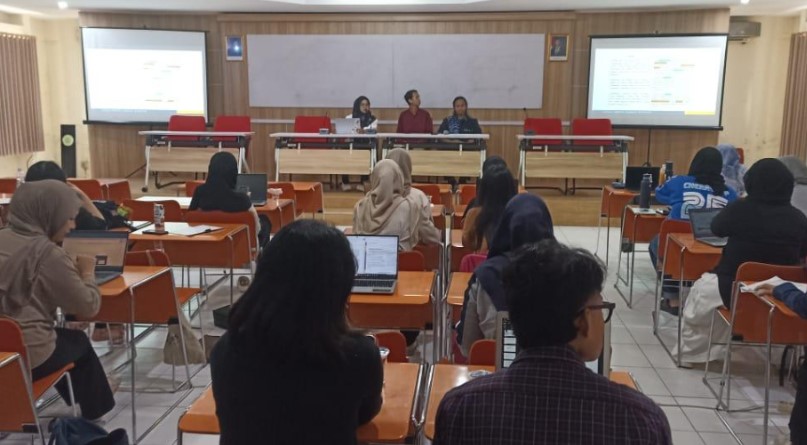
Yogyakarta, 5 December 2025 – Ten graduate students of the Master of Literature Program at the Faculty of Cultural Sciences held a Philology Clinic Exhibition themed “Tracing Cosmology in Ancient Manuscripts.” This exhibition is part of an academic activity guided by lecturers of the Philology Program: Prof. Dr. Aprinus Salam, M.Hum., Prof. Dr. Sangidu, M.Hum., and Dr. Arsanti Wulandari, S.S., M.Hum.

Cosmology, as a way for humans to understand the origins, structure, and order of the universe, has long served as a fundamental aspect of cultural development. Long before the emergence of modern science, the peoples of the Nusantara had developed their own cosmological perspectives and recorded them in various Arabic, Javanese, and Malay manuscripts. This knowledge was passed down across generations as an integral part of the region’s intellectual tradition.

Through the Philology Clinic activities, the students aim to create a space for disseminating and reintroducing cosmological insights found in ancient manuscripts. These manuscripts not only contain stories or moral teachings, but also reflect the worldview, knowledge structures, and belief systems of communities in the past.

In today’s modern world—where rational knowledge is often separated from spiritual experience—this exhibition invites the public to revisit how past societies understood the universe holistically, combining empirical, symbolic, and practical experiences in everyday life. As such, the exhibition serves as a bridge between the past and the present, opening new avenues for appreciating the intellectual heritage of the Nusantara.

This exhibition aligns with the commitment to sustainable education as outlined in the Sustainable Development Goals (SDGs), particularly SDG 4 on Quality Education. Through manuscript preservation, the strengthening of cultural literacy, and the advancement of humanities research, this activity supports the creation of inclusive, high-quality education and promotes lifelong learning. Additionally, this initiative reflects ongoing efforts to safeguard cultural heritage, in line with SDG 11 on Sustainable Cities and Communities, which emphasizes cultural preservation as a key component of sustainable community development.

[Public Relations of FIB UGM, Alma Syahwalani]

UGM Arabic Study Program Students Refresh Their Minds Before Final Exams Through an Outing Class Titled “Lu’bah Arabiyyah”

News Release Wednesday, 10 December 2025

Yogyakarta, 3 December 2025 — A total of 68 first-year students from the Arabic Study Program at Universitas Gadjah Mada (UGM) attend an outing class at Wisdom Park UGM on Wednesday, 3 December 2025. The activity, titled Lu’bah Arabiyyah, served as a collaborative program for Arabic Writing, Arabic Speaking, and Tasrif courses to help students review lesson material through interactive games while refreshing their minds ahead of final exams. The event was accompanied by lecturers from the Arabic Study Program and supported by student tutors from the 2022 and 2023 cohorts.

During Lu’bah Arabiyyah, students are invited to do a series of game stations set up across Wisdom Park. Each game required them to actively use and recall their Arabic skills in preparation for the final exams. Among the activities were Sentence Relay, Puzzle Tasrif, and Arabic crossword puzzles. After completing all stations, the outing concluded with a communal meal and a shared rujak session with lecturers.

The 2025 cohort participated enthusiastically from start to finish. Many students expressed that Lu’bah Arabiyyah boosted their confidence and motivation ahead of the Final Examinations, as the activities helped them recall and reinforce material learned throughout the semester. Beyond academic preparation, the event also strengthened collaborations and intimacy among students, tutors, and lecturers, which is an important foundation for smoother communication and collaboration in future learning processes.


Author: Muhammad Ardiansyah

Culture Preservation Pioneer: Paksi, Alumni of Javanese Language, Literature, and Culture, Receives the 2025 UGM Outstanding Alumni Award

News Release Wednesday, 10 December 2025

Yogyakarta, December, 9, 2025 – Paksi Raras Alit, widely known as Mas Paksi, has been awarded the 2025 UGM Outstanding Alumni Award for his significant contributions to cultural literacy development and the preservation of traditional arts. An alumnus of the Javanese Language, Literature, and Culture Study Program, Faculty of Cultural Sciences (FIB) UGM, Mas Paksi is recognized as the founder of the JAWACANA Community, a cultural education platform that continues to expand access to cultural learning for the wider public.

Since its establishment, JAWACANA has consistently offered various programs such as cultural magazines, Javanese language classes, and inclusive, accessible art performances. These initiatives directly contribute to improving cultural education quality in society, aligning with UGM’s commitment to supporting sustainable development.

Mas Paksi’s contributions also reflect strong support for the Sustainable Development Goals (SDGs), particularly through expanding access to cultural education (SDG 4: Quality Education), strengthening local identity and community sustainability through the preservation of regional arts and languages (SDG 11: Sustainable Cities and Communities), and fostering collaboration among communities, academics, and cultural practitioners across various JAWACANA programs (SDG 17: Partnerships for the Goals).

This award further reinforces Mas Paksi’s role as a representative of FIB UGM alumni who brings tangible positive impact to society. Through JAWACANA, he demonstrates that cultural preservation can become an educational, sustainable movement that contributes significantly to strengthening local culture amid ongoing societal changes.

[Public Relations of FIB UGM, Alma Syahwalani]

123…81

Video UGM

[shtmlslider name='shslider_options']
Universitas Gadjah Mada

Faculty of Cultural Sciences
Universitas Gadjah Mada
Jl. Nusantara 1, Bulaksumur Yogyakarta 55281, Indonesia
   fib@ugm.ac.id
   +62 (274) 513096
   +62 (274) 550451

Work Units

  • Office of Journal & Publishing
  • INCULS
  • Information Technology and Database
  • Language Learning Center
  • Library Unit
  • Public Relations
  • Research

Facilities

  • Computer Laboratory
  • Gamelan
  • Guest House
  • Language Library
  • Library
  • Phonetics Library
  • Self Access Unit
  • Student Internet Centre

Importan Links

  • Journal of Humaniora
  • Subscriber Journal
  • Alumni Portal
  • Career
  • Departmens News
  • UGM Streaming

Contacts

  • Academic
  • Administration
  • Dean’s Office
  • Departments / Study Programs
  • Public Relations

© 2024 Faculty of Cultural Sciences Universitas Gadjah Mada

KEBIJAKAN PRIVASI/PRIVACY POLICY

[EN] We use cookies to help our viewer get the best experience on our website. -- [ID] Kami menggunakan cookie untuk membantu pengunjung kami mendapatkan pengalaman terbaik di situs web kami.I Agree / Saya Setuju