
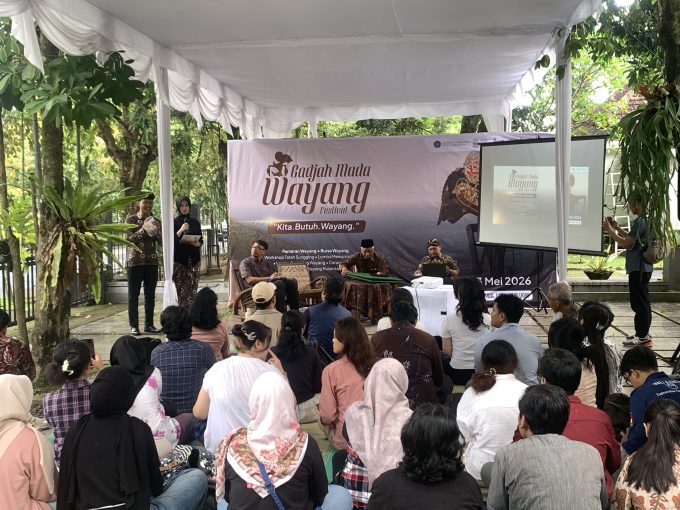
Yogyakarta, May 22, 2026 – The Gadjah Mada Wayang Festival (GWF) 2026 once again presented a series of cultural events as part of the 80th Anniversary celebration of the Faculty of Cultural Sciences, Universitas Gadjah Mada. On the second day, an “Expert Lecture” themed “Wayang as Tangible and Intangible Cultural Heritage” was held at the Pusaka Jawa Courtyard of UGM on May 22, 2026.
This activity was part of a community engagement program under the theme of Equity, supported by LPDP. In his opening remarks, the Chairperson of the Gadjah Mada Wayang Festival Committee, Rudy Wiratama, expressed his gratitude to all invited guests and participants who had supported the event.
Rudy Wiratama also expressed his hope that the Gadjah Mada Wayang Festival would continue to be held annually as a cultural program. According to him, the Faculty of Cultural Sciences UGM aims to continuously introduce wayang and selected dalang (puppeteers) to the public as part of preserving Javanese culture.
The expert lecture featured various discussions related to the world of wayang. Ir. Wono Sri Suwito, M.M. discussed cultural heritage within the wayang tradition. Meanwhile, Mas Tyo Cahya Sadewa presented the art of tatah sungging (traditional carving and coloring techniques) of wayang kulit within the treasury of Javanese puppetry. Zakariya Pamuji also provided perspectives from philology and epigraphy to examine wayang as a cultural heritage rich in historical values and knowledge.
The event was moderated by Dr. R. Bima Slamet Raharja, S.S., M.A. During the discussion session, he stated that wayang essentially belongs to everyone.
“When we talk about wayang, wayang belongs to all of us,” he remarked.
Through this activity, the Gadjah Mada Wayang Festival 2026 served not only as a space for appreciating performing arts but also as a medium for cultural learning for younger generations and the wider community, encouraging them to appreciate and preserve the cultural heritage of the Indonesian archipelago.
This activity was also aligned with the Sustainable Development Goals (SDGs), particularly SDG 4 on Quality Education through the dissemination of cultural knowledge, SDG 11 on Sustainable Cities and Communities through the preservation of tangible and intangible cultural heritage, and SDG 17 on Partnerships for the Goals, as the event involved collaboration among academics, artists, LPDP, and the community in maintaining the sustainability of Indonesian culture.
[Public Relations of FIB UGM, Alma Syahwalani]
