
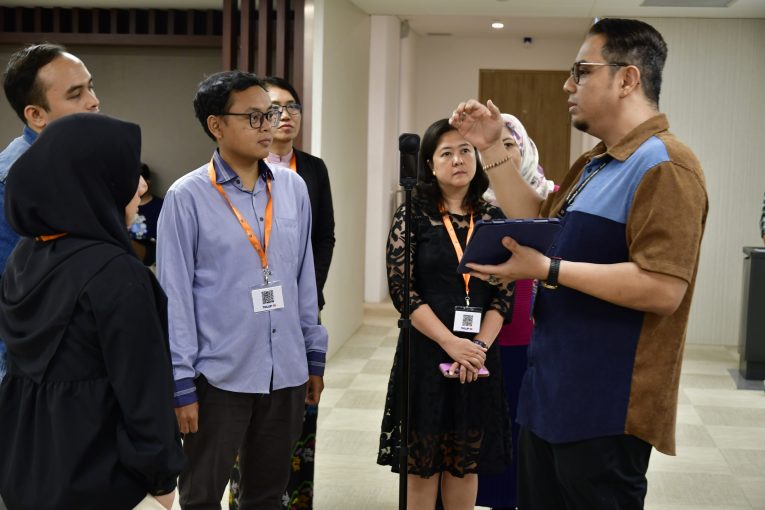
Singapore, January 5, 2026 – Randy Setiawan, an educational staff member of the Faculty of Cultural Sciences (FIB) at Universitas Gadjah Mada (UGM), was selected as a delegate in the Transforming University Libraries Leadership and Innovation Programme (TULLIP) organized by NUS Libraries. The program brought together 19 participants from various countries and was held over five days, focusing on strengthening leadership, innovation, and digital transformation in university libraries.
The TULLIP program was designed to foster collaboration between librarians across the ASEAN region and the global academic community. Through a series of workshops, seminars, roundtable discussions, and learning visits, participants were equipped with strategic skills to address the challenges of library management amid a rapidly evolving information landscape.
Throughout the program, participants took part in a range of thematic sessions. The first day explored leadership in driving transformative change within libraries. The second day highlighted the use of artificial intelligence, digital transformation, and innovation in leading academic libraries. The third day focused on library partnership practices in supporting education and research. On the fourth day, libraries were positioned as living labs through the management of collections, infrastructure, and spatial design. The program concluded on the fifth day with a case study-based problem-solving session.
In one of the presentation sessions, Setiawan outlined the challenges faced by the FIB UGM Library, particularly in relation to limited collection storage space. “In yesterday’s paper presentation, we highlighted an issue faced by the Faculty of Cultural Sciences Library, namely the need to accommodate space as the library collection continues to grow,” Setiawan explained.
He added that older collections remain in high demand among students. “In addition, there is an urgent need to transform library collections from physical formats to digital ones. This is due to the limited capacity of the temporary library space, which can only accommodate around 15 percent of the total collection,” he said. As a result, approximately 85 percent of the collection must be stored long term and is at risk of deterioration.
Setiawan also shared that the workshop sessions provided participants with insights into effective and up-to-date collection digitization processes. On the same occasion, he introduced efforts to promote the Faculty of Cultural Sciences UGM’s rare collections through the Lawang Sejarah platform, which can be accessed at langka.lib.ugm.ac.id.
The participation of the FIB UGM delegate in the TULLIP program reflects the university’s ongoing commitment to adapting to developments in information technology and strengthening the role of libraries as centers for learning and research. Through enhanced human resource capacity and international networking, libraries are expected to better support an inclusive, impactful, and sustainability-oriented academic ecosystem.
[Public Relations of FIB UGM, Candra Solihin]
