• About UGM
  • Academic Portal
  • IT Center
  • Library
  • Research
  • Webmail
  • Informasi Publik
  • English
    • Indonesia
Universitas Gadjah Mada Faculty of Cultural Sciences
Universitas Gadjah Mada
  • Home
  • Profile
    • History
    • Vision and Mission
    • Organizational structure
    • Administration
    • Staff
    • Faculty Members
  • Academic
    • Academic Calendar
    • Undergraduate Programs
      • Bachelor of Cultural Antrophology
      • Bachelor in Archaeolagy
      • Bachelor in History
      • Bachelor in Tourism
      • Bochetor in Korean Language and Culture
      • Bachelor in Indonesian Language and Culture
      • Bachelor in English
      • Bachelor in Arabic
      • Bachelor in Japanese Language and Culture
      • Bachelor in Javanese Language, Literature and Culture
      • Bachelor in French language and literature
    • Graduate Programs
      • Master in Antrophology
      • Master in ArchaeoIogy
      • Master in History
      • Master in Linguistics
      • Master in Literature
      • Master In American Studies
      • Master in Middle Eastern Cultural Studies
    • Post-Graduate Programs / S3
      • Doctor in Antropology
      • Doctor in American Studies
      • Doctor in Humanities
    • Student Service
  • KPPM
    • Research Information
    • Scientific / Academic Publications
    • Community Service
    • International Cooperation
    • Domestic Cooperation
  • Student Organizations
    • Student Executive Council
    • Semi-Autonomous Organizations
      • KAPALASASTRA
      • Christian Student Alliance
      • LINCAK
      • Saskine
      • Catholic Student Family
      • Dian Budaya
      • Sastra Kanuragan (sasgan)
      • Family of Muslim Cultural Sciences Students (KMIB)
      • Bejo Mulyo
    • Autonomous Organizations
      • Family of Anthropology Students (KEMANT)
      • English Department Student Association
      • Tourism Students Association (HIMAPA)
      • Family of Indonesian Literature Students (KMSI)
      • West Asian Literature Student Association (IMABA)
      • Association of Korean-Language Students (HIMAHARA)
      • Family of Regional Indonesian Literatures Students (KAMASUTRA)
      • The Family Body of History Students (BKMS)
      • The French Literature Students Association (HMSP)
      • Family of Anthropology Students
      • Japanese Student Association (HIMAJE)
  • Admission
    • Student Evaluation
  • Home
  • SGDs 4: Quality Education
  • SGDs 4: Quality Education
Arsip:

SGDs 4: Quality Education

Speech by Prof. Dr. Atik Triratnawati, “Masuk Angin: A Blessing or a Curse?”

News Release Thursday, 30 April 2026

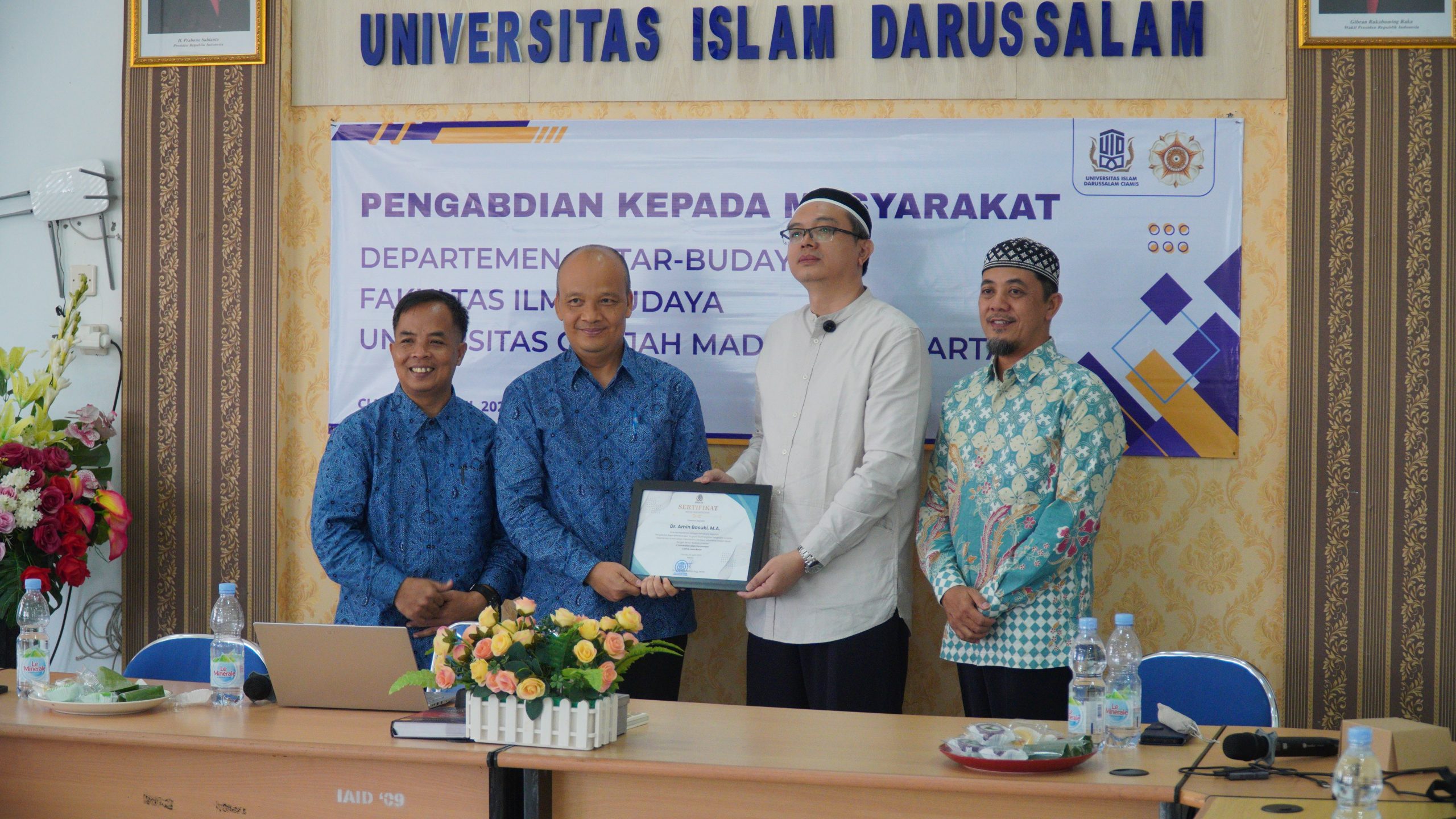
Yogyakarta, April 26, 2026 — Prof. Dr. Atik Triratnawati conducted a community service activity by delivering a lecture related to her field at Teladan State High School in Yogyakarta. The title of her lecture posed the question “Masuk Angin (Catching a Cold): A Blessing or a Curse?” and opened up a relevant discussion in the health and well-being sector. The term “masuk angin” has long been part of Indonesian society. The public’s understanding of “masuk angin” highlights the importance of an inclusive and culturally-based approach to health.

Many people still rely on traditional methods such as scraping therapy, herbal remedies, and rest as initial treatments. These practices reflect local wisdom that has the potential to support the healthcare system, provided they are balanced with appropriate medical education. “Masuk angin” is described as a Javanese concept of illness caused by an excess of wind elements within the body. Javanese cosmology forms the basis for health and illness; in medical anthropology, this is referred to as the hot-cold theory.

Prof. Atik explains that “masuk angin” is not a disease or sickness. However, she notes that “masuk angin” falls under magico-religious models—meaning this condition arises from spiritual or supernatural causes, so its treatment follows accordingly, such as scraping therapy (kerokan/pijat), consuming herbal remedies (jamu), and other practices. Additionally, it is referred to as holistic models, where health is viewed as the result of a balance among various aspects of life—not merely the physical. Physical conditions may be influenced by psychological, social, environmental, or spiritual factors, such as stress or an unhealthy lifestyle. She also explained that “wind entering the body” is categorized into several types: ordinary (mild) wind, severe wind, and “kasep” wind (sedentary wind). Her interpretations regarding “masuk angin” include health disorders (illness), failure to adapt, a reflection of low bodily resilience, a signal to rest, and “angin duduk” as a result of magical influences.

Prof. Atik focuses on the field of health from an anthropological perspective. This is because health literacy is key to building a community that is aware of its physical condition. Appropriate education can help the public distinguish between mild symptoms and serious illnesses requiring medical intervention. Additionally, a culture-based approach helps reach communities with limited access to formal healthcare services. By integrating local knowledge into the healthcare system, it is hoped that no group will be left behind.

This discussion underscores that traditional practices such as “catching a chill” are not always an obstacle to health development; rather, they can serve as a bridge toward a more inclusive and sustainable healthcare system. Collaboration among healthcare professionals, academics, and the community is key to achieving this goal.

Author: Dewi Widyastuti
Photo: Prof. Dr. Atik Triratnawati, M.A.

A Mexican Research Professor’s Visit to the Pradangga of English Literature (Prasasti) UGM

News Release Tuesday, 14 May 2024

SGDs 4: Quality Education| SDGs 4: Cultural diversity | SDGs 4: Basic literacy skills | SDGs 8: Creativity and innovation | SDG 9: Industry innovation and infrastructure | SDGs 9: Cooperation | SGDs 16: Peace, Justice and Strong Institutions | SDGs 17: Fostering innovation | SDGs 17: Global partnership

Last Sunday (17/3/2024), the English Literature student activity, namely the English Literature Pradangga or often known as Prasasti Club received a visit from Dr. Antonio Guerra Arias, a research professor and creator with a specialist field of ethnodrama studies from the Universidad Autonoma de Chihuahua. The visit took place at the Faculty of Cultural Sciences of Universitas Gadjah Mada, accompanied by the Head of the English Literature Program, Dr. Adi Sutrisno, M.A. and a retired English Literature lecturer who is also an arts activist, Dr. Eddy Pursubaryanto, Dip.TESL, M.Hum.

The purpose of Dr. Antonio Guerra Arias’ visit was to explore and understand the art of drama performance, especially Javanese Puppetry. Dr. Antonio Guerra Arias believes that the art of drama performance in Indonesia and in Mexico has similarities, namely the stories presented in drama performances are still strongly related to rituals and mystical things. In his research entitled “Shadows of Little Mexico”, Dr. Antonio intends to collaborate the story in his homeland with the Mahabharata story in Indonesia in a puppetry show.

During the visit, Dr. Adi Sutrisno, M.A. and Dr. Eddy Pursubaryanto, Dip.TESL, M.Hum. invited Dr. Antonio to watch the weekly practice of Prasasti which was held at the Margono building of the Faculty of Cultural Sciences UGM. While listening to the music, Dr. Antonio had a conversation with the teacher and composer of the songs performed by the club, Nanang Karbito, M. Sn. The conversation was about the art of Javanese puppetry and the stories behind it. 

Currently, Dr. Antonio still needs the help of experts in the field of Javanese art, especially Javanese puppetry. For colleagues who are experts in this field, you can contact him via email address tony_war@hotmail.com and WhatsApp number +62 823-3383-6437.


Video UGM

[shtmlslider name='shslider_options']
Universitas Gadjah Mada

Faculty of Cultural Sciences
Universitas Gadjah Mada
Jl. Nusantara 1, Bulaksumur Yogyakarta 55281, Indonesia
   fib@ugm.ac.id
   +62 (274) 513096
   +62 (274) 550451

Work Units

  • Office of Journal & Publishing
  • INCULS
  • Information Technology and Database
  • Language Learning Center
  • Library Unit
  • Public Relations
  • Research

Facilities

  • Computer Laboratory
  • Gamelan
  • Guest House
  • Language Library
  • Library
  • Phonetics Library
  • Self Access Unit
  • Student Internet Centre

Importan Links

  • Journal of Humaniora
  • Subscriber Journal
  • Alumni Portal
  • Career
  • Departmens News
  • UGM Streaming

Contacts

  • Academic
  • Administration
  • Dean’s Office
  • Departments / Study Programs
  • Public Relations

© 2024 Faculty of Cultural Sciences Universitas Gadjah Mada

KEBIJAKAN PRIVASI/PRIVACY POLICY

[EN] We use cookies to help our viewer get the best experience on our website. -- [ID] Kami menggunakan cookie untuk membantu pengunjung kami mendapatkan pengalaman terbaik di situs web kami.I Agree / Saya Setuju