• About UGM
  • Academic Portal
  • IT Center
  • Library
  • Research
  • Webmail
  • Informasi Publik
  • English
    • Indonesia
Universitas Gadjah Mada Faculty of Cultural Sciences
Universitas Gadjah Mada
  • Home
  • Profile
    • History
    • Vision and Mission
    • Organizational structure
    • Administration
    • Staff
    • Faculty Members
  • Academic
    • Academic Calendar
    • Undergraduate Programs
      • Bachelor of Cultural Antrophology
      • Bachelor in Archaeolagy
      • Bachelor in History
      • Bachelor in Tourism
      • Bochetor in Korean Language and Culture
      • Bachelor in Indonesian Language and Culture
      • Bachelor in English
      • Bachelor in Arabic
      • Bachelor in Japanese Language and Culture
      • Bachelor in Javanese Language, Literature and Culture
      • Bachelor in French language and literature
    • Graduate Programs
      • Master in Antrophology
      • Master in ArchaeoIogy
      • Master in History
      • Master in Linguistics
      • Master in Literature
      • Master In American Studies
      • Master in Middle Eastern Cultural Studies
    • Post-Graduate Programs / S3
      • Doctor in Antropology
      • Doctor in American Studies
      • Doctor in Humanities
    • Student Service
  • KPPM
    • Research Information
    • Scientific / Academic Publications
    • Community Service
    • International Cooperation
    • Domestic Cooperation
  • Student Organizations
    • Student Executive Council
    • Semi-Autonomous Organizations
      • KAPALASASTRA
      • Christian Student Alliance
      • LINCAK
      • Saskine
      • Catholic Student Family
      • Dian Budaya
      • Sastra Kanuragan (sasgan)
      • Family of Muslim Cultural Sciences Students (KMIB)
      • Bejo Mulyo
    • Autonomous Organizations
      • Family of Anthropology Students (KEMANT)
      • English Department Student Association
      • Tourism Students Association (HIMAPA)
      • Family of Indonesian Literature Students (KMSI)
      • West Asian Literature Student Association (IMABA)
      • Association of Korean-Language Students (HIMAHARA)
      • Family of Regional Indonesian Literatures Students (KAMASUTRA)
      • The Family Body of History Students (BKMS)
      • The French Literature Students Association (HMSP)
      • Family of Anthropology Students
      • Japanese Student Association (HIMAJE)
  • Admission
    • Student Evaluation
  • Home
  • SDGs 3: Kehidupan sehat dan sejahtera
  • SDGs 3: Kehidupan sehat dan sejahtera
Arsip:

SDGs 3: Kehidupan sehat dan sejahtera

To Support Student Well-being During Final Exams, FIB UGM Holds the Sibuya Program Again

News Release Monday, 8 June 2026

Yogyakarta, June 6, 2026 – The Faculty of Cultural Sciences at Gadjah Mada University is once again reaching out to students with the Sibuya (Cultural Sciences Breakfast) program. This program is designed to support the final exams (UAS) for the second semester of the 2025/2026 academic year by providing free breakfast. Sibuya provides 200 servings daily, distributed via a coupon system on June 6, 11, 15, and 18. Each coupon is worth Rp13,000.00 and can be redeemed at any food stall in the Sastra Cafeteria. Sibuya will also take place on June 10 and 17, with boxed meals distributed in front of the Soegondo Building. 

Sibuya is a program initiated by FIB since 2024. To date, Sibuya has consistently supported the well-being of FIB students during midterm and final exam weeks by providing free, nutritious breakfasts. By ensuring adequate nutrition, FIB hopes to ensure students are in top condition when taking exams. This is part of FIB UGM’s commitment to creating a friendly and healthy campus environment.  

Through this program, FIB UGM contributes to the achievement of the Sustainable Development Goals (SDGs), particularly SDG 2: Zero Hunger, by ensuring students have access to sufficient food and nutrition so they do not go hungry during exams, and SDG 3: Good Health and Well-being, by implementing the Health Promoting University (HPU) program to ensure nutritional needs are met. This program also aligns with SDG 4: Quality Education, as maintaining physical health and sustained focus enables students to perform optimally during exams to achieve high-quality academic results.

Through the consistent implementation of the Sibuya program, FIB UGM demonstrates that academic support extends beyond the classroom to include tangible care for students’ physical well-being. With their nutritional needs met, it is hoped that students can navigate exam week with full focus and achieve optimal results.

[Humas FIB UGM, Maylafaizza Nafisha Zifa]

FIB UGM Holds Qurbani for Eid al-Adha 1447 H, Strengthening Social Care and the Spirit of Sharing

News Release Tuesday, 2 June 2026

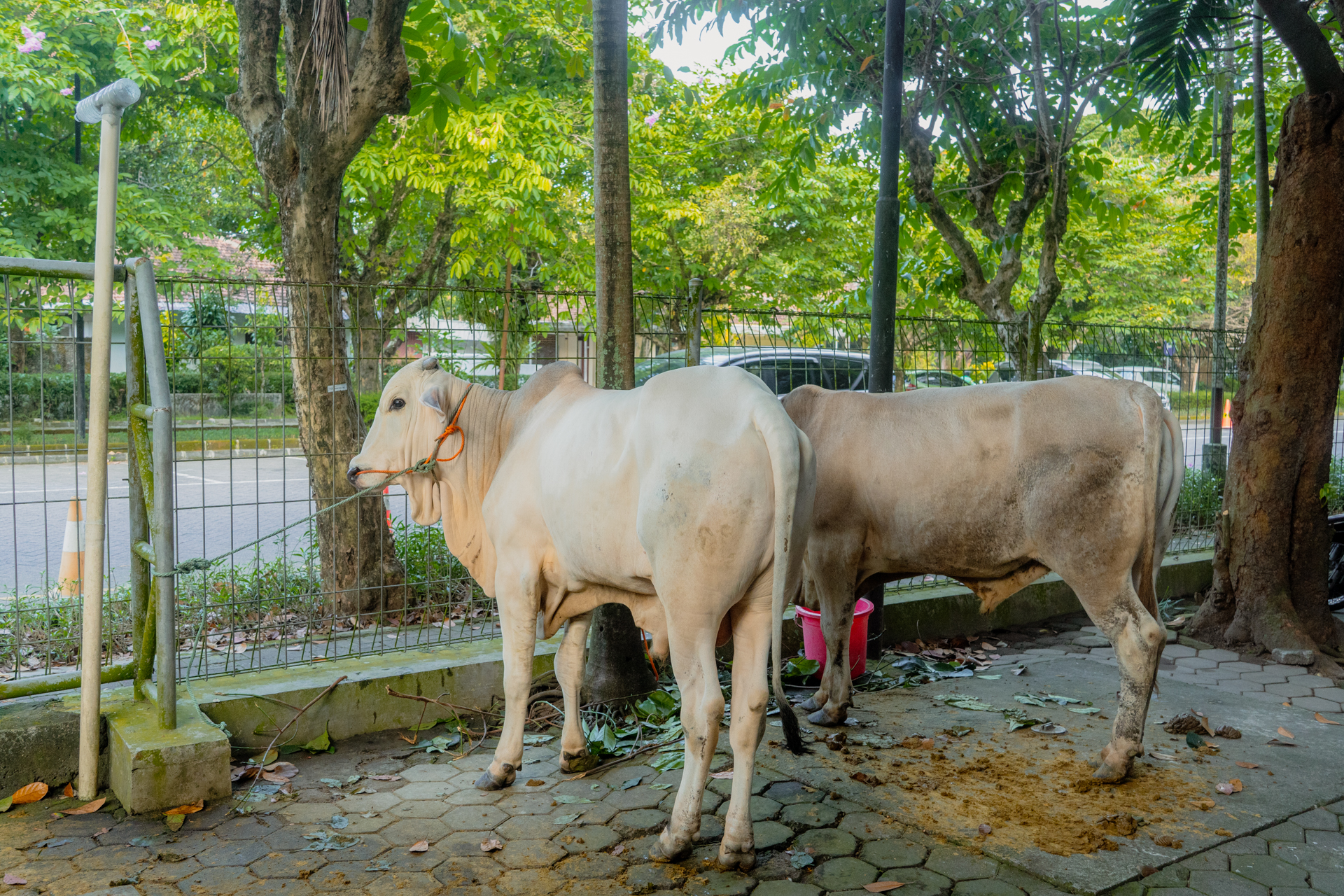
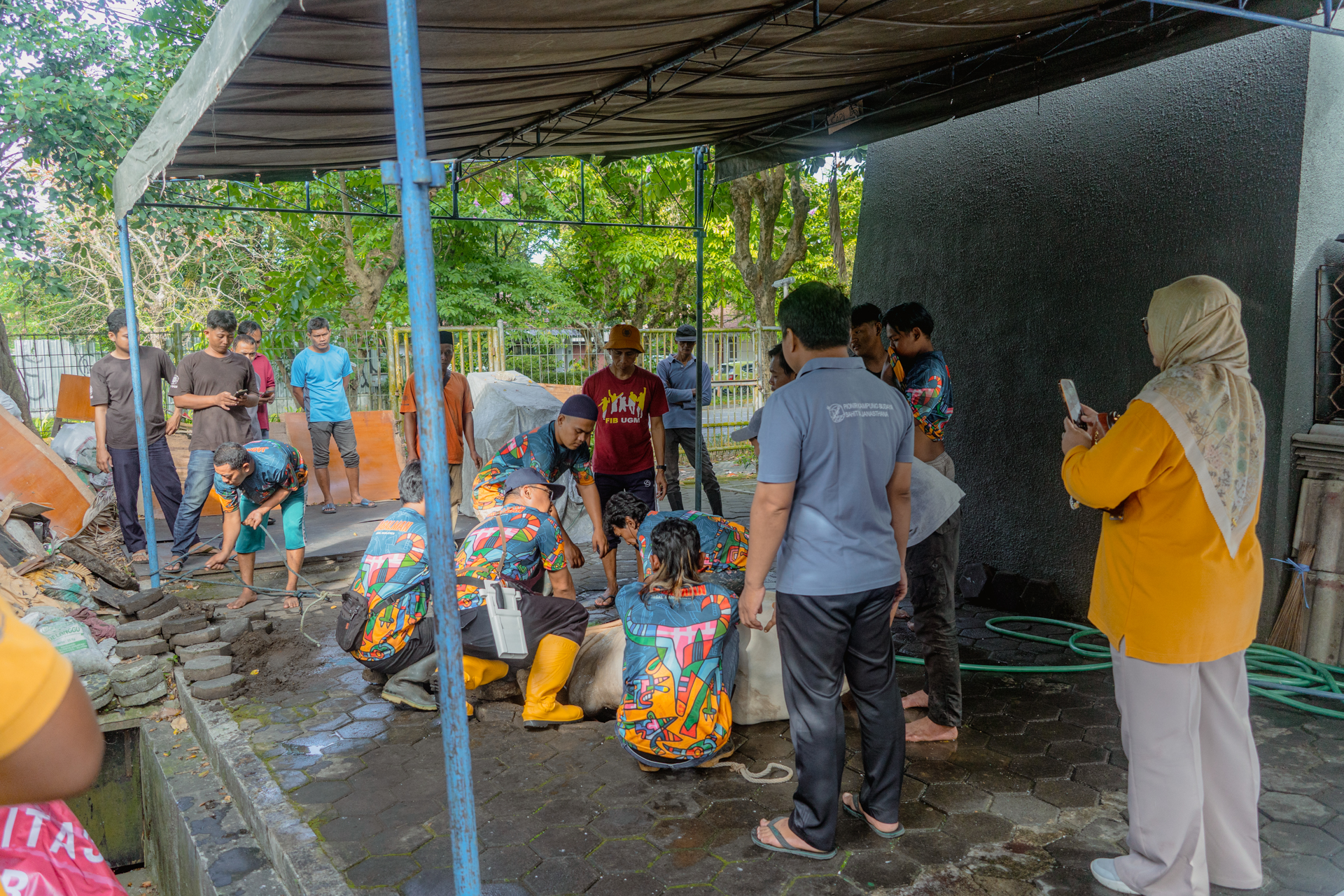
Yogyakarta, May 29, 2026 – The Faculty of Cultural Sciences (FIB), Universitas Gadjah Mada (UGM), organized the slaughtering of qurbani animals in commemoration of Eid al-Adha 1447 H on Friday (May 29) in the eastern area of the R.M. Margono Djojohadikusumo Building, FIB UGM. The event served as an expression of gratitude while also fostering social solidarity and a sense of togetherness within the university community.

For this year’s qurbani program, FIB UGM collected two cows and two goats contributed by shohibul qurban (qurbani donors), consisting of faculty members and administrative staff. The donors for Cow I were Aprillia Firmonasari, Hayatul Cholsy, Sulistyowati, Tular Sudarmadi, Wening Udasmoro, Wiwien Widyawati Rahayu, and Irwan Abdullah. Meanwhile, the donors for Cow II were Nur Saktiningrum, Pujo Semedi, Intan Kumala Sari, Adi Sutrisno, Rr. Agustin Nawang Wulan, Susanti, and Arif Akhyat. The goat donors were D.S. Nugrahani and Niken Wirasanti.

The qurbani process began with the slaughtering of the animals, followed by skinning, meat processing, weighing, and the distribution of qurbani meat to eligible recipients. The activity involved members of the FIB UGM academic community, who worked together to ensure that the entire process ran smoothly.

Beyond serving as a form of religious observance, the qurbani program also reflects FIB UGM’s commitment to supporting the Sustainable Development Goals (SDGs), particularly SDG 2: Zero Hunger, through the distribution of qurbani meat to help meet the nutritional needs of the community. The activity also contributes to SDG 3: Good Health and Well-being by improving access to nutritious animal-based protein sources.

Furthermore, the collaboration among faculty members, administrative staff, the management of Al-Adab Prayer Room (Musholla Al-Adab), and the local community in organizing the qurbani program reflects SDG 17: Partnerships for the Goals. The spirit of mutual cooperation demonstrated throughout the event highlights the role of the university not only as a center of education and research but also as a space for community engagement that delivers tangible benefits to society.

Through the implementation of the 1447 H qurbani program, FIB UGM once again reaffirmed its role as an institution that upholds the values of humanity, social responsibility, and togetherness, in line with the spirit of Eid al-Adha, which teaches sincerity, sacrifice, and sharing with others.

[Public Relations Office of FIB UGM, Alma Syahwalani]

Anthropology Students Win Gold Medals at the National Excellence Competition

News Release Wednesday, 20 May 2026

Good news comes from three undergraduate students in Cultural Anthropology at the Faculty of Humanities, UGM, who achieved a proud accomplishment at the 2026 National Excellence Competition (NEC). The NEC was organized by Eduhub Incubator in collaboration with Mataram University. The competition took place on May 9–10, 2026, at the Faculty of Agriculture, Mataram University, Lombok, West Nusa Tenggara. The team, consisting of Dinaesy Fadillah Hidayat, Aly Aydeed, and Nadila Aryani Az-Zalfa, won a Gold Medal in the Tourism and Creative Economy Research Essay category under the guidance of Agus Indiyanto, S.Sos., M.Si.

The competition’s theme was “Integrating Critical Thinking, Social Innovation, and Sustainable Entrepreneurial Capabilities within the Framework of Inclusive Development and Achieving the SDGs in Indonesia.” In their paper, the team addressed the issue of event management and tourism waste in Yogyakarta, which is still considered a challenge in supporting sustainable tourism.

As a solution, the team proposed an innovation in the form of a circular economy-based event management agency. This concept is designed to integrate event management with waste reduction and reuse systems, thereby creating a more environmentally friendly event ecosystem while supporting the creative economy sector in a sustainable manner.

It is hoped that this achievement will motivate other students to remain critical of phenomena occurring in society, to present innovative ideas, and to contribute to addressing various social issues through research and academic work that has a positive impact on the community.


Author: Dewi W – adapted from a report by Dinaesy Fadillah Hidayat

Photo: Dinaesy Fadillah Hidayat et al.


Department of Anthropology Hold a Rohingya Refugee Film

News Release Tuesday, 10 March 2026

Human migration and displacement are increasingly relevant issues in this era of global cross-regional relations. On Friday, February 13, 2026, the Department of Anthropology at Gadjah Mada University held a film screening and discussion on this topic. When The Water Horse Seeks a New Home is a short film by director Andrianus “Oetjoe” Merdhi, who has produced many films about various communities in Indonesia. The film was also produced with the assistance of Gerhard Hoffstaedter from the University of Brisbane and Prof. Dr. Antje Missbach (Mbak Antje) from the University of Bielefeld. Broadly speaking, this film tells the story of the experiences of Rohingya refugees who crossed the sea to seek asylum in Aceh, Indonesia. The screening was attended by Mbak Antje and facilitated by Dr. Realisa Darathea Masardi (Mbak Lisa) as the event organizer from the Department of Anthropology at UGM.

The film begins with an exposition from the perspective of a Rohingya migrant who fled to Aceh. During their journey, the group faced many challenges, such as engine failure that forced them to drift at sea for several days, unable to control their direction. They received assistance from several patrol officers in the waters they crossed, but no one gave them permission to dock. After a long journey, they finally arrive on the coast of Aceh.

Upon arrival, many local residents express their rejection of their presence. During negotiations with residents over where to live, the refugees wait on the coast, near their boat, not allowed to go far. After that, they settle in a crowded and squalid refugee camp. The residents’ rejection was actually justified, due to concerns about the behavior of the Rohingya refugees. However, there were also residents who empathized with these refugees. After the refugees moved to the camp, he found a hippopotamus toy belonging to one of the refugee children. Some time later, he tried to return the toy, but it turned out that the child and her family had left the camp and could not be contacted.

The empathy shown stems from a sense of shared destiny, because he himself was once a refugee. The Aceh war forced him to leave his home and family. So, he has experienced what the Rohingya refugees are experiencing today. This perspective shows the human side of this conflict, and reveals that many similar experiences have been endured by communities in Indonesia itself.

After the screening, Ms. Antje opened a discussion and QnA session with the audience. A lively discussion ensued, focusing on how civilians can respond and help these refugees. The discussion also touched on how the state can handle this crisis, balancing the interests of its citizens with providing humanitarian assistance to refugees. After the discussion, the event concluded with the Department of Anthropology presenting a memento to Ms. Antje.

Author: Amadeus Abhirama Paramanindita

The Ghibli Anime Film “Kiki’s Delivery Serviceand” Reflections on the Life of Young Migrants

News Release Monday, 2 February 2026

The Studio Ghibli anime film Kiki’s Delivery Service, directed by Hayao Miyazaki, presents a story that remains relevant to the realities of young migrants, particularly university students. Through a simple yet meaningful narrative, the film invites audiences to reflect on the process of growing up, independence, and the importance of maintaining mental well-being during the transition into adulthood.

Kiki’s Delivery Service follows the journey of Kiki, a 13-year-old young witch who decides to leave home and live away from her family in order to learn independence. In an unfamiliar city, Kiki struggles to survive by running a delivery service using her ability to fly. At the beginning of her journey, she is portrayed as enthusiastic, confident, and optimistic about her new life.

However, as time passes, Kiki begins to face various challenges. Feelings of exhaustion, self-doubt, and the tendency to compare herself with others lead her into an identity crisis. This condition even affects her magical abilities, causing her to lose her power. Through this conflict, Kiki’s Delivery Service illustrates that the process of growing up does not always run smoothly and is not solely about achievements, but also about failure, uncertainty, and learning to accept oneself.

Kiki’s experiences closely resonate with the lives of young migrants, especially students who live far from their families. The initial excitement of gaining freedom often turns into the realization that independent living comes with great responsibility. Academic pressure, demands for productivity, and constant exposure to others’ achievements frequently generate feelings of insecurity and stagnation. In such circumstances, a supportive environment and a strong support system play a crucial role in maintaining emotional balance.

More than mere entertainment, the anime film Kiki’s Delivery Service conveys an important message about giving oneself space to rest. The film emphasizes that feeling tired is not a sign of failure, but a natural part of the growth process. This message aligns with the Sustainable Development Goals (SDGs), particularly Goal 3, Good Health and Well-being, which highlights the importance of mental health as a component of individual well-being. In addition, the film also reflects SDG Goal 4 on Quality Education, especially learning through life experiences, as well as SDG Goal 8 on Decent Work and Economic Growth, as seen in Kiki’s efforts to work independently and adapt to a new environment.

Through Kiki’s story, the film encourages students and young migrants to recognize that everyone grows at their own pace. Taking time to breathe, understand oneself, and accept the process are essential steps in the journey toward adulthood.

[Public Relations FIB UGM, Alma Syahwalani]

Source: Studio Ghibli anime film Kiki’s Delivery Service directed by Hayao Miyazaki (released in 1989)

Photo source: Kiki’s Delivery Service Original 1989 Japanese B5 Chirashi Handbill – Posteritati Movie Poster Gallery

1234

Video UGM

[shtmlslider name='shslider_options']
Universitas Gadjah Mada

Faculty of Cultural Sciences
Universitas Gadjah Mada
Jl. Nusantara 1, Bulaksumur Yogyakarta 55281, Indonesia
   fib@ugm.ac.id
   +62 (274) 513096
   +62 (274) 550451

Work Units

  • Office of Journal & Publishing
  • INCULS
  • Information Technology and Database
  • Language Learning Center
  • Library Unit
  • Public Relations
  • Research

Facilities

  • Computer Laboratory
  • Gamelan
  • Guest House
  • Language Library
  • Library
  • Phonetics Library
  • Self Access Unit
  • Student Internet Centre

Importan Links

  • Journal of Humaniora
  • Subscriber Journal
  • Alumni Portal
  • Career
  • Departmens News
  • UGM Streaming

Contacts

  • Academic
  • Administration
  • Dean’s Office
  • Departments / Study Programs
  • Public Relations

© 2024 Faculty of Cultural Sciences Universitas Gadjah Mada

KEBIJAKAN PRIVASI/PRIVACY POLICY

[EN] We use cookies to help our viewer get the best experience on our website. -- [ID] Kami menggunakan cookie untuk membantu pengunjung kami mendapatkan pengalaman terbaik di situs web kami.I Agree / Saya Setuju