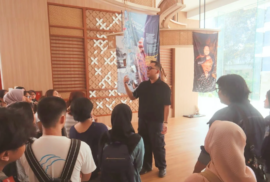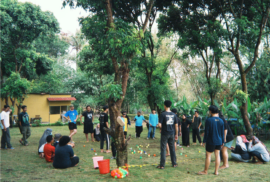
A healthy learning environment is a crucial factor influencing the academic success of master’s students. Therefore, the Master’s Program in Anthropology, Department of Anthropology, Universitas Gadjah Mada, held a Student Kinship Gathering on October 24, 2026, at Kaligriya, Kaliurang. The event aimed to strengthen solidarity among students, which is ultimately expected to foster a healthy learning environment. The gathering was attended by approximately 40 students from the even 2025 and odd 2026 cohorts of the Master’s Program in Anthropology. Participants took part in two main activities: a talent mapping session led by Halo Kitik as a Talent Mapping & NLP consultant, and outdoor team-building games organized by Sang Learner Outbound.
The gathering and bonding activities ran from morning until late afternoon despite heavy rain pouring over the Turi area. This anthropology student gathering serves as an implementation of SDG 3 (Good Health and Well-being), as the event motivates students and nurtures camaraderie (well-being). Set in a quiet and secluded venue, the event successfully brought together the even and odd cohorts, forging a unified bond as “anthropology kin.” The gathering was also attended by department administrators, namely Dr. Agung Wicaksono, S.Ant., M.A., and Dr. Realisa Darathea Masardi, S.Ant., M.A.
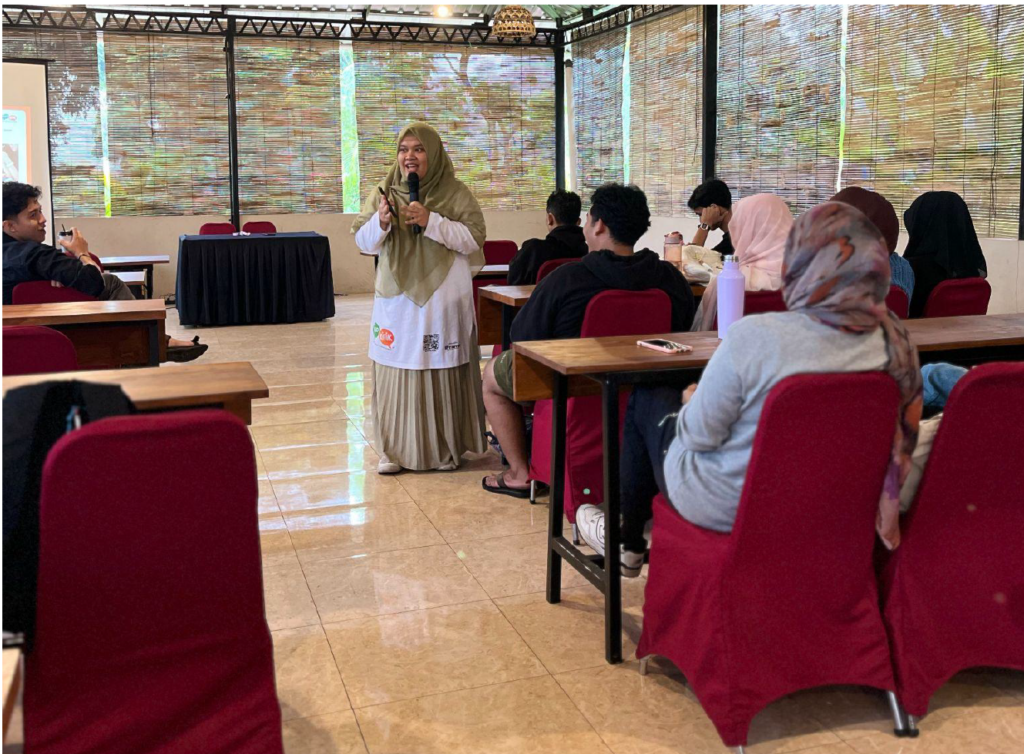
The Department of Anthropology extends its deepest gratitude for the participation of all students involved, as well as the support from Kaligriya, Halo Kitik, and Sang Learner. Thanks to their support, the Master’s in Anthropology student gathering proceeded with great enthusiasm. Moving forward, it is hoped that similar bonding events will continue to be held for future cohorts so that relationships among students remain harmonious and they can get to know one another better. With harmonious relationships in place, students can support each other selflessly. As ties among students grow closer, they are expected to go through their studies more peacefully and comfortably, having built deeper friendships with one another.
Author: Humas FIB, Zaidan Abdurrahman