• About UGM
  • Academic Portal
  • IT Center
  • Library
  • Research
  • Webmail
  • Informasi Publik
  • English
    • Indonesia
Universitas Gadjah Mada Faculty of Cultural Sciences
Universitas Gadjah Mada
  • Home
  • Profile
    • History
    • Vision and Mission
    • Organizational structure
    • Administration
    • Staff
    • Faculty Members
  • Academic
    • Academic Calendar
    • Undergraduate Programs
      • Bachelor of Cultural Antrophology
      • Bachelor in Archaeolagy
      • Bachelor in History
      • Bachelor in Tourism
      • Bochetor in Korean Language and Culture
      • Bachelor in Indonesian Language and Culture
      • Bachelor in English
      • Bachelor in Arabic
      • Bachelor in Japanese Language and Culture
      • Bachelor in Javanese Language, Literature and Culture
      • Bachelor in French language and literature
    • Graduate Programs
      • Master in Antrophology
      • Master in ArchaeoIogy
      • Master in History
      • Master in Linguistics
      • Master in Literature
      • Master In American Studies
      • Master in Middle Eastern Cultural Studies
    • Post-Graduate Programs / S3
      • Doctor in Antropology
      • Doctor in American Studies
      • Doctor in Humanities
    • Student Service
  • KPPM
    • Research Information
    • Scientific / Academic Publications
    • Community Service
    • International Cooperation
    • Domestic Cooperation
  • Student Organizations
    • Student Executive Council
    • Semi-Autonomous Organizations
      • KAPALASASTRA
      • Christian Student Alliance
      • LINCAK
      • Saskine
      • Catholic Student Family
      • Dian Budaya
      • Sastra Kanuragan (sasgan)
      • Family of Muslim Cultural Sciences Students (KMIB)
      • Bejo Mulyo
    • Autonomous Organizations
      • Family of Anthropology Students (KEMANT)
      • English Department Student Association
      • Tourism Students Association (HIMAPA)
      • Family of Indonesian Literature Students (KMSI)
      • West Asian Literature Student Association (IMABA)
      • Association of Korean-Language Students (HIMAHARA)
      • Family of Regional Indonesian Literatures Students (KAMASUTRA)
      • The Family Body of History Students (BKMS)
      • The French Literature Students Association (HMSP)
      • Family of Anthropology Students
      • Japanese Student Association (HIMAJE)
  • Admission
    • Student Evaluation
  • Home
  • Bahasa Sastra dan Budaya Jawa
  • Bahasa Sastra dan Budaya Jawa
Arsip:

Bahasa Sastra dan Budaya Jawa

Seputar Jawa: Basa Kedhaton and Basa Bagongan, Typical Speech Varieties of the Surakarta and Yogyakarta Palaces

News Release Wednesday, 11 March 2026

The most popular are the ngoko and krama levels of speech. However, within the Javanese royal court, a specific language variety developed, used by courtiers within the palace: Basa Kedhaton and Basa Bagongan. What is Basa Kedhaton or Basa Bagongan?

Termically, basa means ‘language,’ while kedhaton refers to ‘palace’ or ‘kingdom.’ Basa Kedhaton or Basa Bagongan itself is used by the sentana (relatives of the king) and courtiers when attending the king, such as the Sultan or Sunan, as well as Pangeran Adipati Anom (crown prince) in the palace (Padmosoekotjo, 1953:16). The term used in the Surakarta Kasunanan Palace is Basa Kedhaton, while in the Yogyakarta Sultanate Palace it is known as Basa Bagongan (Padmosoekotjo, 1953).

The Serat Purwa Ukara manuscript records the use of Basa Bagongan as early as the reign of Hamengkubuwana (HB) I. However, its use was banned during the reign of HB V due to its perceived disapproval, before finally being reinstated by HB VI (Setyowijaya, 2015:61–63).

The term “Bagongan” itself is often associated with the character Bagong in the Yogyakarta puppet tradition. This character is known for his straightforward, matter-of-fact manner and lack of refinement in speech. This character is considered to represent the “half-middle” nature of Basa Bagongan, not as refined as krama, but still polite and well-intentioned (Padmosoekotjo, 1953:89). Meanwhile, the Serat Purwa Ukara manuscript explains that the term “Bagongan” was coined by Sri Sultan himself. This term is synonymous with pegoan, meaning “unusual Javanese language or a deviation from custom” (Setyowijaya, 2015:62–63).


The uniqueness of Basa Kedhaton and Basa Bagongan can be seen in their linguistic forms, namely their special terms, grammatical structures, and the use of literary forms with the addition of affixes typical of Kawi or Old Javanese literary varieties (Padmosoekotjo, 1953; Setyowijaya, 2015; and Poedjosoedarmo & Laginem, 2014).

The most prominent characteristic of Basa Kedhaton is its use of first-person pronouns (I) and second-person pronouns (you). The pronoun forms in Kasunanan Surakata are differentiated according to position: mara ‘I’ and para ‘you’ are used by putra sentana ‘children of palace officials’, manira ‘I’ and pakenira ‘you’ for retainer, kula ‘I’ and jengandika ‘you’ for panèwu ‘sub-district head’ and mantri ‘village head’, and robaja ‘I’ and pantèn ‘you’ for poet. Meanwhile, in Yogyakarta only the pair manira ‘I’ and pakenira ‘you’ are known (Padmosoekotjo, 1953:16).

In addition, there are a number of other distinctive vocabulary items. Poedjosoedarmo and Laginem (2014) noted that there are approximately 40 specific vocabulary items in Basa Kedhaton and 11 specific vocabulary items in Basa Bagongan. Some of these include:

  • enggèh ‘yes’
  • wènten ‘there is’
  • wikana ‘don’t know’
  • sumitra ‘lion’.

Furthermore, this variety often utilizes literary nuances or Kawi affixes, for example, kakersake ‘wanted’, mangangge ‘wear’, sinerat ‘written’, and lumebet ‘enter’.

Grammatically, there are differences between the grammatical structures of Basa Kedhaton from Surakarta and Basa Bagongan from Yogyakarta. Basa Kedhaton from Surakarta still uses krama sentence structure. Based on this, the prefixes and suffixes used remain variations of krama, namely the passive prefix {dipun-} and the suffix {-aken}.

This situation differs from the structure of Basa Bagongan, which exhibits a mixture of krama and ngoko in a single form. An example found in Serat Purwa Ukara is as follows:

Rawuhé Kanjeng Tuwan Panes, wènten ing negari Ngayugya minangka kumissarising gupermèn…

‘The arrival of Kanjeng Tuwan Panes, in Negari Yogyakarta as commissioner of gupermen…’.

In this case, the word rawuhé is derived from the root word rawuh ‘to come’ (krama inggil) to which the suffix {-é} (ngoko) is attached. This phenomenon demonstrates the blending of speech levels within a single word (Setyowijaya, 2015:57).

Furthermore, another difference is the usage of Basa Kedhaton and Basa Bagongan. Basa Kedhaton is not intended to create a sense of equality between speakers (Poedjosoedarmo & Laginem, 2014:21–22). Poedjosoedarmo & Laginem (2014:22) explain that there are several different levels, such as:

  • Manungkara, used by nobles, such as His Majesty the King and the Prince’s Treasurer
  • Mangungkak basa, used by high-ranking courtiers to address one another
  • Angagok wicara, used by high-ranking nobles to address those of lower rank.

This contrasts with Basa Bagongan in Yogyakarta, which still conveys respect while maintaining equality between speakers and interlocutors (Poedjosoedarmo & Laginem, 2014:10).

The function of Basa Bagongan extends beyond oral communication within the palace. This Javanese language variation is also found in written communication and correspondence. Apart from that, Basa Bagongan is also used in traditional palace ceremonies, specifically when the leader of the soldiers is ordered to deliver the gunungan in the Grebeg traditional procession (Setyowijaya, 2015:63-66).

Both Basa Kedhaton and Basa Bagongan have their own distinctive characteristics. Despite being a priceless cultural treasure, Basa Bagongan is becoming increasingly rare. Setyowijaya (2015:66–67) notes that active speakers are generally courtiers over 60 years old. The younger generation of the palace tends to use only ngoko and krama. Regeneration from outside the palace environment and the perceived impoliteness of using it to high-ranking officials have contributed to its rare use.


Author: Haryo Untoro

Editor: Haryo Untoro

Thumbnail Maker: Nurul Fajri Rahmani

Bibliography

Padmosoekotjo, S. (1953). Ngéngréngan Kasusastran Djawa. Jogyakarta: Hien Hoo Sing

Poedjosoedarmo, S., dan Laginem. (2014). Bahasa Bagongan. Yogyakarta: Kementerian Pendidikan dan Kebudayaan, Badan Pengembangan dan Pembinaan Bahasa, Balai Bahasa Provinsi Daerah Istimewa Yogyakarta.

Setyowijaya, A. (2015). Teks Basa Bagongan dalam Naskah Sêrat Purwa Ukara: Suntinga Teks, Terjemahan, dan Deskripsi Kebahasaan. Skripsi. Yogyakarta: Universitas Gadjah Mada.

List of Figures

Verkaik, A. (t.t.). Abdi Dalem – Yogya [Gambar]. Pinterest. https://pin.it/5XmXoVqln

Widya. (t.t.). Keraton Kasunan Surakarta Hadiningrat / Surakarta Hadiningrat Royal Palace. Solo, Java [Gambar]. Pinterest.  https://pin.it/5Wm9RNcqm. 

Wirasandjaya, F.R. (2019, 16 Agustus). Spiritualisme Masyarakat Jawa [Gambar]. Kompasiana.com. https://www.kompasiana.com/frwirasandjaya/5d56c9ff097f3675ad5e5bd4/spiritualisme-masyarakat-jawa.

Exploring the Types and Meanings of Sesajen Culture in the Javanese Language, Literature, and Culture Study Program Workshop

News Release Wednesday, 3 December 2025

The Javanese Language, Literature, and Culture Study Program held a workshop titled “Exploring the Types and Meanings of Culture from Sesajen” on Thursday, November 27, 2025, at the Margono 4th floor lobby. This event was attended by Dr. R. Bima Slamet Raharja, S.S., M.A., as the lecturer in charge of the course, as well as students from the Javanese Language, Literature, and Culture Study Program and various other study programs. The guest speaker was Faizal Noor Singgih, S.T.P., a cultural practitioner and ceremonial master of ceremonies.

In his presentation, Faizal Noor Singgih explained various aspects of offerings, ranging from types and functions to cultural meanings. He emphasized that offerings in Javanese tradition are essentially a form of prayer or hope to God Almighty through a series of symbols contained within them. In addition to being a spiritual tool, offerings also serve as a medium of social communication, a form of respect from the Javanese people towards their environment, and an expression of the local community’s culture.

The participants were enthusiastic, saying that this activity provided them with new insights into offerings as part of Javanese culture. The workshop was closed with a prayer and a meal together.

Through this workshop, it is hoped that students will gain a deeper understanding of Javanese culture. The presence of speakers from the cultural sector is considered to enrich perspectives, both in terms of theory and practice. Thus, cooperation from various parties is essential to continue studying, preserving, and reviving Javanese culture.

Author : Haryo Untoro
Editor : Haryo Untoro

The Javanese Language, Literature, and Culture Study Program Celebrates Its 70th Anniversary through the 14th Gugur Gunung

News Release Friday, 31 October 2025

The Javanese Language, Literature, and Culture Study Program, Faculty of Cultural Sciences, Gadjah Mada University, is once again holding its annual Gugur Gunung 14 event as part of the 70th anniversary of the study program’s establishment. Established on September 19, 1955, the Javanese Language, Literature, and Culture Study Program has now entered its seventh decade of research, development, and preservation of Javanese culture in both academic and wider communities.

This year, Gugur Gunung carries the theme Tataning Ucap Sirnaning Dhesti, which means “organizing speech to avoid misfortune.” This theme forms the basis of values in fostering a spirit of mutual cooperation, unity, and togetherness in order to achieve the noble goal of preserving and realizing the sustainability of Javanese language, literature, and culture.

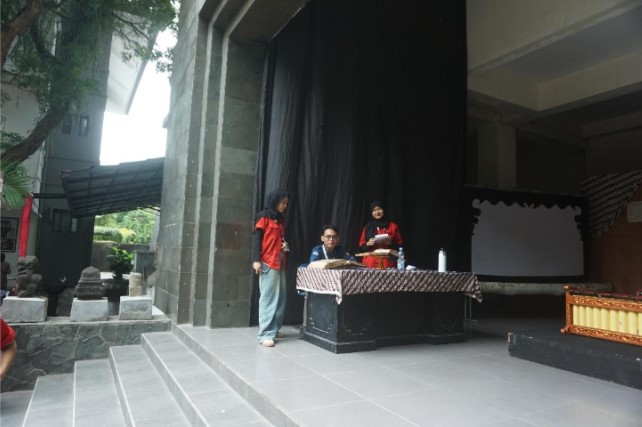
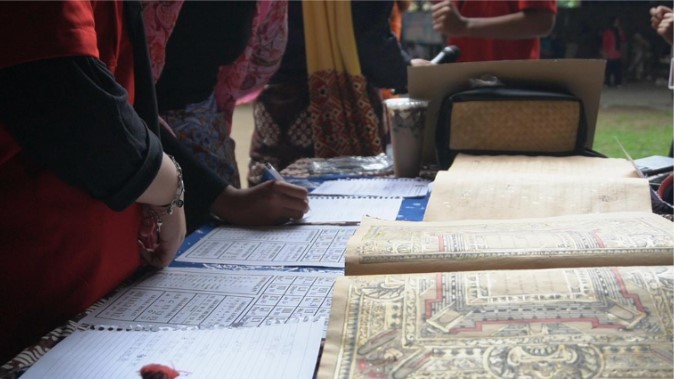
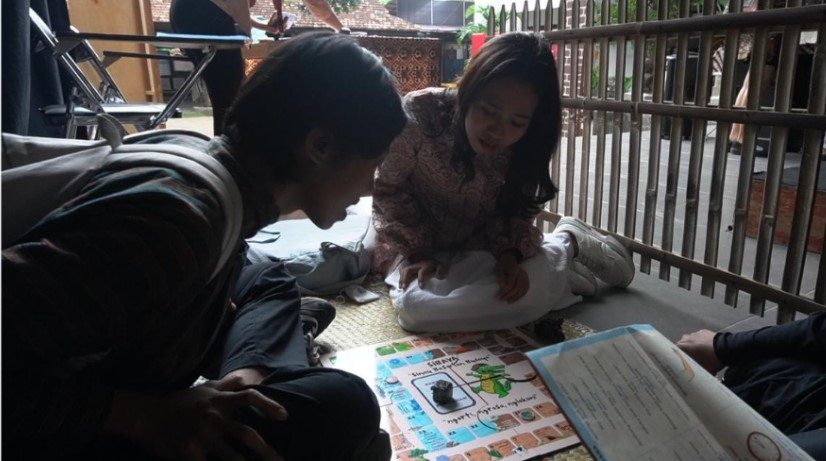
The first series of activities is a Javanese cultural exhibition which will be held on September 17-18, 2025, on the 1st floor of the Margono Building, from 10:00 a.m. to 4:00 p.m. During the exhibition, visitors are invited to explore various forms of Javanese culture through traditional games, gamelan musical instruments, wayang kulit (shadow puppets), ancient manuscripts, and weton (birth date calculations). Visitors can not only observe, but also interact directly and gain knowledge about the philosophical meaning behind each culture on display.

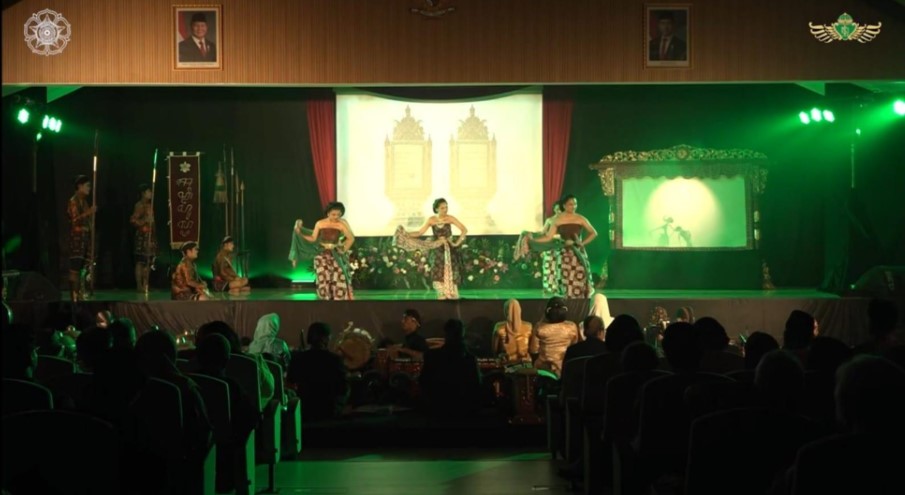
The highlight of the Gugur Gunung 14 event will be held on September 19, 2025, at the Poerbatjaraka Building Auditorium on the 3rd floor. The highlight of the evening will feature a variety of art performances, including classical dance, creative dance, and the dance drama “Adisari: Cahaya Kasih di Balik Penaklukan” (Adisari: The Light of Love Behind Conquest).

Full screenshot of the Faculty of Cultural Sciences Knowledge Channel (2025, September 30) at [13:00]. Accessed from https://www.youtube.com/watch?v=gLnTciXTCEg.

The dance drama was adapted from the text and illustrations of the Babad Metawis Skriptorium Pakualaman manuscript, which was initiated by Sri Paku Alam II. In addition to showcasing the richness of traditional art, the event was made even more special by the collaborative performance of students from Osaka University. It also served as a moment of farewell and appreciation for Dr. Sri Ratna Saktimulya, M.Hum., who was retiring from her position. 

The Gugur Gunung 14 event is not just an anniversary celebration, but also a concrete means of preserving and reviving Javanese culture. Through this event, the Javanese Language, Literature, and Culture Study Program affirms its commitment to maintaining the sustainability of the noble values of Javanese culture so that they remain relevant amid the tide of modernity.

Author : Haryo Untoro
Editor : Haryo Untoro


Bibliography
Kanal Pengetahuan Fakultas Ilmu Budaya UGM. (2025, 29 September). Alih Wahana Manuskrip Kuna ke Seni Pertunjukan, Adisari: Cahaya Kasih di Balik Penaklukan [Video]. Youtube. Retrieved from https://www.youtube.com/watch?v=gLnTciXTCEg.

Sestra Manitra: Warm Memories from Dr. Sri Ratna Saktimulya, M.Hum., for the Javanese Language, Literature, and Culture Study Program

News Release Friday, 31 October 2025

Yogyakarta, October 29, 2025 — A warm and emotional atmosphere enveloped the 4th floor hallway of the Margono Building on Wednesday afternoon. The Department of Javanese Language, Literature, and Culture, Faculty of Cultural Sciences, witnessed a special event hosted by Dr. Sri Ratna Saktimulya, M.Hum., a retired lecturer from the department. On this occasion, she distributed a book titled Sastra Menitra to the program and students from various batches as a memento and token of appreciation for the academic journey she had undertaken with the students.

The Sestra Manitra book is not merely a collection of writings, but rather a collaborative work by students from the classes of 2022, 2023, and 2024 who took courses taught by Dr. Sri Ratna Saktimulya, M.Hum., in the even semester of the 2024/2025 academic year. The course covered Creative Written Javanese Language, Philology, Codicology, Communicative Spoken Javanese Language, and New Javanese Poetry Texts.

Presentation of the Sestra Manitra book to representatives of the class of 2022

Presentation of the Sestra Manitra book to representatives of the class of 2023

Presentation of the Sestra Manitra book to representatives of the class of 2024

The class of 2022 contributed through Javanese-language coverage, while the class of 2023 presented illumination results in the form of rubrikasi, renggan, wedana renggan, and wedana gapura renggan. Meanwhile, the class of 2024 wrote various forms of Javanese literature, including parikan, geguritan, macapat, sengkalan, wangsalan, saduran, piwulang, and dongeng.

Etymologically, the title Sastra Menitra means “writings that are composed with deep feeling based on real means.” This meaning reflects the depth of the writings produced by the students through the use of the five senses—sight, hearing, smell, taste, and touch—as gifts and creative powers from God Almighty.

The event began at 4:30 p.m. with an opening and prayer led by Dr. Sri Ratna Saktimulya, M.Hum. The event continued with a speech from the Head of the Javanese Language, Literature, and Culture Study Program, Dr. Daru Winarti, M.Hum. The atmosphere became solemn when all participants sang the song Panyuwunan “permohonan” (prayer) composed by the late Dr. I. Kuntara Wiryamartana, SJ. The situation became even more solemn with the reading of a poem recited by Noviyanti Alfitri, a student from the class of 2024.

Entering the main session, Dr. Sri Ratna Saktimulya, M.Hum., symbolically handed over the book Sastra Menitra to Dr. Daru Winarti, M.Hum., which was then followed by distribution to lecturers and students. More than just a book handover ceremony, this moment became a form of deep appreciation and remembrance for the entire academic community.

In the introduction to the book, Dr. Sri Ratna Saktimulya, M.Hum., expressed her hope that Sestra Manitra would become a fond memory for students and a sincere tribute to the late Dr. I. Kuntara Wiryamartana, SJ., who had been a teacher and role model from his undergraduate studies to his current service.

She also hopes that this work will inspire the younger generation to continue learning, studying, and preserving Javanese culture. “May Sestra Manitra be useful for anyone who wants to study Javanese language, literature, and culture,” wrote Dr. Sri Ratna Saktimulya, M.Hum.

The book handover ceremony for Sastra Menitra concluded in a warm and grateful atmosphere, marking a beautiful farewell between a dedicated educator and the students who will carry forward the spirit of preserving Javanese culture in the future.

[Javanese Literature, Languange and Culture, Haryo Untoro]

“Prameswari”: A Gapura Renggan Artwork by Javanese Language, Literature, and Culture Students Featured in Sestra Manitra

News Release Thursday, 30 October 2025

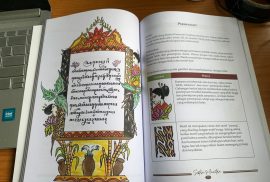
Yogyakarta, October 30, 2025 — Three students from the Javanese Language, Literature, and Culture Study Program, Faculty of Cultural Sciences, Universitas Gadjah Mada (FIB UGM)—Eka Nur Cahyani, Alma Syahwalani, and Nur Wakhid Fajar S.—contributed to the book Sestra Manitra through an artistic work titled “Prameswari.” The piece takes the form of a Gapura Renggan, a decorative gate that harmoniously combines aesthetic beauty with the philosophical values of Javanese culture.

The Prameswari artwork presents a text rich in meaning about the ideal woman from the Javanese cultural perspective. The text reads:

“Tiyang wadon kang kasebut Prameswari langkung luhuring estri. Tiyang wadon utama ana ing manah kudu sabar, nrima, rila, lan sumarah. Wong wadon kang sinau olah rasa kudu bisa nampa kanthi lila legawa lan lembah manah.”

The passage translates as follows:

“A woman referred to as a queen, one who holds a higher virtue than other noble women. A woman with a noble heart must be patient, sincere, generous, and accepting. A woman who learns to master her emotions can embrace life with humility and an open heart.”

Through this work, Eka, Alma, and Wakhid aim to portray the noble virtues of Javanese women—emphasizing patience, sincerity, and inner wisdom. Prameswari serves not only as a symbol of respect for women’s roles in Javanese culture but also as a medium for younger generations to reflect on the essence of feminine virtue from a local cultural perspective.

The students’ participation in Sestra Manitra demonstrates the synergy between learning and cultural preservation, where students not only engage in literary creation but also develop artistic expressions that reflect Javanese cultural identity.

This initiative aligns with the Sustainable Development Goals (SDGs), particularly SDG 4 (Quality Education) and SDG 5 (Gender Equality). Through such activities, students are encouraged to appreciate cultural values while promoting the recognition of women’s wisdom and strength—supporting the realization of humanistic and gender-inclusive education.

Moreover, Prameswari represents a concrete effort in preserving regional culture, contributing to social and cultural sustainability within the community. The work embodies the spirit upheld by the Faculty of Cultural Sciences, Universitas Gadjah Mada, to nurture a young generation that is cultured, ethical, and dedicated to the values of humanity.

[Public Relations of FIB UGM, Alma Syahwalani]

12

Video UGM

[shtmlslider name='shslider_options']
Universitas Gadjah Mada

Faculty of Cultural Sciences
Universitas Gadjah Mada
Jl. Nusantara 1, Bulaksumur Yogyakarta 55281, Indonesia
   fib@ugm.ac.id
   +62 (274) 513096
   +62 (274) 550451

Work Units

  • Office of Journal & Publishing
  • INCULS
  • Information Technology and Database
  • Language Learning Center
  • Library Unit
  • Public Relations
  • Research

Facilities

  • Computer Laboratory
  • Gamelan
  • Guest House
  • Language Library
  • Library
  • Phonetics Library
  • Self Access Unit
  • Student Internet Centre

Importan Links

  • Journal of Humaniora
  • Subscriber Journal
  • Alumni Portal
  • Career
  • Departmens News
  • UGM Streaming

Contacts

  • Academic
  • Administration
  • Dean’s Office
  • Departments / Study Programs
  • Public Relations

© 2024 Faculty of Cultural Sciences Universitas Gadjah Mada

KEBIJAKAN PRIVASI/PRIVACY POLICY

[EN] We use cookies to help our viewer get the best experience on our website. -- [ID] Kami menggunakan cookie untuk membantu pengunjung kami mendapatkan pengalaman terbaik di situs web kami.I Agree / Saya Setuju