• About UGM
  • Academic Portal
  • IT Center
  • Library
  • Research
  • Webmail
  • Informasi Publik
  • English
    • Indonesia
Universitas Gadjah Mada Faculty of Cultural Sciences
Universitas Gadjah Mada
  • Home
  • Profile
    • History
    • Vision and Mission
    • Organizational structure
    • Administration
    • Staff
    • Faculty Members
  • Academic
    • Academic Calendar
    • Undergraduate Programs
      • Bachelor of Cultural Antrophology
      • Bachelor in Archaeolagy
      • Bachelor in History
      • Bachelor in Tourism
      • Bochetor in Korean Language and Culture
      • Bachelor in Indonesian Language and Culture
      • Bachelor in English
      • Bachelor in Arabic
      • Bachelor in Japanese Language and Culture
      • Bachelor in Javanese Language, Literature and Culture
      • Bachelor in French language and literature
    • Graduate Programs
      • Master in Antrophology
      • Master in ArchaeoIogy
      • Master in History
      • Master in Linguistics
      • Master in Literature
      • Master In American Studies
      • Master in Middle Eastern Cultural Studies
    • Post-Graduate Programs / S3
      • Doctor in Antropology
      • Doctor in American Studies
      • Doctor in Humanities
    • Student Service
  • KPPM
    • Research Information
    • Scientific / Academic Publications
    • Community Service
    • International Cooperation
    • Domestic Cooperation
  • Student Organizations
    • Student Executive Council
    • Semi-Autonomous Organizations
      • KAPALASASTRA
      • Christian Student Alliance
      • LINCAK
      • Saskine
      • Catholic Student Family
      • Dian Budaya
      • Sastra Kanuragan (sasgan)
      • Family of Muslim Cultural Sciences Students (KMIB)
      • Bejo Mulyo
    • Autonomous Organizations
      • Family of Anthropology Students (KEMANT)
      • English Department Student Association
      • Tourism Students Association (HIMAPA)
      • Family of Indonesian Literature Students (KMSI)
      • West Asian Literature Student Association (IMABA)
      • Association of Korean-Language Students (HIMAHARA)
      • Family of Regional Indonesian Literatures Students (KAMASUTRA)
      • The Family Body of History Students (BKMS)
      • The French Literature Students Association (HMSP)
      • Family of Anthropology Students
      • Japanese Student Association (HIMAJE)
  • Admission
    • Student Evaluation
  • Home
  • News Release
  • Min Seong Kim’s Public Lecture Explores More-than-Human Antagonism and Pluriversal Politics in the Indonesian Archipelago

Min Seong Kim’s Public Lecture Explores More-than-Human Antagonism and Pluriversal Politics in the Indonesian Archipelago

  • News Release
  • 9 June 2026, 09.55
  • Oleh: Humas FIB
  • 0

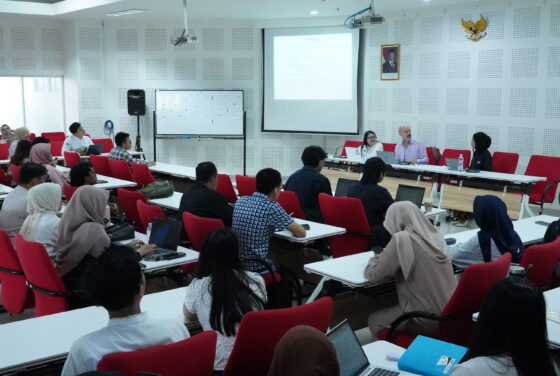
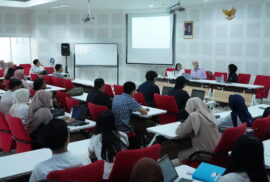
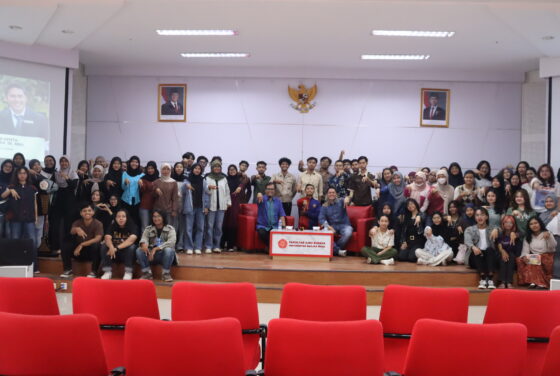
Yogyakarta, June, 4 2026 — A public lecture featuring Min Seong Kim was held on Thursday, June 4, from 11:00 a.m. to 1:00 p.m. in Room 205 of the Poerbatjaraka Building. On this occasion, Kim delivered a presentation entitled “Trembling Grounds of the Archipelago: Pluriversal Ontopolitics and More-than-Human Antagonism,” a study that reexamines the foundational assumptions of pluriversal politics through ecological and political experiences emerging across the Indonesian archipelago.

In his presentation, Kim addressed ongoing debates surrounding pluriversal politics that have recently gained prominence within environmental studies, decolonial thought, and posthumanist scholarship. As articulated by a number of contemporary thinkers, pluriversal politics seeks to challenge the modern worldview that separates humans from nature and treats the world as an object to be mastered and controlled. Instead, this perspective emphasizes that life is constituted through networks of interdependent relations among humans and a wide range of nonhuman entities, including animals, plants, landscapes, and the material forces of the earth.

According to Kim, pluriversal politics is generally grounded in the assumption that relationality constitutes the ontological basis of life. From this perspective, politics is understood as the effort to establish and sustain relationships that enable diverse forms of existence to coexist. However, Kim questioned whether relationality can truly serve as an adequate foundation for understanding political dynamics, particularly when confronted with conflict, tension, and division that cannot always be resolved through reconciliation and relational repair.

To develop this critique, Kim drew on the works of Adam Bobbette and Sophie Chao, whose research explores various forms of human–nonhuman relations in Indonesia. The cases they examine demonstrate that interconnectedness among beings does not necessarily produce harmony. Rather, such relations are often marked by frictions, competing interests, and forms of instability that reveal the political dimensions of the more-than-human world. The presence of nonhuman actors in politics, therefore, not only creates possibilities for collaboration and relationality but also gives rise to antagonisms that shape social and ecological fields.

Building on this reading, Kim connected the question of more-than-human politics to the tradition of post-foundational political thought, particularly the concept of antagonism developed by Ernesto Laclau. Within this framework, antagonism refers to the condition that no social order can ever be fully complete, final, or free from conflict. Every attempt to establish order inevitably encounters something that cannot be fully integrated into the existing system. Politics, therefore, is never simply a matter of creating relationships; it must also contend with the limits, tensions, and forms of negativity that accompany every mode of collective existence.

Through this analysis, Kim proposed that conflict and negativity should occupy a more central place in discussions of pluriversalism. Rather than treating relationality as a pre-given foundation, he argued that collective life—whether among humans or between humans and nonhumans—is always shaped through processes of negotiation, struggle, and antagonism that can never be entirely eliminated.

The public lecture offered a critical perspective on contemporary developments in political theory and ecological thought while opening a space for reflection on how societies understand their relationship with a world that extends beyond the human. At a time of growing concern over ecological crises and interspecies relations, Kim’s presentation provided a compelling framework for understanding conflict, tension, and uncertainty as inseparable dimensions of political life itself.

Author: Khotibul Umam

Tags: FIB UGM Master of Literature SDGs 13: Climate Action SDGs 14: Life below water SDGs 15: Life on Land SDGs 16: Peace Justice and Strong Institution SDGs 4: Quality Education UGM Yogyakarta

Video UGM

[shtmlslider name='shslider_options']
Universitas Gadjah Mada

Faculty of Cultural Sciences
Universitas Gadjah Mada
Jl. Nusantara 1, Bulaksumur Yogyakarta 55281, Indonesia
   fib@ugm.ac.id
   +62 (274) 513096
   +62 (274) 550451

Work Units

  • Office of Journal & Publishing
  • INCULS
  • Information Technology and Database
  • Language Learning Center
  • Library Unit
  • Public Relations
  • Research

Facilities

  • Computer Laboratory
  • Gamelan
  • Guest House
  • Language Library
  • Library
  • Phonetics Library
  • Self Access Unit
  • Student Internet Centre

Importan Links

  • Journal of Humaniora
  • Subscriber Journal
  • Alumni Portal
  • Career
  • Departmens News
  • UGM Streaming

Contacts

  • Academic
  • Administration
  • Dean’s Office
  • Departments / Study Programs
  • Public Relations

© 2024 Faculty of Cultural Sciences Universitas Gadjah Mada

KEBIJAKAN PRIVASI/PRIVACY POLICY

[EN] We use cookies to help our viewer get the best experience on our website. -- [ID] Kami menggunakan cookie untuk membantu pengunjung kami mendapatkan pengalaman terbaik di situs web kami.I Agree / Saya Setuju