
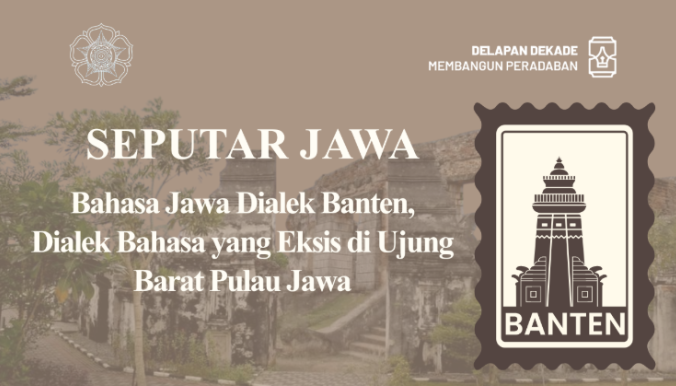
Javanese has often been associated with the regions of Yogyakarta and Surakarta, which are known as the centers of Javanese culture. In addition, people are also familiar with the straightforward East Javanese dialect or the Banyumasan dialect, which is often considered unique by other Javanese speakers. However, not many people realize that Javanese is also alive and thriving outside these main areas, namely in Banten Province, at the western tip of Java Island. In this region, a language variation known as the Banten dialect of Javanese has developed.
In his classification of Javanese dialects, Ras (1994) divides Javanese into three major groups, namely the western, central, and eastern Javanese dialects. The Banten Javanese dialect (BJDB) belongs to the western Javanese dialect group and is often referred to as Serang Javanese or Jaseng, because most of its speakers are located in the city of Serang and Serang Regency (Rohbiah & Mu’awwanah, 2021).
There are several sources that mention different areas of BJDB usage. Research by Danasasmita and Pronggodigdo states that this dialect is used in the former Banten Residency, which includes the regencies of Serang, Pandeglang, and Lebak. Meanwhile, the West Java Provincial Tourism Office also includes the Tangerang area as a region where speakers of this dialect are found (Iskandarwassid, Mulyana, Hudari, et al., 1985). Geographically, the existence of this language is quite unique because it is located between several other language communities, namely Betawi speakers in the Jakarta area, Sundanese speakers in southern Banten, and Lampung speakers across the Sunda Strait (Rohbiah & Mu’awwanah, 2020).
The Influence of History on Dialect Development
The emergence of the Javanese language in Banten cannot be separated from the long historical process of the region. In the early 16th century, the Banten region was still under the rule of the Sunda Kingdom. This situation changed after the Sunda-Portuguese Treaty in 1522. The treaty sparked a conflict that led to the conquest of the Port of Banten in 1526 and Sunda Kelapa in 1527 by the armies of Demak and Cirebon (Iskandarwassid, Mulyana, Hudari, et al., 1985).
After the conquest, Banten was led by Syarif Hidayatullah, who came from Cirebon. However, politically, Banten was actually controlled by the Sultan of Demak. Under the leadership of Syarif Hidayatullah, Banten developed into an Islamic kingdom that was active in the trade and transportation network for Javanese and Islamic traders (Iskandarwassid, Mulyana, Hudari, et al., 1985). Patmadiwiria (1977) added that the settlement of Banten’s conquering soldiers from Java also brought with it the Javanese language and culture. Therefore, it can be understood that the Demak and Cirebon Sultanates were the cause or origin of the emergence of the Banten dialect.
The influence of Javanese culture also grew stronger in the 17th century when the Mataram Sultanate expanded its influence to West Java. The spread of Javanese culture at that time occurred not only among the elite, but also among the lower classes (Iskandarwassid, Mulyana, Hudari, et al., 1985).
In addition to historical factors, geographical conditions also shaped the development of BJDB. The existence of the Port of Merak, which served as a connecting route between Java and Sumatra, enabled intensive interaction with the Lampung community. This interaction gave rise to communities of Lampung language speakers in several coastal areas of Banten, such as in the Anyer District. This cultural contact then influenced the vocabulary of the Banten dialect of Javanese (Rohbiah & Mu’awwanah, 2021).
Unique Pronunciation
As a dialect, BJDB has distinctive characteristics, especially in terms of pronunciation and vocabulary. One of the most prominent unique features is the variation in the pronunciation of the phoneme /a/. In a study conducted by Iskandarwassid, Mulyana, Hudari, et al. (1985), it is mentioned that this sound has three different pronunciations, depending on the region of the speaker.
In the areas of Serang City, Cilegon, and the surrounding regions, the phoneme /a/ is often pronounced closer to the sound [ɤ], which is similar to the sound “eu” in Sundanese (Patmadiwiria, 1977; Iskandarwassid, Mulyana, Hudari, et al., 1985). Meanwhile, in the suburbs of Serang, such as Barugbug, Pagelaran, Cikande, and Kragilan, the phoneme /a/ is still pronounced as [a]. In some areas, such as Rancasawah and parts of Cilegon, the phoneme /a/ is pronounced as [ɔ] (Iskandarwassid, Mulyana, Hudari, et al., 1985).
Variations in the sound of the phoneme /a/ occur in several circumstances, including the following (Karia, 1914; Iskandarwassid Mulyana, Hudari, et al., 1985):
- The phoneme /a/ in open syllables will produce variations in sound. Examples: sira [sirɤ], ora [orɤ], and kula [kulɤ].
- Specifically in the Serang City area and its surroundings, /a/ can be pronounced [ɤ] in one-syllable words, such as mah [mɤh]. However, other one-syllable words such as lah, la, and tah are still pronounced [a].
- If /a/ is located in a word with an open syllable, then followed by a suffix, /a/ is pronounced as /a/. Examples: sira [sirɤ] becomes sirane [siranI] and apa [apɤ] becomes apane [apanI].
Distinct Vocabulary
In addition to pronunciation, BJDB also has a number of words that differ from the standard Javanese language used in Yogyakarta and Surakarta. Here are five examples and their pronunciations based on and adapted from Karia (1914), Iskandarwassid, Mulyana, Hudari, et al. (1985), Poerwadarminta (1939), Sulistyowati (2015), and Patmadiwiria (1977):
- kastelâ or kêstelâ ‘papaya’, which in standard Javanese is called kates
- sirâ ‘you’, which in standard Javanese is called kowe
- kepremen ‘how’, which in standard Javanese to kepiye
- ayun ‘want’, which in standard Javanese is called arep
- ning ‘if’, which in standard Javanese is called yen
- derbe ‘have’, which in standard Javanese is called duwe
- linggar ‘go’, which in standard Javanese to lungå
These vocabulary differences show that BJDB has unique lexical developments and is not completely identical to standard Javanese.
*For convenience, the author provides special symbols for <a>, which is pronounced [a], <å>, which is pronounced [ɔ], and <â>, which is pronounced [ɤ].
Language Contact Results
The uniqueness of BJDB is also reflected in the large number of words resulting from contact with other languages. Sundanese, Betawi, Malay, and Lampung languages have also influenced the vocabulary of this dialect. Based on Rohbiah & Mu’awwanah (2021), the following are examples of the influence of each of these languages.
- From Sundanese, for example, the words kolot, meaning ‘old’, and beuleum, meaning ‘to burn’, are used by BJDB speakers in Binong Village, Pamarayan District, instead of the words tuâ and ngobong in BJDB.
- From the Betawi language, there are the words engkong, which means ‘grandfather’, and betot, which means ‘to pull’, which are used by BJDB speakers in Pedaleman Village, Tanara District, instead of using the words ende lanang and narik in BJDB.
- The influence of the Malay language can be seen in the use of the word laki to refer to ‘husband’ by BJDB speakers in Kampung Baru & Binong Villages, Pamarayan District, Pontang & Wanayasa Villages, Pontang District, Tanara & Pedaleman Villages, Tanara District, and Anyar & Cikoneng Villages, Anyar District, instead of using the words rayat lanang in BJDB.
- The influence of the Lampung language is evident in the words eppak, which means ‘four’, and duwai, which means ‘lake’, used by BJDB speakers in Anyar Village, Anyar District, instead of using the words papat and danau in BJDB.
This phenomenon of absorption usually occurs in areas that have a high intensity of cultural contact with certain language communities.
Bibliography
Iskandarwassid; Mulyana, Y.; Hudari, A; Sjarif, T.K.S. (1985). Struktur Bahasa Jawa Dialek Banten. Jakarta: Departemen Pendidikan dan Kebudayaan.
Karia, M. M. D. (1914). Dialect Djawa Banten. Batavia: G Kolff & Co.
Patmadiwiria, M. (1977). Kamus Dialek Jawa Banten-Indonesia. Jakarta: Departemen Pendidikan dan Kebudayaan.
Poerwadarminta, W.J.S. (1939). Baoesastra Jawa. Batavia: J.B. Wolters’ Uitgevers-Maatschappij N. V. Groningen.
Ras, J.J. (1994). Inleiding tot het Modern Javaans. Leiden: KITLV.
Rohiah, T.S., & Mu’awwanah, U. (2020). Inovasi Leksikal Bahasa Jawa Banten di Perbatasan Kabupaten Serang Provinsi Banten: Kajian Geografis – Linguistik. Serang: Media Madani
Sulistyowati. (2018). Kompleksitas dan Fleksibilitas Realisasi Bunyi Vokal Bahasa Jawa. Mutiara dalam Sastra Jawa Edisi 4, 4(3), 29-45.
List of Figures
Akbar. (2025, October 13th). Keraton Kaibon, Jejak Kejayaan Kesultanan Banten di Kota Serang [Picture]. Serangkota.go.id. https://serangkota.go.id/detailpost/keraton-kaibon-jejak-kejayaan-kesultanan-banten-di-kota-serang.
