
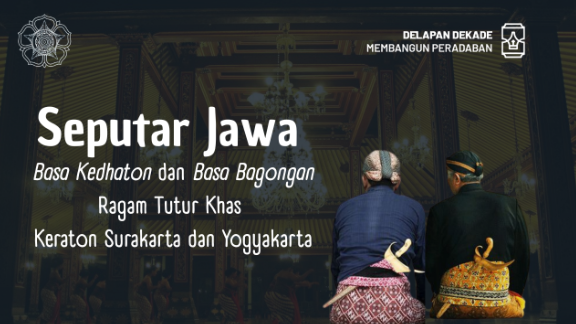
The most popular are the ngoko and krama levels of speech. However, within the Javanese royal court, a specific language variety developed, used by courtiers within the palace: Basa Kedhaton and Basa Bagongan. What is Basa Kedhaton or Basa Bagongan?
Termically, basa means ‘language,’ while kedhaton refers to ‘palace’ or ‘kingdom.’ Basa Kedhaton or Basa Bagongan itself is used by the sentana (relatives of the king) and courtiers when attending the king, such as the Sultan or Sunan, as well as Pangeran Adipati Anom (crown prince) in the palace (Padmosoekotjo, 1953:16). The term used in the Surakarta Kasunanan Palace is Basa Kedhaton, while in the Yogyakarta Sultanate Palace it is known as Basa Bagongan (Padmosoekotjo, 1953).
The Serat Purwa Ukara manuscript records the use of Basa Bagongan as early as the reign of Hamengkubuwana (HB) I. However, its use was banned during the reign of HB V due to its perceived disapproval, before finally being reinstated by HB VI (Setyowijaya, 2015:61–63).
The term “Bagongan” itself is often associated with the character Bagong in the Yogyakarta puppet tradition. This character is known for his straightforward, matter-of-fact manner and lack of refinement in speech. This character is considered to represent the “half-middle” nature of Basa Bagongan, not as refined as krama, but still polite and well-intentioned (Padmosoekotjo, 1953:89). Meanwhile, the Serat Purwa Ukara manuscript explains that the term “Bagongan” was coined by Sri Sultan himself. This term is synonymous with pegoan, meaning “unusual Javanese language or a deviation from custom” (Setyowijaya, 2015:62–63).
The uniqueness of Basa Kedhaton and Basa Bagongan can be seen in their linguistic forms, namely their special terms, grammatical structures, and the use of literary forms with the addition of affixes typical of Kawi or Old Javanese literary varieties (Padmosoekotjo, 1953; Setyowijaya, 2015; and Poedjosoedarmo & Laginem, 2014).
The most prominent characteristic of Basa Kedhaton is its use of first-person pronouns (I) and second-person pronouns (you). The pronoun forms in Kasunanan Surakata are differentiated according to position: mara ‘I’ and para ‘you’ are used by putra sentana ‘children of palace officials’, manira ‘I’ and pakenira ‘you’ for retainer, kula ‘I’ and jengandika ‘you’ for panèwu ‘sub-district head’ and mantri ‘village head’, and robaja ‘I’ and pantèn ‘you’ for poet. Meanwhile, in Yogyakarta only the pair manira ‘I’ and pakenira ‘you’ are known (Padmosoekotjo, 1953:16).
In addition, there are a number of other distinctive vocabulary items. Poedjosoedarmo and Laginem (2014) noted that there are approximately 40 specific vocabulary items in Basa Kedhaton and 11 specific vocabulary items in Basa Bagongan. Some of these include:
- enggèh ‘yes’
- wènten ‘there is’
- wikana ‘don’t know’
- sumitra ‘lion’.
Furthermore, this variety often utilizes literary nuances or Kawi affixes, for example, kakersake ‘wanted’, mangangge ‘wear’, sinerat ‘written’, and lumebet ‘enter’.
Grammatically, there are differences between the grammatical structures of Basa Kedhaton from Surakarta and Basa Bagongan from Yogyakarta. Basa Kedhaton from Surakarta still uses krama sentence structure. Based on this, the prefixes and suffixes used remain variations of krama, namely the passive prefix {dipun-} and the suffix {-aken}.
This situation differs from the structure of Basa Bagongan, which exhibits a mixture of krama and ngoko in a single form. An example found in Serat Purwa Ukara is as follows:
Rawuhé Kanjeng Tuwan Panes, wènten ing negari Ngayugya minangka kumissarising gupermèn…
‘The arrival of Kanjeng Tuwan Panes, in Negari Yogyakarta as commissioner of gupermen…’.
In this case, the word rawuhé is derived from the root word rawuh ‘to come’ (krama inggil) to which the suffix {-é} (ngoko) is attached. This phenomenon demonstrates the blending of speech levels within a single word (Setyowijaya, 2015:57).
Furthermore, another difference is the usage of Basa Kedhaton and Basa Bagongan. Basa Kedhaton is not intended to create a sense of equality between speakers (Poedjosoedarmo & Laginem, 2014:21–22). Poedjosoedarmo & Laginem (2014:22) explain that there are several different levels, such as:
- Manungkara, used by nobles, such as His Majesty the King and the Prince’s Treasurer
- Mangungkak basa, used by high-ranking courtiers to address one another
- Angagok wicara, used by high-ranking nobles to address those of lower rank.
This contrasts with Basa Bagongan in Yogyakarta, which still conveys respect while maintaining equality between speakers and interlocutors (Poedjosoedarmo & Laginem, 2014:10).
The function of Basa Bagongan extends beyond oral communication within the palace. This Javanese language variation is also found in written communication and correspondence. Apart from that, Basa Bagongan is also used in traditional palace ceremonies, specifically when the leader of the soldiers is ordered to deliver the gunungan in the Grebeg traditional procession (Setyowijaya, 2015:63-66).
Both Basa Kedhaton and Basa Bagongan have their own distinctive characteristics. Despite being a priceless cultural treasure, Basa Bagongan is becoming increasingly rare. Setyowijaya (2015:66–67) notes that active speakers are generally courtiers over 60 years old. The younger generation of the palace tends to use only ngoko and krama. Regeneration from outside the palace environment and the perceived impoliteness of using it to high-ranking officials have contributed to its rare use.
Author: Haryo Untoro
Editor: Haryo Untoro
Thumbnail Maker: Nurul Fajri Rahmani
Bibliography
Padmosoekotjo, S. (1953). Ngéngréngan Kasusastran Djawa. Jogyakarta: Hien Hoo Sing
Poedjosoedarmo, S., dan Laginem. (2014). Bahasa Bagongan. Yogyakarta: Kementerian Pendidikan dan Kebudayaan, Badan Pengembangan dan Pembinaan Bahasa, Balai Bahasa Provinsi Daerah Istimewa Yogyakarta.
Setyowijaya, A. (2015). Teks Basa Bagongan dalam Naskah Sêrat Purwa Ukara: Suntinga Teks, Terjemahan, dan Deskripsi Kebahasaan. Skripsi. Yogyakarta: Universitas Gadjah Mada.
List of Figures
Verkaik, A. (t.t.). Abdi Dalem – Yogya [Gambar]. Pinterest. https://pin.it/5XmXoVqln
Widya. (t.t.). Keraton Kasunan Surakarta Hadiningrat / Surakarta Hadiningrat Royal Palace. Solo, Java [Gambar]. Pinterest. https://pin.it/5Wm9RNcqm.
Wirasandjaya, F.R. (2019, 16 Agustus). Spiritualisme Masyarakat Jawa [Gambar]. Kompasiana.com. https://www.kompasiana.com/frwirasandjaya/5d56c9ff097f3675ad5e5bd4/spiritualisme-masyarakat-jawa.
