Event Category: Diskusi
Penelitian sosial adalah sebuah kegiatan fundamental yang menjadi salah satu fokus utama dari Pusat Studi Sosial Asia Tenggara (PSSAT) Universitas Gadjah Mada sebagai penerima program World Class Professor. Dalam rangka memperluas kajian Asia Tenggara dan mengakumulasi pengetahuan, penting kiranya bagi PSSAT Universitas Gadjah Mada untuk menyelenggarakan pelatihan penelitian untuk umum. Pelatihan penelitian dalam kajian tersebut mencakup pembahasan tentang metodologi dan praktik penelitian yang diharapkan membantu peserta memahami secara teoritis maupun praktis tentang penelitian sosial, khususnya dalam konteks kajian Asia Tenggara. Oleh karena itu, penyelenggaraan program World Class Professor diharapkan mampu membantu perwujudan tujuan kegiatan tersebut dengan menyelenggarakan pelatihan metodologi penelitian dalam bidang kajian sosial Asia Tenggara melalui kegiatan yang bersifat terbuka dan mampu menampung ide-ide peserta pelatihan.
Launching Penghargaan Sastra dan Seni Nasional
Narasumber:
Dr. Ari Dwipayana.
Dr. Wening Udasmoro.
Dr. Aprinus Salam
Diskusi
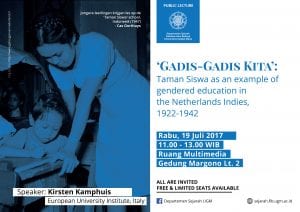
Rabu 19 Juli 2017 pukul 11.00-13.00
Ruang Multi Media Gedung Margono Lt 2
Fakultas Ilmu Budaya UGM
‘Gadis-gadis kita’: Taman Siswa as an example of gendered education in the Netherlands Indies, 1922-1942
Kirsten Kamphuis ǀ PhD Candidate
European University Institute ǀ Firenze (FI) ǀ Italy
Kirsten.Kamphuis@eui.eu
Abstract
In my PhD project, I analyse education for Indonesian girls’ education in four regions of the Netherlands Indies between 1880 and 1940. So far, historians have mainly interpreted colonial education in terms of the ‘ethical policy’. This has resulted in a government-focused historiography, which leaves little space for children’s experiences. My research, on the other hand, focuses on educational practices. Inspired by the recent ‘turn to childhood’ in colonial studies, my main methodological tools are the categories of gender and age.
My focus is mainly on non-governmental initiatives, such as Islamic and Christian schools. This helps me to argue against the idea of education as purely a matter of governance. By comparing schools of varying signatures, I investigate how developments in girls’ education reflected broader developments in colonial society, such as the changing position of Indonesian women on the labour market and the birth of an anticolonial movement.
In this presentation I will use the example of Taman Siswa schools to illustrate my research project. I will go into different aspects of Taman Siswa education surrounding the position of girls within its schools. This will make clear what historians of education and colonialism can gain from a method based on gender and age.