Description

The contemporary world appears increasingly interconnected due to advances in technology and improvements in transportation and communication infrastructure. At the same time, global socio-political conditions often reinforce boundaries and contribute to the polarisation of societies. When one considers the current intensifying political tensions, armed conflicts, and geopolitical disputes in many regions of the world, it raises questions about the effectiveness of conventional political diplomacy alone in navigating contemporary global tensions. In these contexts, one must ask if alternative modes of diplomatic engagement might prove more impactful. One strategy employed by governments, politicians, academics, cultural practitioners, and civil society to navigate these challenges is cultural diplomacy, through which they seek to foster mutual understanding among diverse communities and to create transcultural dialogues across cultures and nations (Goff, 2013; Sadiki, 2009). Its practices take many forms, including gastrodiplomacy, art exhibitions, music and dance performances, international film festivals, student and academic exchange programs, and tourism.

Grincheva (2023) traces the historical development of the concept of cultural diplomacy and maps the actors involved in its various forms. They argue that although cultural exchanges and encounters among people from different societies have long existed through migration, the conceptual formulation of cultural diplomacy is relatively recent. It was only in the 19th century that cultural diplomacy was articulated as a form of cultural exchange conducted by states as part of strategic policy implementations. The establishment of state-affiliated cultural institutions, such as the British Council in the United Kingdom and the Goethe Institute in Germany in the early 1900s, further institutionalised cultural diplomacy.

The term cultural diplomacy itself was first used in the New York Times in 1954 (Cull 2019, qtd in Grincheva 2009) and was formally defined by the U.S. Department of State as “the direct and enduring contact between people of different nations to help create a better climate of international trust and understanding in which official relations can operate” (U.S. Department of State, 1959, p. iv). Since then, cultural diplomacy as a concept has evolved and its use expanded beyond the domains of politicians and state officials to include cultural organisations. The year 1990 saw nascent scholarly attention paid to the concept, and today, cultural diplomacy remains an open, contested, and multi-interpretive concept.

In the contemporary context, one oft-discussed aspect of cultural diplomacy is the shift in who gets to be the actors of cultural diplomacy, from the state to broader publics, with non-state actors increasingly functioning as agents of cultural diplomacy. Moreover, many cultural diplomacy initiatives are now more strongly rooted in cultural relationships and exchanges than in formal political agendas (Duchacek, 2023). This shift is also observable within academia, where the production of knowledge about cultural diplomacy was once largely dominated by scholars and practitioners in international relations, international politics, and communication studies. Today, cultural diplomacy has also been widely explored and studied by scholars and practitioners from the humanities and social sciences, including history, arts, literature, anthropology, and geography (Gricheva, 2023).

Within cultural studies in the Global South, in particular, knowledge production and critical reflection on cultural diplomacy are increasingly crucial. This is especially important within the framework of understanding in Global South societies of what “culture” is and how human relations within those cultural contexts are articulated through cultural diplomacy practices (see Gienow-Hecht & Donfried, 2010; Iwabuchi, 2002; Tella, 2021). In the Indonesian context, as a postcolonial society, it is also necessary to reexamine how power asymmetries and the politics of everyday cultural representation manifest in the discourse and practices of cultural diplomacy in the Global South. This poses a critical question: does cultural diplomacy create spaces for equitable intercultural dialogues, or does it reproduce unequal power relations and further marginalise certain communities?

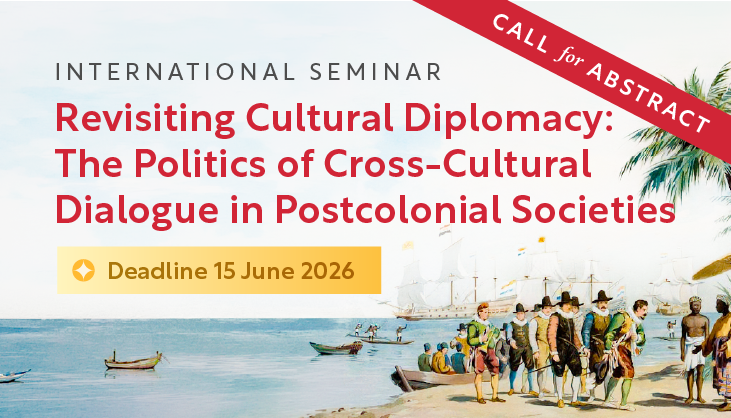
To answer and engage critically with the evolving concepts, practices, and humanities aspects of cultural diplomacy, this conference invites academics, students, and practitioners to present research on cultural diplomacy. Indicative sub-themes for submissions include, but are not limited to:

Language and Literature

  • Language, teaching, and diplomacy
  • Translation and diplomacy
  • Cultural diplomacy through arts and literature

Intercultural Studies

  • Intercultural communication and diplomacy
  • South-to-south diplomacy
  • Religious diplomacy
  • Diplomatic cultures in the Global South

Anthropology

  • Power relation in cultural diplomacy
  • (De)representation of culture in cultural diplomacy discourse
  • Micro-level diplomacy and diaspora communities
  • Transnational cultural diplomacy
  • Gastrodiplomacy
  • Transnational activism and grassroots diplomacy
  • Corporate diplomacy and cultural governance
  • Space and opportunity in cultural diplomacy

Archaeology

  • Heritage diplomacy: Paradiplomacy and cultural heritage preservation
  • Museum diplomacy: Actors, repatriation, and curatorial power
  • Cultural diplomacy in fashion
  • The role of technology in cultural exchanges

History

  • Historical perspective on cultural diplomacy
  • Decolonial critiques of cultural diplomacy
  • Postcolonial memory and heritage politics
  • The past and future of cultural diplomacy

Tourism

  • Tourism and cultural diplomacy
  • Environmental sustainability and tourism diplomacy
  • Commodification of culture in tourism diplomacy

General areas

  • Knowledge production on cultural diplomacy
  • Media literacy, cross-cultural engagement, and cultural power
  • Inclusion, ethics, and accountability in cultural diplomacy
  • Post-colonial perspective on cultural diplomacy
  • Gender perspective on cultural diplomacy
  • Digital platforms and cultural diplomacy

Proposed timeline


Abstract submission deadlines:

:

15 June 2026

Notification for abstract acceptance

:

24 June 2026

Confirmation of registration & payment 

:

24 July 2026

Notification for Letter of acceptance 

:

31 July 2026

Notification for seminar details & package

:

19 Agustus 2026

Seminar Days 1 & 2

:

13-14 October 2026

Registration Fee

  • Presenting:
    • Student: IDR 250.000 (USD 15)
    • Academics/Professionals: IDR 1.000.000 (USD 60)
  • Non-presenting:
    • Student: IDR 100.000 (USD 6)
    • Academics/Professionals: IDR 250.000 (USD 15)

Proposals:

  • Abstract (250-300 words)
  • Keywords (up to 5)
  • Short bio (100-150 words)

Submitted through Google Form.

More Information: culturaldiplomacy.fib80@ugm.ac.id 

References

Duchacek, Ivo D, 'Perforated Sovereignties: Towards a Typology of New Actors in International Relations', in Hans J Michelmann, and Pana Yotis Soldatos (eds), Federalism and International Relations: The Role of Subnational Units (Oxford, 1990; online edn, Oxford Academic, 31 Oct. 2023), https://doi.org/10.1093/oso/9780198274919.003.0001, accessed 3 Mar. 2026.

Gienow-Hecht, J. C. E., & Donfried, M. C. (Eds.). (2010). Searching for a Cultural Diplomacy (Explorations in Culture and International History, 6). Berghahn Books.

Goff, Patricia M., 'Cultural Diplomacy', in Andrew Cooper, Jorge Heine, and Ramesh Thakur (eds), The Oxford Handbook of Modern Diplomacy (2013; online edn, Oxford Academic, 1 Aug. 2013), https://doi.org/10.1093/oxfordhb/9780199588862.013.0024, accessed 3 Mar. 2026.

Grincheva, N. (2023). The past and future of cultural diplomacy. International Journal of Cultural Policy, 30(2), 172-191. https://doi.org/10.1080/10286632.2023.2183949

Iwabuchi, K. (2002). Recentering Globalization: Popular Culture and Japanese Transnationalism. Durham, NC: Duke University Press

Said Saddiki. (2009). The meaning of cultural diplomacy. Revista CIDOB d’Afers Internacionals, No. 88, 107–127.

Tella, O. (2021). Africa's soft power: Philosophies, political values, foreign policies and cultural exports (1st ed.). Routledge. https://doi.org/10.4324/9781003176022